Add TOPKHOJ as a Preferred Source on Google
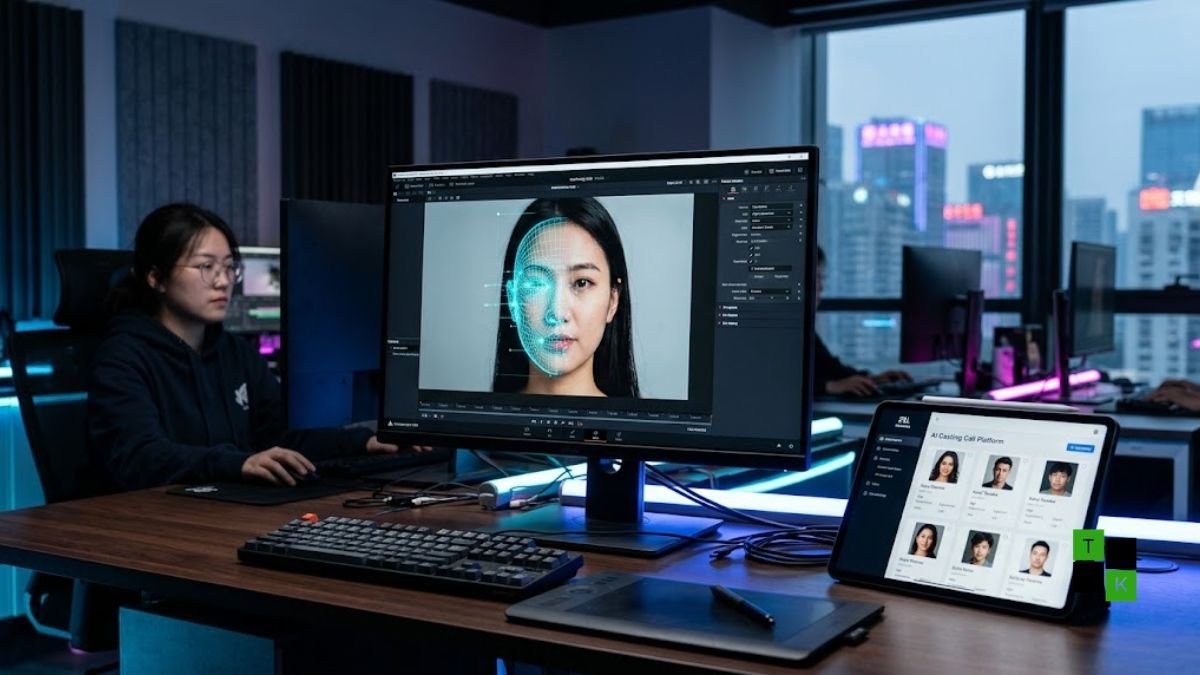
China’s generative artificial intelligence boom has opened an unprecedented biometric marketplace: everyday citizens are legally licensing their facial likenesses to star in algorithmic micro-dramas, mobile video games, and commercial advertisements. Through emerging digital talent platforms such as ActID and New Claw (Xinzhua), individuals can verify their identity and register their facial geometry into searchable actor catalogs.
Production studios, facing tight release cycles and shrinking budgets, can browse these catalogs by age, gender, and aesthetic archetype to generate synthetic on-screen talent without paying for physical shoots, set rentals, or crew time. Payouts for face owners range from standard daily rates of 50 to 500 yuan (approximately ₹700 to ₹7,000) per episode to rare buyout caps reaching 99,999 yuan (nearly ₹14 lakh).
The Micro-Drama Boom: Why AI Studios Need Real Faces
The primary catalyst behind this emerging biometric economy is China’s massive short-form vertical drama market:
- 128,000 Micro-Dramas in Three Months: During the first quarter of 2026 alone, over 128,000 micro-dramas were published across Chinese platforms, with industry regulators noting that more than 95% of productions utilized AI tools during character generation, scripting, or background compositing.
- The “Uncanny Valley” Dilemma: While generative models like Sora, Kling, and Seed can construct entire digital human bodies, purely synthetic faces frequently display unnatural eye tracking and synthetic artifacts that break viewer immersion.
- Cost-Efficient Realism: By mapping real, verified human facial geometry onto generative 3D wireframes, studios achieve photorealistic expressions and emotional micro-cues at a fraction of traditional actor booking costs.
How Platforms Like ActID and New Claw Operate
Operating out of tech hubs like Shenzhen and Chengdu, face-licensing platforms function like automated digital casting agencies:
- Digital Actor Registrations: Platforms such as Shenzhen-based Yuanxiang Xinsheng (which runs ActID) and Chengdu-based Xinzhua (New Claw) require users to submit high-resolution neutral facial scans alongside national identity credentials to prevent identity theft.
- Categorized Casting Pools: Directors and advertisers search talent profiles filtered by demographic brackets (“rugged”, “college youth”, “girl-next-door”, “corporate executive”).
- Granular Usage Permissions: Sellers can define where their likeness appears-restricting permissions to specific media like mobile games, vertical dramas, or e-commerce marketing-while dictating license expiration windows.
- Fast Micro-Earnings: Repeated licensing can quickly compound. Chinese business outlets documented a local bank employee who pocketed nearly 2,500 yuan (around ₹35,000) in three days after an advertising firm licensed his portrait across seven different product campaigns.
China’s AI Face-Licensing Market: Key Numbers & Structure
| Metric / Parameter | Platform & Industry Details |
| Active Specialized Platforms | ActID (Yuanxiang Xinsheng) & New Claw (Xinzhua) |
| Q1 2026 Micro-Drama Volume | 128,000 titles released (over 95% AI-assisted) |
| Entry-Level License Fee | 50 to 99 yuan (~₹700 to ₹1,400) per project/episode |
| Standard Mid-Tier Payout | 500 to 6,000 yuan (~₹7,000 to ₹85,000) |
| Maximum Reported License | 99,999 yuan (approximately ₹14 lakh) |
| Platform Commission | Typically 10% retained by service operators |
| Popular Archetypes | “Girl-next-door”, “Rugged senior”, “Corporate professional” |
| Enforcement Actions | 85,000+ unauthorized face videos purged by ByteDance |
The Legal Grey Area: Perpetual Likeness and Model Training
While the prospect of earning passive income without ever stepping foot on a film set appeals to students, gig workers, and extras, legal experts and privacy advocates urge caution:
- Loss of Downstream Control: Beijing-based intellectual property attorneys point out that once a high-resolution face mesh enters a digital studio’s pipeline, monitoring where that likeness travels becomes nearly impossible. A face sold for a clean-cut corporate explainer could be digitally swapped into low-quality viral content or manipulative e-commerce livestreams.
- Model Training vs. Single-Use Licensing: Platforms state that licensing a portrait for a video does not grant permission to train foundational AI weights on the user’s facial geometry. However, verifying whether independent developers scrub facial assets from internal training datasets remains technically unfeasible for everyday users.
- The Rise of Unauthorized Scraping: The commercialization of faces has already triggered major enforcement headaches. ByteDance’s micro-drama division reported removing more than 85,000 videos featuring unauthorized synthetic reproductions of real people’s faces and voices since early 2026, underlining how easily portrait boundaries are breached.
Redefining the Acting Profession
The emergence of direct face licensing highlights how deeply generative tools are restructuring creative industries. For professional background extras and commercial models, selling digital rights provides a way to monetize their appearance alongside offline work.
However, as text-to-video diffusion engines continue to improve in coherence and consistency, industry observers anticipate that the window for paid human licensing may eventually narrow, as studio cost-cutting pushes productions toward entirely algorithmic, non-human faces that carry zero royalty or legal obligations.
🚨 Stay Updated with TopKhoj! 🚨
Get the latest tech news, deals, and exclusive offers first!
📰 Visit News Section📲 Join our Telegram Channel for real-time updates and best deals!
🔗 Join Telegram Now💡 Stay informed and never miss a great deal with TopKhoj!
⚠️ Disclaimer: Any link provided in the article related to a product or service will redirect you to our affiliate partner(s)' website, which are affiliate links. This means that if you make a purchase through these links, we may earn a commission at no extra cost to you. This commission helps support our blog and our work.
🔔 All prices mentioned above are subject to change based on current offers and availability on e-commerce platforms. Please check the latest price and product details on the product page before making a purchase.