Apple’s new Mac mini M6 commercial may look like a polished piece of digital animation, but the company’s latest behind-the-scenes video reveals a much more hands-on production.
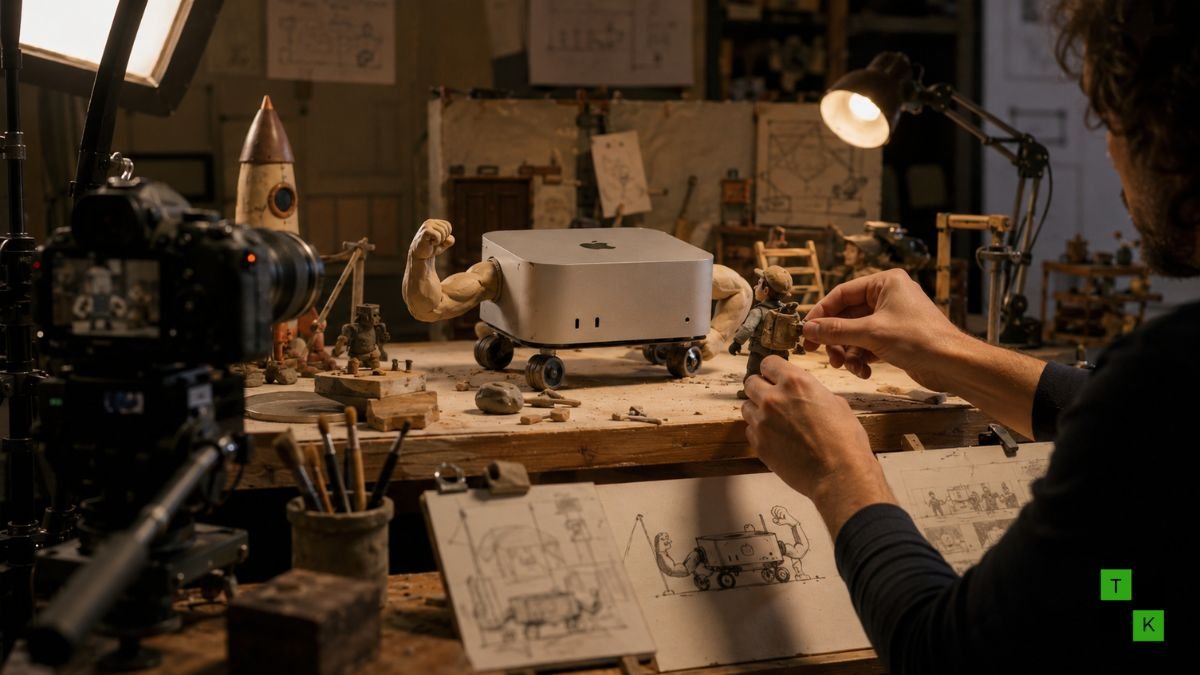
Apple has shared a short making-of video through its @helloapple Instagram account, showing animators Justin Rasch and Scott DaRos and art director Josh Mahan working with sketches, props, sculptures and physical materials to create the visual world of the new Mac mini campaign. The footage also includes stop-motion time-lapses showing how the individual animated sequences were built.
The behind-the-scenes reveal is particularly timely because the commercial itself is designed around the idea of making the tiny Mac mini look unexpectedly powerful. In the ad, the computer is transformed into a muscular character and then into other exaggerated forms, turning Apple’s performance message into a playful physical animation.
30-Second TL;DR
Big Reveal: Apple’s new Mac mini M6 commercial was built using extensive practical animation and handmade elements.
Behind the Scenes: Apple shows sketches, sculptures, props, materials and stop-motion time-lapses featuring animators Justin Rasch and Scott DaRos.
Why It Matters: The making-of film gives viewers a look at the physical craftsmanship behind an ad promoting a computer whose headline feature is its new AI-focused M6 chip.
The “Mighty Mac mini” Is More Hands-On Than It Looks
The new commercial, titled “The Mighty Mac mini,” turns Apple’s compact desktop into a visual joke about power.
Rather than simply showing benchmark numbers or a succession of product shots, the advertisement gives the Mac mini an exaggerated physical personality. The computer is presented with muscular arms, becomes a racing-style vehicle and is even transformed into a rocket as the narration highlights its upgraded processing, graphics and AI capabilities.
The concept fits the product itself rather neatly.
The Mac mini remains physically tiny, but Apple’s new M6 platform is considerably more powerful than the previous generation. So the campaign essentially asks one question in visual form: what would a really small computer look like if you treated it like a powerhouse?
The answer, apparently, involves muscles, wheels and a rocket.
Apple Actually Built the Visual Pieces
The most interesting part of the campaign is what happens before the final animation reaches the screen.
Apple’s behind-the-scenes reel shows the creative team preparing the physical components used in the commercial, including drawings, props, sculptures and other materials. The video features animators Justin Rasch and Scott DaRos alongside art director Josh Mahan explaining elements of the production.
That practical approach gives the advertisement a very different character from a purely computer-generated commercial.
The textures, miniature objects and sculptures are physically present on the set. Instead of creating every visual element digitally and animating it afterward, the production team manipulates tangible pieces and photographs their positions to create movement.
It’s an old filmmaking technique applied to a very modern product.
How the Stop-Motion Animation Works
Stop motion can look deceptively simple once the final footage is edited together.
The basic process is painstaking: an object is positioned, a frame is captured, the object is moved slightly, another frame is captured, and the process is repeated again and again. When those individual images are played back in sequence, the tiny movements become continuous animation.
The time-lapse footage Apple shared makes that process easier to appreciate. What looks like a quick transformation in the finished commercial can require a long series of physical adjustments behind the camera.
That also explains some of the visual character of the advertisement. Practical animation naturally introduces tiny variations in movement, texture and lighting that can make the finished footage feel tactile rather than perfectly digital.
The People Behind the Mac Mini’s Transformation
Apple’s behind-the-scenes video puts some of the creative team in front of the camera rather than focusing exclusively on the finished product.
Justin Rasch and Scott DaRos are identified as the animators, while Josh Mahan serves as art director. The trio walks through parts of the production process, showing how the sketches and physical materials become the finished animation.
The glimpse is brief, but that’s part of what makes the reel useful. Instead of presenting the advertisement as a mysterious finished object, Apple exposes the practical work behind individual shots.
For viewers interested in animation, it’s almost a separate advertisement for the craft itself.
A Physical Ad for a Computer Built Around AI
There is an amusing contrast at the center of the campaign.
Apple is using physical, handcrafted animation to promote a computer whose biggest technological selling points involve increasingly sophisticated on-device AI processing.
The M6 Mac mini is Apple’s first Mac mini built around its new M6 silicon, with Apple highlighting faster CPU and graphics performance as well as significantly faster AI workloads. The company says the M6 delivers up to four times the AI performance of the previous M4 Mac mini in its own testing.
Yet the commercial doesn’t need to demonstrate that AI capability with futuristic computer-generated imagery.
Instead, Apple chose clay, physical props, miniature sets and stop motion.
That contrast gives the campaign some personality. The product is being sold as cutting-edge technology, while the advertisement itself deliberately embraces a much older creative technique.
The Production Team Used Practical Materials for the Shots
According to coverage of Apple’s behind-the-scenes release, the process included the construction of physical objects and miniature elements specifically for the shoot. The footage shows the team working through the materials and techniques used to create the individual scenes.
The result is more than simply a nostalgic animation style.
Practical materials give animators direct control over the shape, texture and lighting of every object. A change as small as moving a miniature arm or adjusting a prop can alter the next frame, which is precisely what makes stop motion so labor-intensive.
It’s also why a few seconds of finished animation can represent a surprisingly large amount of production work.
The Campaign Has a Bigger Advertising Connection
The “Mighty Mac mini” concept also fits into a broader Apple advertising habit: turning computing performance into physical demonstrations of strength.
Recent Apple campaigns have used exaggerated physical imagery to communicate the capabilities of Apple silicon. In 2024, for example, Apple used a weightlifter in a MacBook Pro campaign to visualize the performance of its M4 generation.
The Mac mini campaign takes that idea in a more playful direction.
Instead of showing a human athlete using a powerful computer, Apple effectively turns the computer into the character doing the heavy lifting.
It is an unusually literal interpretation of the phrase “mighty Mac mini.”
Why Apple Chose Stop Motion
Apple hasn’t publicly framed the making-of video as a statement about abandoning computer-generated production, so it would be a mistake to read too much into the creative decision.
But the approach does achieve something useful for the campaign.
The Mac mini itself is an extremely familiar object: a small aluminum box that does its work quietly on a desk. Giving that object a handmade animated world makes the product feel more expressive without changing the hardware.
The practical animation also reinforces the central joke. The Mac mini may be physically small, but the world around it can become ridiculously oversized.
That contrast is easier to communicate through physical props than through a conventional specification-focused advertisement.
It Is Also a Nice Reminder of How Much Work Goes Into Short Ads
One of the most interesting things about Apple’s reel is how much effort becomes invisible once the final commercial is finished.
A viewer may see a character move, a prop transform and the Mac mini suddenly take on another shape. The final footage is quick enough that the individual steps disappear.
The making-of footage reverses that process.
You see sketches before the finished models. You see the objects before they are animated. And you see the stop-motion setup itself, where each tiny change has to be deliberately made before the next frame is captured.
That makes the behind-the-scenes video more than promotional filler. It changes how the original advertisement is viewed.
After seeing the production process, the animation becomes less about a computer magically transforming and more about a team physically building every transformation.
What Apple Has Actually Revealed
The confirmed details from Apple’s behind-the-scenes release are relatively straightforward:
- Apple published the making-of Reel through @helloapple on Instagram.
- Justin Rasch and Scott DaRos are featured as animators.
- Josh Mahan is identified as art director.
- The video shows sketches, props, sculptures, materials and animation techniques.
- Stop-motion time-lapses reveal portions of the production process.
- The footage accompanies the new Mac mini M6 advertising campaign.
The broader production credits reported by advertising-focused coverage include TBWA\Media Arts Lab, Blinkink and Stoopid Buddy Stoodios, with direction by Nicos Livesey. The campaign also uses “Pili Pili” by French duo Polo & Pan.
Those production details are useful context, but the most important new information from Apple’s own Reel is the amount of practical work visible behind the animation.
Why This Matters for Mac Mini Fans
The advertisement itself does not change what the Mac mini can do.
The M6’s performance, AI capabilities and specifications remain the substantive technology story.
But Apple’s decision to reveal the production process gives the launch a little more character. Hardware announcements can easily become a parade of CPU cores, benchmark numbers and feature lists. A handcrafted commercial gives the product a personality that specifications cannot provide.
And for people who enjoy animation, filmmaking or advertising, the making-of footage turns a short product commercial into something worth examining on its own.
It is also an increasingly rare kind of behind-the-scenes content: a major technology company showing viewers the physical craftsmanship behind a highly polished piece of advertising.
The Bigger Takeaway
Apple’s new Mac mini campaign makes an amusing creative argument: the computer may be small, but the performance inside it is anything but.
What makes the campaign especially interesting is that Apple chose to express that idea with hands-on stop motion rather than a purely digital presentation.
The finished commercial may last only a short time, but the behind-the-scenes footage shows that the tiny movements required to make it work were anything but effortless.
The result is a nice little reversal of the usual technology-advertising formula.
Apple is selling a computer built around some of its most advanced silicon yet, while using one of the oldest animation techniques in the book to tell the story.
What Happens Next?
Apple’s behind-the-scenes Reel is already live on its @helloapple Instagram account, giving viewers a closer look at how the “Mighty Mac mini” advertisement was constructed.
For Mac mini fans, the commercial is a playful introduction to the new M6 generation. For animation fans, the making-of footage may actually be the more interesting part.
After all, the Mac mini only had to be powerful.
Someone still had to build all those muscles.
🚨 Stay Updated with TopKhoj! 🚨
Get the latest tech news, deals, and exclusive offers first!
📰 Visit News Section📲 Join our Telegram Channel for real-time updates and best deals!
🔗 Join Telegram Now💡 Stay informed and never miss a great deal with TopKhoj!
⚠️ Disclaimer: Any link provided in the article related to a product or service will redirect you to our affiliate partner(s)' website, which are affiliate links. This means that if you make a purchase through these links, we may earn a commission at no extra cost to you. This commission helps support our blog and our work.
🔔 All prices mentioned above are subject to change based on current offers and availability on e-commerce platforms. Please check the latest price and product details on the product page before making a purchase.