Add TOPKHOJ as a Preferred Source on Google
Since color electronic paper entered mainstream consumer e-readers and digital notebooks, readers have grappled with a persistent compromise: while color filters brought book covers, graphic novels, and textbook annotations to life, they placed a dark, grayish mesh over the display that reduced background reflectance and demanded constant front-lighting. Addressing these core optical limitations, E Ink Corporation has officially unveiled its next-generation color ePaper platform: E Ink Kaleido 4.
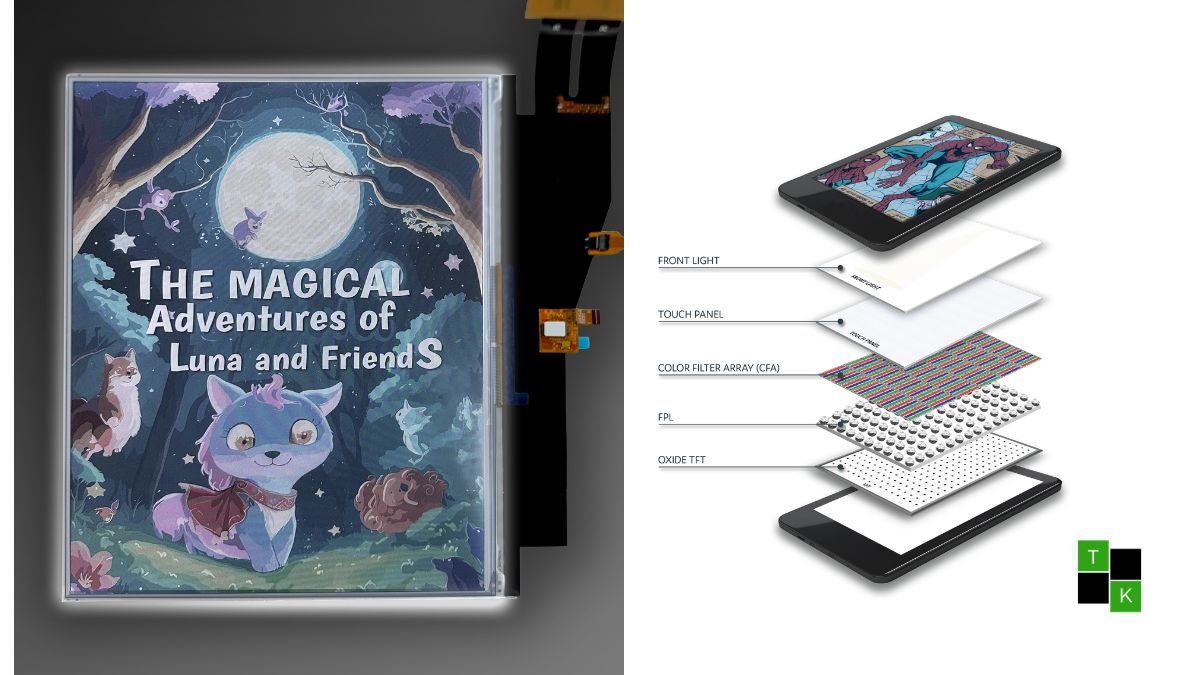
Officially introduced on October 15, 2026, E Ink Kaleido 4 marks the most comprehensive physical and structural overhaul of the Print Color ePaper architecture to date. Driven by an advanced Oxide TFT (Thin-Film Transistor) backplane and refined color filter integration, the new panel doubles its color gamut volume to more than 40,000 colors, increases white reflectance by 15%, and improves contrast ratio by 50% compared to the preceding Kaleido 3 generation.
Furthermore, newly developed driving algorithms allow Kaleido 4 panels to support video playback and fluid animations at up to 18 frames per second (FPS), repositioning color e-paper from a static reading format into a dynamic canvas for productivity tablets, academic notebooks, and interactive digital signage. The technology is making its immediate commercial debut inside Hanvon Technology’s M10C II in China, with wider global adoption across international e-reader brands expected in early 2027.
The Engineering Breakthrough: Oxide TFT Backplane
The defining technological shift inside E Ink Kaleido 4 lies beneath the microcapsules: the transition to an Oxide TFT backplane:
- Higher Electron Mobility: Traditional e-paper panels have historically utilized amorphous silicon (a-Si) TFT backplanes, which suffer from relatively sluggish electron mobility and higher leakage currents. By moving to an advanced metal-oxide semiconductor backplane (such as IGZO), the driving circuitry delivers significantly higher electrical conductivity and instantaneous switching speeds.
- Faster Microcapsule Repositioning: The higher drive capacity allows the display’s electrophoretic microcapsules (black and white pigments) to reposition in fractions of the time required by prior panels, drastically reducing ghosting artifacts during rapid scrolling and page turns.
- Enabling 18 FPS Fluid Motion: In conjunction with newly engineered timing controllers and proprietary waveform algorithms, the Oxide TFT layer enables refresh rates capable of rendering video clips, educational animations, and dynamic web content at up to 18 frames per second-a threshold previously unattainable on color E Ink displays without severe image degradation.
Solving the “Dark Screen” Problem: White Reflectance & 50% Contrast Boost
The most common critique of Kaleido 3 was its dark, muted unlit state; placing an RGB color filter array (CFA) over monochrome black-and-white microcapsules naturally absorbed incoming ambient light, forcing users to rely heavily on built-in LED frontlights even in well-lit rooms. Kaleido 4 introduces substantial optical improvements:
- 15% Increase in White Reflectance: By refining the optical stack, thinning internal bonding layers, and optimizing pigment density, the unlit background of Kaleido 4 reflects 15% more ambient white light. This results in a cleaner, paper-white reading canvas that closely resembles physical newsprint or paperback books under natural sunlight.
- 50% Improvement in Contrast Ratio: Black text appears noticeably crisper, deeper, and more distinct against colored illustrations, charts, and background fills, eliminating the muddy, washed-out presentation common to early color e-readers.
- Reduced Screen-Door Graininess: E Ink has re-engineered the micro-patterning of its color filter array to minimize the visible grid structure (often described by users as looking like looking through fine nylon mesh or textured parchment), delivering smoother continuous tones across photos, graphic novels, and digital magazines.
Color Gamut Doubled: Over 40,000 Displayable Hues
While earlier iterations achieved functional color for highlighting and basic diagrams, Kaleido 4 substantially broadens color fidelity:
- More Than 40K Color Gamut Volume: Kaleido 4 more than doubles the total color gamut volume of Kaleido 3, expanding the palette past 40,000 distinct color permutations.
- Richer Saturation in Natural Light: Tones across children’s books, comic art, and digital charts exhibit greater saturation and chromatic separation without requiring artificial software oversaturation that degrades text sharpness.
- Redesigned Frontlight System: Working in tandem with hardware partners, E Ink introduced an updated front-light architecture with calibrated light-guide layers that distribute illumination uniformly across the color filter without washing out delicate pastel shades.
First Commercial Hardware: Hanvon M10C II
The first production consumer device built around the E Ink Kaleido 4 panel is the Hanvon M10C II, unveiled in China alongside E Ink’s platform launch:
- T2000 Timing Controller & Enhanced Pressure Floating: Hanvon pairs the Kaleido 4 display with its proprietary T2000 ASIC timing controller and “Enhanced Pressure Floating” technology, yielding 27% faster page-turning and document scrolling speeds.
- Paper-Like Stylus Interaction: The 10.3-inch digital paper tablet features a micro-etched tempered glass cover designed to eliminate surface glare while providing physical tactile friction for handwriting. It includes a battery-free electromagnetic resonance (EMR) stylus offering 8,192 levels of pressure sensitivity.
- AI Productivity Suite: Powered by onboard OCR, multi-language speech transcription, and AI office productivity tools, the M10C II is positioned beyond leisure e-reading as an enterprise device for R&D review, contract signing, and boardroom meeting minutes.
E Ink Kaleido 4 vs. Kaleido 3 vs. Gallery 3
| Display Attribute | E Ink Kaleido 4 (2026) | E Ink Kaleido 3 (2022/2023) | E Ink Gallery 3 (ACeP Pigment) |
| Color Technology | Print Color ePaper (Color Filter Array) | Print Color ePaper (Color Filter Array) | Advanced Color ePaper (4-Color Particles) |
| Backplane Architecture | Oxide TFT (High-Mobility IGZO) | Amorphous Silicon (a-Si) TFT | Amorphous Silicon (a-Si) TFT |
| Color Gamut Volume | >40,000 Colors (2× Gamut Volume) | Baseline (~4,096 Colors) | Full Gamut (>50,000 Colors) |
| White Reflectance | +15% Brighter Background | Baseline (Darker / Gray-tinted) | High Whiteness |
| Contrast Ratio | +50% Improvement | Standard Baseline | High Static Contrast |
| Motion & Refresh Speed | Up to 18 FPS Video Playback | ~8 – 12 FPS Max (Noticeable Ghosting) | Slow Refresh (~500ms – 1.5s update) |
| Page-Turn Latency | ~27% Faster Refresh Cycles | Standard Fast Refresh | Significant Latency / Color Flashing |
| Display Texture / Mesh | Significantly Reduced Graininess | Visible Screen-Door Filter Grid | Seamless (No Color Filter Grid) |
| Primary Use Cases | Reading, Color Comics, Video, E-Notes | Leisure Reading, Light Highlighting | Digital Art, Static Photo Frames |
Market Roadmap: When Will Kindle, Kobo, and Boox Adopt Kaleido 4?
While Hanvon holds the distinction of launching the world’s first Kaleido 4 device in the Chinese domestic market, the transition across the global e-reader ecosystem will follow established manufacturing lead times:
- Agile Brands (Onyx Boox, Bigme, PocketBook): Specialized digital paper tablet makers historically move rapidly to adopt cutting-edge E Ink panels. Industry observers expect first commercial announcements from Onyx Boox and Bigme incorporating Kaleido 4 in late Q4 2026 or early Q1 2027.
- Mass-Market Mainstream (Kobo, Amazon Kindle, Nook): Major consumer platforms require prolonged supply-chain validation, custom enclosure re-tooling, and substantial panel volume commitments. Taiwanese manufacturing supply chain reports indicate that ODM partners like Netronix are already evaluating Kaleido 4 integration. Next-generation consumer hardware-such as anticipated successors to the Kobo Libra Colour or future revisions of the Kindle Colorsoft-is projected to integrate Kaleido 4 panels starting in Spring 2027.
- Expansion to Large-Format Monitors: The introduction of 18 FPS refresh rates and an Oxide TFT backplane makes Kaleido 4 an attractive candidate for secondary desktop monitors (13.3-inch to 24-inch eye-care monitors) and digital signage, broadening E Ink’s reach beyond handheld tablets.
With twice the color saturation, 50% sharper contrast, and the ability to handle animated instructional diagrams and video clips without crippling ghosting, E Ink Kaleido 4 represents the most significant step yet toward delivering an uncompromised, full-color paper replacement for the modern digital era.
🚨 Stay Updated with TopKhoj! 🚨
Get the latest tech news, deals, and exclusive offers first!
📰 Visit News Section📲 Join our Telegram Channel for real-time updates and best deals!
🔗 Join Telegram Now💡 Stay informed and never miss a great deal with TopKhoj!
⚠️ Disclaimer: Any link provided in the article related to a product or service will redirect you to our affiliate partner(s)' website, which are affiliate links. This means that if you make a purchase through these links, we may earn a commission at no extra cost to you. This commission helps support our blog and our work.
🔔 All prices mentioned above are subject to change based on current offers and availability on e-commerce platforms. Please check the latest price and product details on the product page before making a purchase.