Add TOPKHOJ as a Preferred Source on Google
Samsung has maintained a cautious approach to battery capacity in its flagship tier for years. While entry-level and mid-range devices like the Galaxy M-series and the recently launched Galaxy A08 4G regularly feature 6,000mAh cells, Samsung’s ultra-premium hardware-including the Galaxy S26 Ultra and the Galaxy Z Fold lineup-has remained capped at or below 5,000mAh.
That dynamic is set to shift with the development of the Samsung Galaxy Z TriFold2. Emerging hardware leaks and supply chain schematics indicate that the second-generation tri-fold device is engineered to pack a 6,000mAh+ battery, making it Samsung’s first true flagship to cross that endurance threshold.
Breaking the 5,000mAh Flagship Ceiling
Ever since the battery recalibration following the Galaxy Note 7, Samsung has prioritized conservative thermal margins on high-wattage, thin-profile flagships:
- The 5,000mAh Standstill: From the Galaxy S20 Ultra through to the Galaxy S26 Ultra, Samsung retained a 5,000mAh cell ceiling on its premier glass slabs.
- Foldable Constraints: Book-style dual-screen foldables like the Galaxy Z Fold series have had to manage even tighter internal volume constraints, often settling around 4,400mAh to maintain folded ergonomics.
- The First TriFold Step: Samsung pushed its initial commercial tri-fold hardware to a 5,600mAh total capacity by distributing power across three independent chassis segments.
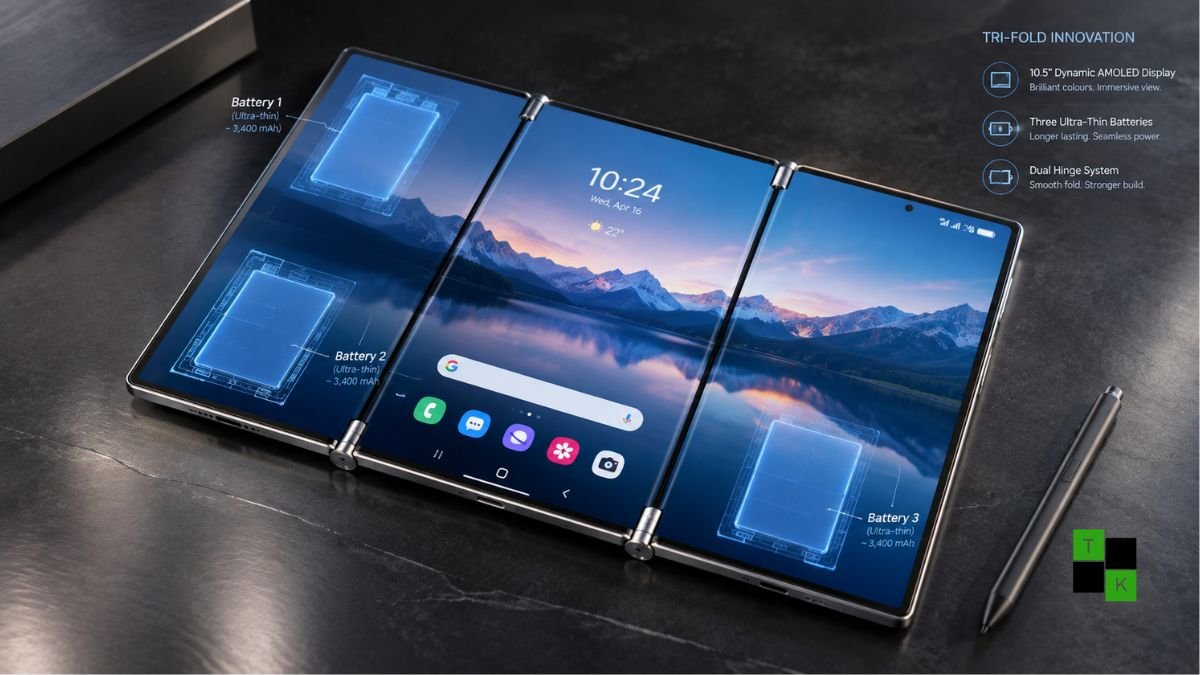
- The 6,000mAh Milestone: For the Galaxy Z TriFold2, engineers are leveraging higher-density chemistry to surpass 6,000mAh, finally bringing multi-day endurance headroom to power users and enterprise multitaskers.
Powering a 10.5-Inch Dynamic AMOLED Canvas
A massive battery is not merely an optional luxury for a dual-hinge form factor-it is a functional necessity:
- Massive Screen Real Estate: The Galaxy Z TriFold2 is expected to center around an expansive 10.5-inch Dynamic AMOLED 2X inner panel alongside an external 6.5-inch cover screen. Driving a 120Hz LTPO display of that surface area requires continuous electrical draw that would deplete a standard 4,500mAh or 5,000mAh cell in just a few hours of intensive work.
- Samsung DeX and Four-App Multitasking: Samsung envisions its tri-fold category as a pocketable PC replacement. Running up to four active split-screen applications simultaneously or projecting an untethered Samsung DeX desktop environment demands sustained power output under heavy multi-threaded compute workloads.
- Faster 68W Charging: To support the larger cell, supply chain reports point to an upgraded 68W wired fast-charging protocol, allowing the device to recharge to 50% in roughly 30 minutes despite the larger capacity.
Galaxy Z TriFold2: Expected Specifications
| Specification / Metric | Technical Details & Rumored Baseline |
| Inner Display | 10.5-inch Dynamic AMOLED 2X (120Hz, Dual-Layer UTG) |
| Cover Display | ~6.5-inch Dynamic AMOLED 2X (120Hz Adaptive) |
| Hinge Mechanism | Dual Armor FlexHinge (~8.9mm folded thickness target) |
| Processor Platform | Qualcomm Snapdragon 8 Elite Gen 2 / Next-Gen 3nm |
| Battery Capacity | 6,000mAh+ (Split 3-Cell Architecture) |
| Wired Charging | 68W Fast Charging via USB Type-C |
| Wireless Support | 15W Qi2 Wireless + Reverse Wireless PowerShare |
| Camera Array | 200MP Main (OIS) + 12MP Ultra-Wide + 10MP Telephoto |
| RAM & Storage | 12GB / 16GB LPDDR5X with 256GB / 512GB / 1TB UFS 4.1 |
| Stylus Support | S Pen Compatible (Magnetic External Docking) |
Split-Cell Packaging: How Samsung Fits 6,000mAh
Fitting more than 6,000mAh into a multi-folding device without turning the folded chassis into an unmanageable brick requires structural redesigns:
- Three-Piece Cell Distribution: Unlike conventional smartphones that use one large pouch cell, the Z TriFold2 divides its power infrastructure into three slim, custom-shaped battery packs situated inside each third of the titanium-aluminum frame.
- Silicon-Carbon Anode Density: Following industry-wide adoption by competitors like Honor and Vivo, Samsung SDI is transitioning toward higher-percentage silicon-carbon composite anodes. This allows greater energy density per cubic millimeter without requiring thicker chassis walls.
- Targeting an 8.9mm Folded Profile: Early engineering leaks suggest Samsung is targeting a folded thickness of approximately 8.9mm-down from the 12.9mm profile of first-generation proof-of-concept hardware-ensuring the tri-fold handles similarly to standard single-fold devices in the pocket.
Market Positioning and Outlook
While commercial availability for the Galaxy Z TriFold2 is projected further down Samsung’s product roadmap, the move to a 6,000mAh+ battery signifies an important turning point for Galaxy flagship architecture.
If Samsung successfully validates silicon-carbon battery density and split-cell power management at this scale, the technology will likely cascade into future mainline flagship generations, addressing long-standing user requests for larger batteries across the broader Galaxy family.
🚨 Stay Updated with TopKhoj! 🚨
Get the latest tech news, deals, and exclusive offers first!
📰 Visit News Section📲 Join our Telegram Channel for real-time updates and best deals!
🔗 Join Telegram Now💡 Stay informed and never miss a great deal with TopKhoj!
⚠️ Disclaimer: Any link provided in the article related to a product or service will redirect you to our affiliate partner(s)' website, which are affiliate links. This means that if you make a purchase through these links, we may earn a commission at no extra cost to you. This commission helps support our blog and our work.
🔔 All prices mentioned above are subject to change based on current offers and availability on e-commerce platforms. Please check the latest price and product details on the product page before making a purchase.