Add TOPKHOJ as a Preferred Source on Google
Chasing raw synthetic benchmark numbers has never been Google’s main philosophy for its Pixel smartphone lineup. While rival chipmakers keep pushing thermal limits to brag about peak processing scores, Google continues to focus on custom silicon optimization, smart computational photography, and deep on-device artificial intelligence.
However, tech enthusiasts still look forward to seeing how much horsepower Google’s next-generation flagships pack under the hood. Just days ahead of Google’s annual hardware event, a public benchmark log for the upcoming Google Pixel 11 Pro XL Geekbench score officially surfaced online.
Spotted running on the newly updated Geekbench 7 testing suite, the benchmark reveals an unconventional seven-core CPU layout, a massive 4.11GHz prime core, 16GB of system memory, and factory Android 17 software. Consequently, mobile reviewers and Pixel fans now have a clear look at what Google’s upcoming flagship brings to the table.
30-Second TL;DR
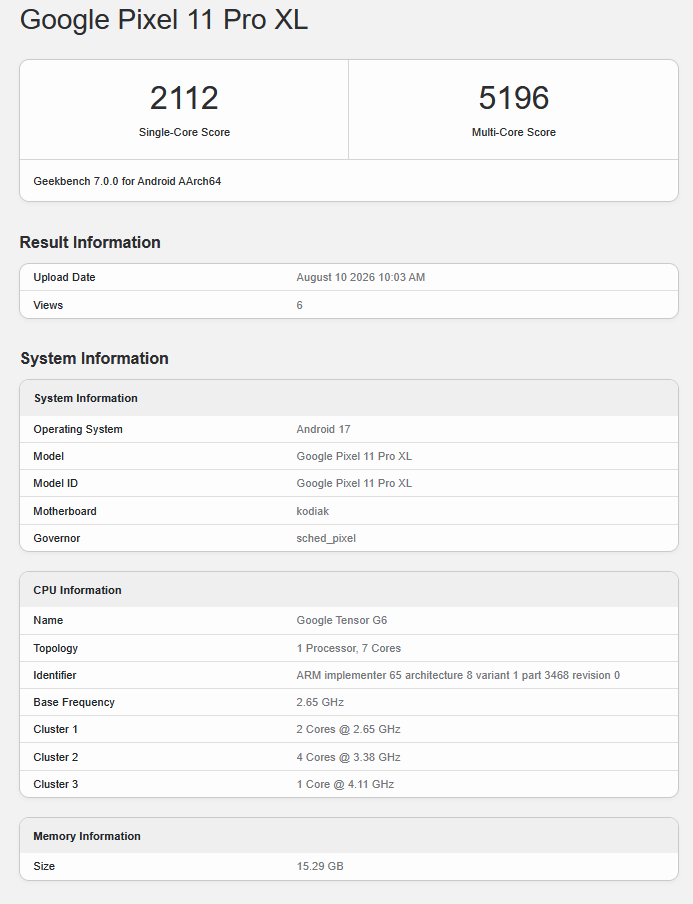
- Geekbench 7 Database Entry: The Google Pixel 11 Pro XL Geekbench score posted 2,112 in single-core and 5,196 in multi-core tests on the new Geekbench 7 suite.
- 7-Core Tensor G6 Architecture: The listing confirms a unique 7-core Tensor G6 chip featuring a 4.11GHz prime core, 16GB of physical RAM, and a PowerVR C-Series GPU.
- Android 17 Out of the Box: The benchmark unit operated on native Android 17, highlighting significant performance recovery compared to early, heavily throttled prototype leaks.
Main News Details
The initial trace of the Pixel 11 Pro XL on Geekbench appeared on August 10, 2026, instantly capturing attention across tech forums and news outlets. The test log identifies the motherboard under the codename kodiak, a internal tag long associated with Google’s top-tier 2026 hardware development.
Google Pixel 11 Pro XL Leaked System Architecture
 ├── Device Model Identifier ──> Google Pixel 11 Pro XL (Kodiak Motherboard)
 ├── System-on-Chip ──> Google Tensor G6 (ARM-based 7-Core Custom Silicon)
 ├── CPU Core Configuration ──> 1x Prime @ 4.11GHz + 4x Performance @ 3.38GHz + 2x Efficiency @ 2.65GHz
 ├── Benchmark Platform ──> Geekbench 7.0.0 for Android AArch64
 ├── Geekbench 7 Output ──> 2,112 Single-Core / 5,196 Multi-Core
 ├── System Memory Load ──> 16GB Physical RAM (15.29GB Reported Usable)
 ├── Graphics Subsystem ──> PowerVR C-Series CXTP-48-1536 MC1 GPU
 └── Operating System Stack ──> Google Android 17 Operating System
Importantly, the benchmark test logged a single-core score of 2,112 and a multi-core score of 5,196. While those numbers look different from older Geekbench 6 metrics, they represent a dramatic leap forward compared to early prototype testing spotted earlier in the year.
In those earlier internal runs, prototype silicon operated under heavy thermal throttling at just 2.0GHz, scoring a modest 845 in single-core tests. The new benchmark demonstrates that Google’s engineering team has successfully unlocked higher clock speeds as retail hardware nears mass production.
“Testing the Tensor G6 at 4.11GHz proves that Google is willing to push higher clock frequencies, ensuring snappy daily responsiveness alongside its dedicated AI hardware acceleration.” – Mobile Hardware Analyst
Key Highlights
| Benchmark & Hardware Category | Confirmed Pixel 11 Pro XL Geekbench Details |
| Official Device Name | Google Pixel 11 Pro XL |
| Motherboard Identifier | Kodiak |
| Benchmark Suite Version | Geekbench 7.0.0 (Android AArch64) |
| Single-Core Test Output | 2,112 Points |
| Multi-Core Test Output | 5,196 Points |
| Primary System Processor | Google Tensor G6 (7-Core Layout) |
| CPU Clock Frequencies | 1 Core @ 4.11GHz + 4 Cores @ 3.38GHz + 2 Cores @ 2.65GHz |
| Graphics Processing Unit | Imagination PowerVR C-Series CXTP-48-1536 MC1 |
| System Physical Memory | 16GB LPDDR5X RAM (15.29GB Usable) |
| Factory Operating System | Google Android 17 |
Detailed Explanation
Unpacking the 7-Core Tensor G6 Architecture
Unlike traditional mobile processors that feature standard eight-core layouts, Google adopts a unique seven-core cluster configuration for the Tensor G6. This architectural design divides tasks across three specialized processing tiers.
Google Tensor G6 Core Distribution
 ├── Prime Performance Core ──> 1x High-Frequency Core @ 4.11GHz (Peak Single-Thread Burst)
 ├── Heavy Workload Cluster ──> 4x Performance Cores @ 3.38GHz (Sustained Multitasking)
 └── Efficiency Cluster ──> 2x Energy-Conscious Cores @ 2.65GHz (Background Tasks)
The Single-Core Advantage: Pushing a primary core to 4.11GHz guarantees that app launches, camera shutter processing, and complex Web browsing tasks feel snappy and instantaneous.
Additionally, reducing the efficiency cluster down to two cores frees up valuable silicon area. That extra space allows Google to integrate a larger Neural Processing Unit (NPU) dedicated entirely to handling complex Gemini AI models directly on the device.
Geekbench 7 vs. Geekbench 6: Understanding the Score
Comparing the Google Pixel 11 Pro XL Geekbench score directly against older smartphones requires careful context. Because this leak runs on the newly released Geekbench 7 testing suite, score scaling differs significantly from the older Geekbench 6 framework.
Benchmark Metric Scaling Reality
 ├── Geekbench 6 Framework ──> Emphasizes Raw Multi-Threaded Workloads
 └── Geekbench 7 Framework ──> Heavily Weights Machine Learning & Unified Memory Speed
The Testing Context: Geekbench 7 uses newer real-world workload workloads that lower numerical output scores across all mobile processors. Therefore, a 2,112 single-core score on Geekbench 7 reflects solid, modern computational speed rather than a step backward.
Furthermore, pre-release benchmark runs rarely represent final retail software optimization. Once Google releases final firmware updates at launch, real-world scores typically climb higher.
16GB RAM for Next-Level On-Device AI
Memory capacity is a crucial requirement for modern AI smartphones. The Geekbench listing confirms that the Pixel 11 Pro XL carries 16GB of physical RAM.
Memory Allocation & System Overhead
 ├── Total Installed RAM ──> 16GB Physical LPDDR5X System Memory
 ├── Hardware & OS Reserved ──> ~0.71GB Operating System Overhead
 └── Available System RAM ──> 15.29GB High-Speed Available Capacity
The Multitasking Perk: Carrying 16GB of fast memory ensures that heavy generative AI tools like Magic Editor, Live Translate, and Gemini Nano remain active in background memory without forcing open browser tabs or games to reload.
In addition, pairing generous memory bandwidth with an upgraded PowerVR C-Series graphics engine guarantees smooth visual frame rates during mobile gaming.
Factory Android 17 and Efficiency Focus
Software integration remains the defining strength of the Pixel experience. The benchmark test confirms that the device runs Android 17 out of the box.
Software Platform Capabilities
 ├── System OS Base ──> Google Android 17 Operating System
 ├── Core Platform Focus ──> Predictive Battery Management & Adaptive Thermal Control
 └── Security Infrastructure ──> Hardware-Isolated Titan M3 Security Architecture
The Daily Impact: Android 17 introduces smarter background process suspension, which works alongside the efficient 7-core CPU to extend battery endurance during busy workdays.
Timeline
        February 2026                 Early August 2026             August 10, 2026
────────────┬─────────────────────────────┬─────────────────────────────┬─────────────
            │                             │                             │
   Early Tensor G6 Prototype     CAD Renders & 5,500mAh        Geekbench 7 Test Surfaces
   Appears at Low 2.0GHz Clock    Battery Specs Leak Online     Confirming 4.11GHz Peak Clock
- February 2026: Early Tensor G6 silicon prototypes appeared in preliminary database logs, heavily throttled at 2.0GHz.
- Early August 2026: High-resolution CAD renders and battery specification leaks confirmed a 5,500mAh energy cell and a 6.8-inch display for the Pixel 11 Pro XL.
- August 10, 2026: The Google Pixel 11 Pro XL officially surfaced on Geekbench 7, revealing a 2,112 single-core score and a 4.11GHz prime core clock.
What is Confirmed
- Geekbench 7 Benchmark Scores: Verified single-core score of 2,112 and multi-core score of 5,196.
- System Processor: Verified 7-core Google Tensor G6 CPU architecture.
- Peak Core Frequencies: Verified 4.11GHz prime core speed paired with 3.38GHz and 2.65GHz core clusters.
- Physical System Memory: Verified 16GB RAM load on the Pro XL model.
- Operating System: Confirmed factory Android 17 software stack.
What is Not Confirmed
- Exact Thermal Dissipation Metrics: Real-world surface temperatures during extended high-frame-rate gaming remain unverified.
- Official Global Retail Pricing: Launch price points across 256GB, 512GB, and 1TB storage variants have not been officially published.
- Generative NPU Performance: Benchmark scores for the dedicated artificial intelligence engine have not been disclosed.
Why This News Matters
The appearance of the Google Pixel 11 Pro XL Geekbench score demonstrates how Google approaches flagship hardware design. Rather than engaging in an arms race over synthetic peak benchmark numbers, Google continues to customize its silicon for practical daily usability.
Furthermore, pairing a fast 4.11GHz prime CPU core with 16GB of RAM, an upgraded PowerVR GPU, and factory Android 17 ensures that the Pixel 11 Pro XL provides smooth performance for computational photography and on-device AI tools.
What Happens Next
With Geekbench tests now public and retail packaging leaks circulating across social media, Google is expected to formally unveil the Pixel 11 series at its upcoming hardware keynote. Full camera tests, battery endurance evaluations, and real-world gaming benchmarks will follow shortly after devices ship to early reviewers.
Conclusion
The leaked Geekbench 7 benchmark of the Google Pixel 11 Pro XL provides an encouraging preview of Google’s 2026 hardware strategy. Featuring a 7-core Tensor G6 processor clocked up to 4.11GHz, 16GB of physical RAM, and Android 17, Google’s newest flagship is well-equipped to deliver an exceptional user experience.
Source: Information compiled from Geekbench 7 database entries first reported by Deal N Tech and detailed via Notebookcheck, Nokiamob, and Android Headlines.
🚨 Stay Updated with TopKhoj! 🚨
Get the latest tech news, deals, and exclusive offers first!
📰 Visit News Section📲 Join our Telegram Channel for real-time updates and best deals!
🔗 Join Telegram Now💡 Stay informed and never miss a great deal with TopKhoj!
⚠️ Disclaimer: Any link provided in the article related to a product or service will redirect you to our affiliate partner(s)' website, which are affiliate links. This means that if you make a purchase through these links, we may earn a commission at no extra cost to you. This commission helps support our blog and our work.
🔔 All prices mentioned above are subject to change based on current offers and availability on e-commerce platforms. Please check the latest price and product details on the product page before making a purchase.