Add TOPKHOJ on Google:
 Preferred Source
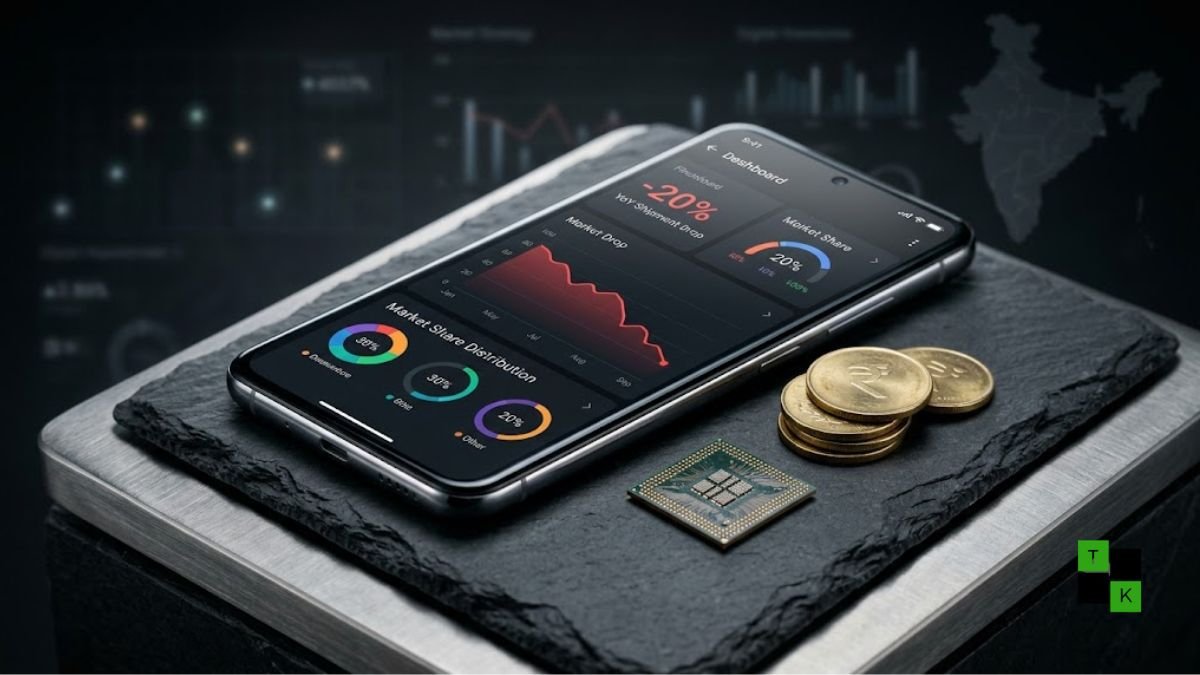
The world’s second-largest mobile phone arena has experienced its sharpest contraction in ten years. According to comprehensive quarterly data from Counterpoint Research and Omdia, India smartphone shipments dropped by 20% to 26% year-on-year (YoY) in Q3 2026 (July–September), falling to approximately 35.8 million units.
Shipment volumes sank to their lowest third-quarter baseline since 2016, defying the typical pre-Diwali inventory buildup. The downturn stems from an unprecedented cost squeeze.
Driven by AI infrastructure demands draining global silicon fabrication capacity, record-high DRAM and NAND flash memory component prices forced smartphone makers to either absorb steep margin losses or raise retail prices.
With brands electing to raise prices, the traditional volume engine of the country-the sub-₹20,000 ($240) budget segment-collapsed by a massive 47% YoY.
Consumers across tier-2 and tier-3 towns responded by delaying upgrades and extending their replacement cycles to nearly 30 months.
Amid the broader contraction, Samsung reclaimed the No. 1 market position after nine consecutive quarters, navigating the volatility through conservative component procurement and flexible consumer financing.
The Core Driver: How Memory Squeeze Crippled the Mass Market
The primary catalyst behind the 2026 market slump is not a sudden lack of consumer interest, but a severe cost crisis across semiconductor supply chains:
- Global Memory Price Spikes: As server foundries prioritized enterprise HBM (High Bandwidth Memory) and high-density LPDDR5X chips for generative AI data centers, standard mobile DRAM and UFS flash memory modules saw record pricing increases.
- The Death of the “Affordable Spec Monster”: For years, Indian consumers expected 8GB RAM, 128GB/256GB storage, and a 120Hz display to retail comfortably below ₹15,000. In 2026, component cost surges made those configurations economically unviable for manufacturers without substantial price hikes.
- The 47% Budget Collapse: As entry-level devices breached the ₹18,000 to ₹22,000 threshold, the sub-₹20,000 segment saw shipments plunge by 47% YoY. Price-sensitive mass-market buyers simply stopped upgrading, choosing to service or replace the batteries of their existing handsets instead.
- Cautious Channel Stocking: Fearing unsold inventory sitting on retail shelves after Diwali, both offline distributors and e-commerce platforms (Amazon India and Flipkart) held back on pre-festive channel stuffing, opting for conservative, lean inventory models.
Brand Realignment: Samsung Reclaims the Crown
The shifting market conditions altered the competitive hierarchy, allowing diversified legacy brands to outmaneuver volume-focused rivals:
- Samsung Back at No. 1 (17% to 18.6% Share): After trailing Vivo and Xiaomi for more than two years, Samsung regained the top spot with approximately 6.7 million shipments. Samsung benefited from internal component synergies-securing memory from its own semiconductor divisions-and steady demand for its Galaxy A-series (A07, A17, A27) alongside flagships.
- Vivo Slides to Second (16% to 17.8% Share): Shipments fell to 6.4 million units, marking a 34% YoY drop-the steepest decline among the top five vendors. Repeated price corrections on entry-level Y-series models disrupted offline retailer confidence.
- OPPO Holds Third (12% to 13.7% Share): Shipping 4.9 million units (down 24% YoY), OPPO cushioned volume losses through its mid-to-premium Reno series and high-margin halo models.
- Xiaomi Takes Heavy Hit (12% to 13.1% Share): Shipping 4.7 million units (down 28% YoY), Xiaomi faced severe pricing trade-offs between RAM capacity and retail cost, softening its competitive edge in the Redmi budget segment.
- Apple Climbs into the Top Five (10.9% Share): Apple proved immune to entry-level economic stress, shipping 3.9 million iPhones. Strong demand for the base iPhone 17 and iPhone 16-bolstered by bank cashback, exchange bonuses, and 24-month zero-interest EMI financing-drove shipments upward.
The Chinese Brand Retreat: Market Share Drops to 68%
The squeeze disproportionately impacted Chinese original equipment manufacturers (OEMs), who built their Indian market presence on aggressive price-to-spec ratios:
- Share Compression: The combined market share of Chinese OEMs in India fell from 75% in Q3 2025 to 68% in Q3 2026.
- Domestic Resurgence: Taking advantage of geopolitical shifts, policy incentives, and localized sourcing, Indian domestic smartphone brands captured approximately 7% to 15% combined market share-their strongest showing since 2018, led by high-growth localized initiatives.
Q3 2026 India Smartphone Market Share & Vendor Performance
| Brand / OEM | Q3 2026 Shipments (Est.) | Market Share Range | YoY Shipment Growth | Key Drivers & Strategy |
| Samsung | 6.7 Million Units | 17.0% – 18.6% | Outperformed Market | Galaxy A-series volumes; memory cost management |
| Vivo | 6.4 Million Units | 16.0% – 17.8% | -34% YoY (Sharp Decline) | Price hikes hit Y-series; restrained channel stocking |
| OPPO | 4.9 Million Units | 12.0% – 13.7% | -24% YoY | Reno premiumization; high-end camera financing |
| Xiaomi (incl. POCO) | 4.7 Million Units | 12.0% – 13.1% | -28% YoY | Budget trade-offs; Redmi Note & POCO resilience |
| Apple | 3.9 Million Units | ~10.9% | Positive YoY Inflow | Premiumization trend; aggressive 24-mo EMI schemes |
| Others (Realme, OnePlus, Lava) | ~9.2 Million Units | ~25.9% – 28.0% | Mixed / Realigned | Niche esports; Indian domestic brands rebound |
| Total Indian Market | ~35.8 Million Units | 100% | -20% to -26% YoY Decline | Decadal Shipment Low (Lowest Since 2016) |
The Silver Lining: “Premiumization” and AI Smartphone Growth
While overall shipment volume plummeted, the financial profile of the Indian smartphone space revealed an underlying divergence:
- Average Selling Price (ASP) Hits All-Time High: Because unit sales fell in the budget segment while premium phones ($600+) remained steady, the industry’s overall Average Selling Price reached an all-time high. Brands are moving fewer boxes, but making more revenue per device sold.
- The Rise of GenAI Handsets: Counterpoint Research highlighted that AI-capable smartphones grew 306% YoY during Q3 2026. Consumers investing over ₹30,000 actively sought on-device AI features, visual translation tools, and automated scheduling.
- Consumer Financing as a Lifeboat: Without 18-to-30-month no-cost EMI schemes from Bajaj Finserv, HDFC, and ICICI, the premium decline would have been far more severe. More than 65% of all smartphones sold above ₹25,000 in India are now purchased through structured monthly installment plans.
What Lies Ahead: A 13% Annual Contraction and Price Hikes
Industry analysts caution that the market will not rebound quickly:
- Full-Year 2026 Forecast: Counterpoint Research predicts that the Indian smartphone market will contract by approximately 13% across full-year 2026, marking one of the steepest calendar-year drops in the country’s telecom history.
- Post-Diwali Price Hikes: With memory fabricators maintaining tight supply quotas, analysts warn that OEMs may be forced to initiate another round of price hikes after the festive season concludes in November.
- Strategic Realignment: The era of flooded retail shelves and hyper-aggressive spec wars appears to have stalled. Moving into 2027, manufacturers are cutting low-margin SKUs, prioritizing silicon-carbon battery endurance, and building structured upgrade pathways to survive India’s transformed smartphone economy.
🚨 Stay Updated with TopKhoj! 🚨
Get the latest tech news, deals, and exclusive offers first!
📰 Visit News Section📲 Join our Telegram Channel for real-time updates and best deals!
🔗 Join Telegram Now💡 Stay informed and never miss a great deal with TopKhoj!
⚠️ Disclaimer: Any link provided in the article related to a product or service will redirect you to our affiliate partner(s)' website, which are affiliate links. This means that if you make a purchase through these links, we may earn a commission at no extra cost to you. This commission helps support our blog and our work.
🔔 All prices mentioned above are subject to change based on current offers and availability on e-commerce platforms. Please check the latest price and product details on the product page before making a purchase.