Add TOPKHOJ as a Preferred Source on Google
We have all been there: you are in the middle of an intense graphics-heavy gaming session, your phone battery hits 15%, and you frantically plug in the charging cable. Within ten minutes, your device feels like a hot brick in your hands, the screen dims automatically to prevent overheating, and your frame rate drops off a cliff.
For years, heavy smartphone users had to choose between letting their battery die or roasting their internal hardware while playing games plugged into a wall outlet. However, smartphone manufacturers have introduced an ingenious hardware feature to solve this exact problem: bypass charging.
Originally reserved for dedicated gaming laptops and specialized handhelds, passthrough power is rapidly making its way into mainstream Android devices. But what is bypass charging, how does it work under the hood, and why should you care about it when buying your next smartphone? Let’s break down the technical details in plain English.
Quick Summary
- Standard Charging: Current flows from your wall adapter into the lithium-ion battery, and the battery simultaneously discharges energy to power your phone’s processor and display. This double workload generates immense heat.
- Bypass Charging: Electric current skips the battery entirely, traveling straight from the USB-C port to the motherboard and processor.
- The Core Benefit: Eliminates charging-induced heat while gaming, prevents severe performance throttling, and halts unnecessary battery degradation cycles.
What Is Bypass Charging? (The Simple Explanation)
Bypass charging-sometimes marketed as Passthrough Power, Pause USB Power Delivery, or H.S. (Heat Suppression) Power Control-is a hardware-level charging mode that routes incoming electrical power directly to your phone’s motherboard, completely bypassing the lithium-ion battery.
Under normal operating conditions, your smartphone acts like a bucket with a small hole in the bottom. When you plug in a standard charger, electricity fills the battery bucket while your phone pulls power from that same bucket to run its screen and chips.
When bypass charging activates, your phone essentially installs a direct pipe from your wall charger directly to your phone’s engine. Consequently, the battery sits idle at its current charge percentage while the wall outlet runs your phone directly.
How It Works: Under the Hood of Power Routing
To understand why this feature is revolutionary, we must look at the two worst enemies of lithium-ion batteries: excessive heat and voltage stress.
When you play a demanding 3D game like Genshin Impact or Call of Duty: Mobile, your phone’s main processor (SoC) draws significant power, generating substantial heat in the process. If you simultaneously charge the battery, chemical reactions inside the cell generate a second wave of intense thermal energy.
When heat builds up inside a sealed phone chassis, two negative outcomes occur rapidly:
- Thermal Throttling: The operating system forcefully scales down CPU and GPU clock speeds to keep the phone from melting its internal circuits, causing severe lag and stuttering.
- Accelerated Degradation: Exposing a lithium-ion cell to high temperatures while keeping it at a high voltage state breaks down internal electrolytes, permanently reducing your battery’s maximum capacity.
[ Standard Charging Under Load ]
Wall Adapter  --->  Lithium Battery (Heats Up)  --->  Motherboard / SoC (Heats Up)
Result: Double Thermal Load = Severe Throttling & Battery Damage

[ Bypass Charging Mode ]
Wall Adapter  --->  Power Management IC  --->  Motherboard / SoC
                     | (Battery Bypassed & Idle)
Result: Zero Battery Heat = Sustained Peak FPS & Protected Battery
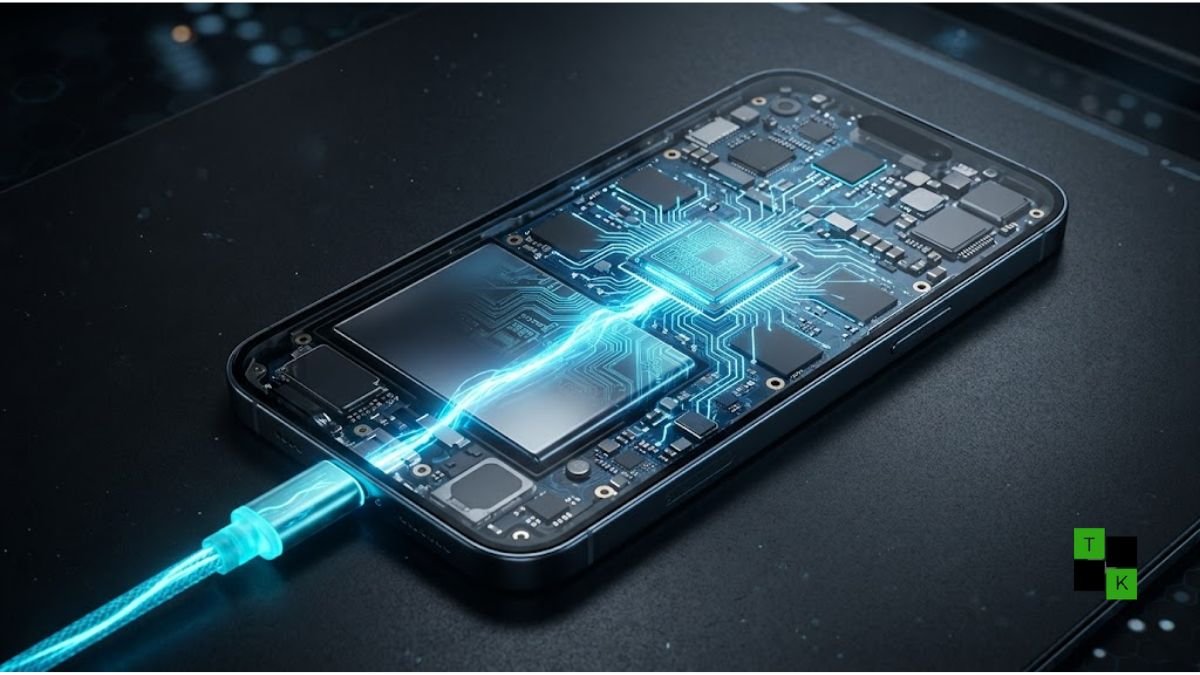
When bypass charging is engaged, the phone’s Power Management Integrated Circuit (PMIC) detects that a compatible charger is connected. Instead of converting incoming voltage into a chemical charge for the battery cells, the PMIC regulates voltage down to the exact millivolt level required by the motherboard. Because the battery is neither charging nor discharging, chemical heat generation drops to zero.
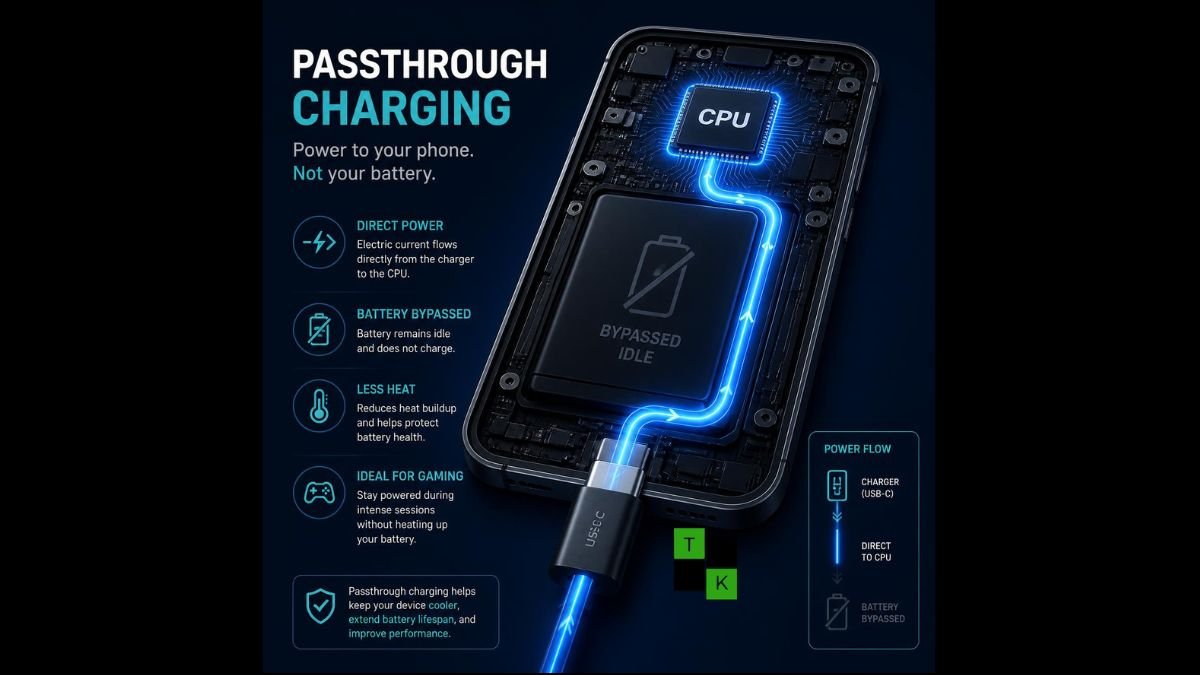
Standard Charging vs. Bypass Charging
The structural differences between traditional charging methods and passthrough power highlight why hardware enthusiasts love this technology:
| Metric / Feature | Standard Fast Charging | Bypass Charging (Passthrough) |
| Power Flow Path | Charger → Battery → Motherboard | Charger → PMIC → Motherboard Direct |
| Battery Activity | Actively charging (chemical reaction) | Completely idle (zero current flow) |
| Heat Generation | High (Battery heat + SoC heat combined) | Low (SoC heat only) |
| Frame Rate Stability | Drops over time due to thermal throttling | Remains smooth and consistent |
| Battery Health Impact | High stress due to heat and charge cycles | Zero wear on battery health during use |
| Required Hardware | Standard USB charging circuit | Smart PMIC with passthrough support |
Real-World Impact: Why This Feature Matters to You
While bypass charging sounds like an enthusiast feature for hard-core gamers, its practical perks extend to everyday smartphone longevity:
1. Buttery-Smooth Gaming Performance
Because the battery generates zero heat during passthrough mode, your phone stays significantly cooler. As a result, your processor maintains high clock speeds for hours without triggering aggressive thermal throttling or dimming display brightness.
2. Multi-Year Battery Protection
Lithium-ion batteries decay primarily through charge-discharge cycles and thermal exposure. By pausing chemical activity while you binge-watch videos or navigate via GPS on long road trips, you save hundreds of micro-charge cycles over the life of your device.
3. Faster Cool-Downs After Heavy Use
If your phone is already warm from outdoors or heavy multitasking, plugging in a standard fast charger forces temps higher. Switching to bypass charging allows the device to cool off naturally while remaining fully operational on wall power.
Which Brands Support Bypass Charging?
Although the underlying concept is identical across manufacturers, tech brands like to give this feature custom marketing names inside their software settings:
- Samsung: Called “Pause USB Power Delivery” (found inside the Game Booster settings on Galaxy S and A-series phones). It requires a USB Power Delivery (PD) charger connected.
- ASUS ROG & Zenfone: Known as “Bypass Charging” inside the Game Genie overlay, allowing users to select exact percentage thresholds.
- Sony Xperia: Branded as “H.S. Power Control” (Heat Suppression Power Control) inside the Game Enhancer suite.
- Infinix & Tecno: Marketed directly as “Bypass Charge” in their gaming software menus.
- Black Shark & RedMagic: Integrated directly into hardware gaming sliders and performance overlays.
Common Myths & Misconceptions Busted
Because passthrough charging is relatively new to mainstream smartphones, several misconceptions continue to confuse buyers:
- Myth #1: “Bypass charging will charge my battery faster.”
- Reality: It actually doesn’t charge your battery at all! The entire purpose of bypass charging is to pause battery charging so incoming power goes straight to running the operating system.
- Myth #2: “You can only use bypass charging with expensive official chargers.”
- Reality: Most modern implementations simply require a standard USB Power Delivery (USB-PD) wall adapter capable of delivering basic 15W to 25W power output.
- Myth #3: “Bypass charging works at 0% battery life.”
- Reality: Most phones require a baseline charge (usually 20% or higher) before enabling passthrough power. This safeguard prevents accidental shutdowns if the power cable gets bumped or disconnected momentarily.
Pro-Tips: How to Enable and Use Bypass Charging
If your phone supports passthrough power, follow these practical steps to get the best performance out of it:
- Use a USB Power Delivery (PD) Charger: Make sure your charging brick supports standard USB-PD protocol. Proprietary fast-chargers without open PD support sometimes fail to trigger passthrough modes.
- Turn It On in Game Launchers: On devices like Samsung Galaxy phones, open the Game Launcher app, go to Game Booster settings, and toggle on Pause USB Power Delivery while plugged in.
- Plug In Before Heavy Tasks: If you plan to stream high-definition video or navigate with Google Maps for hours in a warm car, plug your phone in early to let bypass charging carry the load rather than roasting your battery.
Frequently Asked Questions
Q1: Is bypass charging safe for daily use?
Yes, bypass charging is actually safer than standard charging under heavy workloads. Because it bypasses the battery, it eliminates the risk of high-temperature battery swelling and severe thermal wear.
Q2: Does the iPhone have bypass charging?
Apple uses a limited form of passthrough power management on newer iPhones when connected to MagSafe or high-wattage chargers, but iOS does not offer a manual toggle for users to force bypass charging during gaming like Android does.
Q3: Why doesn’t every smartphone have bypass charging enabled by default?
Implementing bypass charging requires a specialized Power Management IC (PMIC) that can dynamically split voltage lines between the battery and the logic board. While budget phones often skip this chip to cut manufacturing costs, more mid-range and flagship devices are adopting it standard.
Conclusion & Final Takeaway
Smartphone hardware has reached a point where processing power far outpaces thermal dissipation limits. Bypass charging is one of the smartest hardware innovations in recent years, solving thermal throttling and battery wear with simple, elegant power routing.
If you play games on your phone, use your device as a mobile hotspot, or frequently rely on GPS navigation while driving, finding a phone that supports passthrough power is a massive quality-of-life upgrade. It keeps your hands cool, keeps your frame rates high, and ensures your battery lasts for years to come.
🚨 Stay Updated with TopKhoj! 🚨
Get the latest tech news, deals, and exclusive offers first!
📰 Visit News Section📲 Join our Telegram Channel for real-time updates and best deals!
🔗 Join Telegram Now💡 Stay informed and never miss a great deal with TopKhoj!
⚠️ Disclaimer: Any link provided in the article related to a product or service will redirect you to our affiliate partner(s)' website, which are affiliate links. This means that if you make a purchase through these links, we may earn a commission at no extra cost to you. This commission helps support our blog and our work.
🔔 All prices mentioned above are subject to change based on current offers and availability on e-commerce platforms. Please check the latest price and product details on the product page before making a purchase.