AI research labs are quietly snapping up tens of thousands of Apple desktop computers, triggering widespread inventory shortages and shipping delays for high-spec Mac mini and Mac Studio configurations. According to a report by The Information, OpenAI has purchased fleets of compact Mac desktops over recent months, while rival Anthropic is renting substantial Mac capacity through Amazon Web Services (AWS) to power its own research pipelines.
The sudden demand stems not from general large language model pre-training-which remains firmly anchored to massive Nvidia GPU clusters-but from the specialized hardware needs of training “computer-use agents” that must navigate operating systems, edit code, and automate complex desktop workflows autonomously.
30-Second TL;DR
- Core News: OpenAI has purchased tens of thousands of Mac minis and Mac Studios, while Anthropic is renting cloud Mac clusters to train autonomous AI agents.
- Key Detail: Apple’s Unified Memory Architecture (UMA) allows these compact desktops to run local multi-step reinforcement learning tasks without the memory bottlenecks of discrete GPUs.
- What It Means: Surging institutional demand and a wider global memory crunch have pushed delivery wait times for high-RAM Mac desktops to several weeks or months for everyday consumers and developers.
Why AI Labs Are Buying Desktop Macs
Training an autonomous AI agent to control a computer requires running thousands of continuous, localized operating system sessions. In these reinforcement learning environments, the agent reads screen states, executes clicks and keystrokes, and evaluates immediate system feedback millions of times.
This workload differs fundamentally from traditional neural network training:
- Memory-Bound Operations: Agent simulation requires low-latency access to shared system RAM rather than raw, massive matrix multiplication power.
- Unified Memory Advantage: Apple Silicon shares a single, wide memory pool across the CPU, GPU, and Neural Engine (reaching bandwidths up to 1.2TB/s on high-tier chips), bypassing the bus latency that occurs when moving data between discrete PC system RAM and GPU VRAM.
- Thermal Endurance: Unlike laptops, the active cooling solutions in the Mac mini and Mac Studio allow machines to run at continuous peak loads for days without thermal throttling.
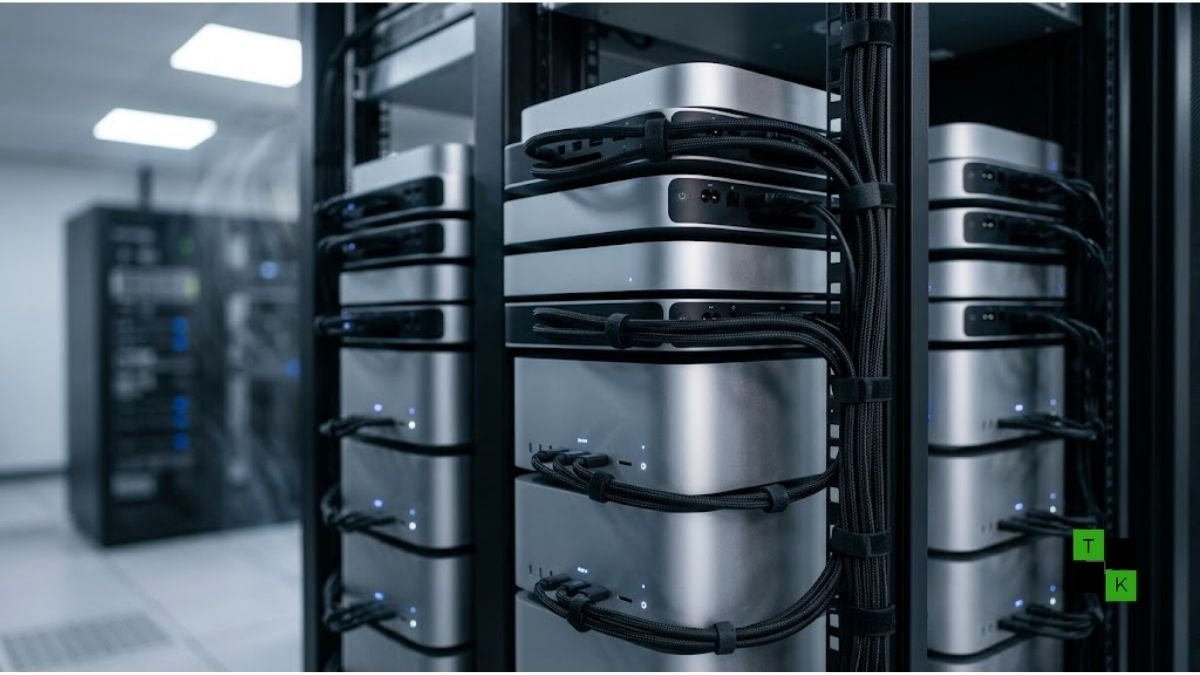
- Horizontal Scaling Economics: Deploying dense racks of Mac minis provides a cost-effective environment to simulate thousands of isolated desktop instances simultaneously without tying up seven-figure cloud GPU clusters.
Cloud GPUs vs. Apple Silicon for Agent Workloads
| Feature | Enterprise Cloud GPUs (e.g., Nvidia H100) | Apple Silicon Desktops (Mac mini / Studio) |
| Primary Workload | Large-scale LLM training & massive batch inference | OS-level agent simulation & reinforcement learning |
| Memory Architecture | High-bandwidth dedicated VRAM (Separate system RAM) | High-speed Unified Memory Architecture (Shared pool) |
| Hardware Form Factor | Rack-mounted 4U/8U server chassis | Compact standalone desktop units |
| Deployment Model | Dedicated multi-million dollar data center clusters | Stackable on-premise clusters or rented cloud instances |
| Cost Profile | High hourly cloud rental / High capital expenditure | Low unit cost per independent operating system node |
Supply Chain Impact: Months-Long Delivery Delays
The bulk purchases have tightened availability across Apple’s desktop lineup. Delivery windows for customized Mac Studio configurations-particularly models equipped with maximum memory allocations-have stretched from standard delivery windows into several weeks or months.
The surge in demand caught Apple in the middle of a wider global memory component crunch, prompting the company to introduce an early refresh of both product lines in late August 2026, featuring M6 and M5-series configurations designed with expanded cluster networking capabilities.
The Emerging Market for Local AI Compute
The scramble for Mac hardware highlights an evolving shift in AI infrastructure. While Nvidia continues to dominate foundational model training, local on-premise hardware capable of executing agentic tasks has become a distinct operational layer.
With startups and established enterprises competing to build agents capable of automating real-world software tasks, compact desktop hardware with large, unified memory pools have unexpectedly emerged as essential AI development infrastructure.
🚨 Stay Updated with TopKhoj! 🚨
Get the latest tech news, deals, and exclusive offers first!
📰 Visit News Section📲 Join our Telegram Channel for real-time updates and best deals!
🔗 Join Telegram Now💡 Stay informed and never miss a great deal with TopKhoj!
⚠️ Disclaimer: Any link provided in the article related to a product or service will redirect you to our affiliate partner(s)' website, which are affiliate links. This means that if you make a purchase through these links, we may earn a commission at no extra cost to you. This commission helps support our blog and our work.
🔔 All prices mentioned above are subject to change based on current offers and availability on e-commerce platforms. Please check the latest price and product details on the product page before making a purchase.