Add TOPKHOJ on Google:
 Preferred Source
Supply chain intelligence and analyst dispatches from Bloomberg’s Mark Gurman, TF International Securities analyst Ming-Chi Kuo, and display research firms have outlined Apple’s hardware roadmap stretching from 2027 into 2029. Following the launch of the ultra-slim iPhone 17 Air and initial Apple Intelligence implementations, Apple is preparing a multi-year hardware pivot focused on foldable displays, ambient artificial intelligence wearables, household robotics, and sub-2nm semiconductor lithography.
The timeline highlights 2027 as a cornerstone year-coinciding with the 20th anniversary of the original iPhone-initiating product transitions across mobile, computing, and smart home divisions.
30-Second TL;DR
- 2027 Milestones: 20th-anniversary iPhone redesign, a dual-purpose 20.3-inch foldable MacBook/iPad hybrid, camera-equipped AirPods for Visual Intelligence, and a first-generation audio smart glasses line.
- Home Robotics Debut: Apple plans to introduce a tabletop robotic smart home companion featuring an interactive display mounted on an articulating motorized limb.
- 2028 Evolution: True augmented reality (AR) waveguide glasses, a 40% lighter “Vision Air” spatial headset, and the introduction of under-display camera (UDC) technology for a cutout-free iPhone.
- 2029 Horizon: Expansion into autonomous mobile home robots and consumer hardware fabricated on TSMC’s 1.4nm (A14 Angstrom) semiconductor node.
- Display Overhaul: Full portfolio OLED migration encompassing the iPad mini, iPad Air, and MacBook Pro lineups.
2027: The 20th Anniversary iPhone, 20.3-Inch Foldable MacBook, and AI Wearables
The 2027 product cycle marks one of the most concentrated hardware overhauls in Apple’s corporate history, anchored by four distinct product categories:
- 20th Anniversary iPhone (“iPhone XX”): Commemorating two decades since Steve Jobs introduced the original iPhone in 2007, Apple is readying a major industrial redesign codenamed internally as V73 and V74. The commemorative models are slated to adopt curved-glass edge-to-edge contours, an under-display Face ID array to minimize display cutouts, and 2nm A21 silicon (“Naxos”).
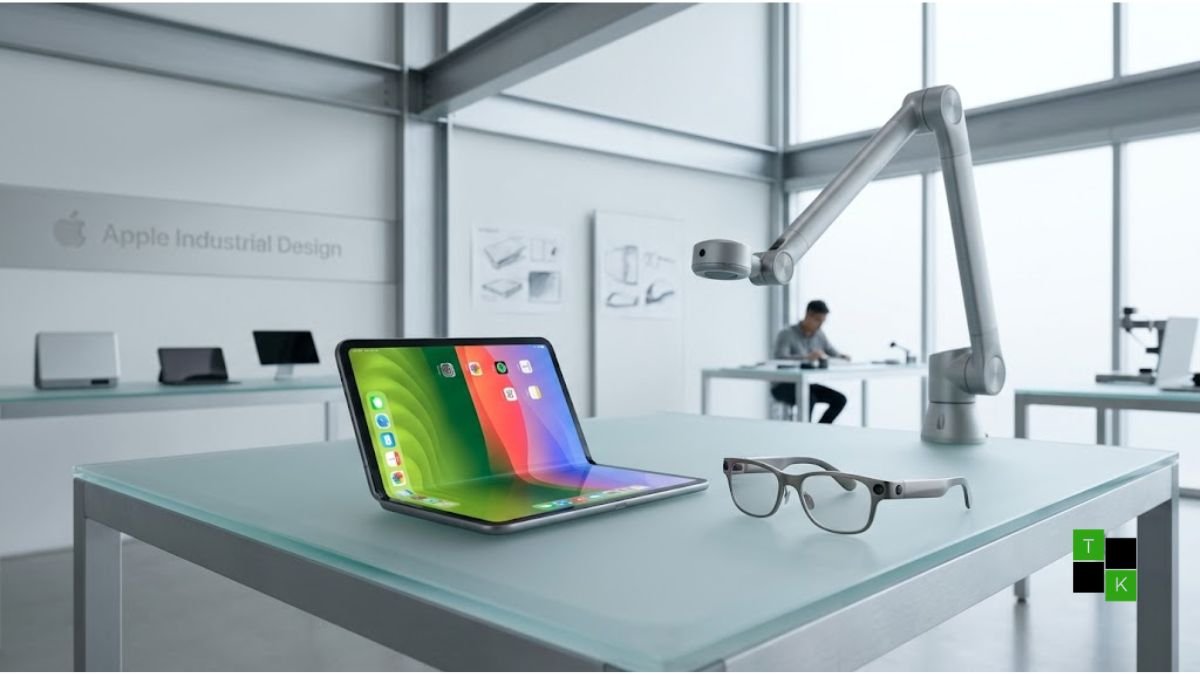
- 20.3-Inch Foldable MacBook Hybrid: According to Ming-Chi Kuo and Ross Young, Apple’s primary commercial foldable project with a finalized development schedule is a 20.3-inch foldable OLED notebook. When opened flat, the device operates as a 20-inch external creative canvas; when folded at 90 degrees, it operates as a full-size laptop with a virtual lower keyboard and haptic touch deck.
- Camera-Equipped AirPods: Apple plans to add low-resolution infrared computer vision sensors to AirPods. Designed not for photo capture but for spatial and environmental awareness, the sensors provide Visual Intelligence data directly to Siri, letting users query objects in their immediate line of sight.
- Display-Free Smart Glasses: To rival Meta’s Ray-Ban glasses, Apple is preparing lightweight audio glasses featuring frame-mounted cameras, speakers, and gesture microphones without an integrated display, projected to ship between 3 and 5 million units in its inaugural year.
Apple Hardware Roadmap: 2027 through 2029
| Hardware Category | 2027 Projected Rollout | 2028 Projected Rollout | 2029+ Long-Term Horizon |
| iPhone Series | 20th-Anniversary Redesign (Curved glass, 2nm A21) | Under-Display Camera (True Full-Screen Slab) | High-end flagships built on TSMC 1.4nm nodes |
| Foldable Devices | 20.3-inch Foldable MacBook/iPad Hybrid | Second-generation Foldable iPhone (“iPhone Ultra 2”) | Mainstream dual-screen convertible laptops |
| Wearables & XR | Camera AirPods; Display-less Smart Glasses | Waveguide XR Smart Glasses; Vision Air Headset | Standalone lightweight consumer AR spectacles |
| Home & Robotics | Tabletop Robot (“Pixar Lamp” with homeOS) | Dedicated Smart Home Command Hub & Security Cameras | Autonomous bipedal/wheeled domestic assistant |
| Mac & iPad | M7-generation Silicon (2nm); OLED MacBook Pro | OLED iPad mini & iPad Air transitions complete | M8 / M9 Mac computing lines with 1.4nm packaging |
2028: Micro-Waveguide XR Glasses, Vision Air, and Cutout-Free Displays
Entering 2028, Apple’s research and development shifts from camera-assisted audio wearables toward integrated spatial visual overlays and seamless display integration:
- Waveguide XR Smart Glasses: Moving past basic audio frames, Kuo reports that Apple is engineering color display glasses utilizing Liquid Crystal on Silicon (LCoS) with optical waveguides. This hardware will overlay turn-by-turn directions, notifications, and interactive AR interfaces directly into the wearer’s field of vision.
- Vision Air (Lightweight Headset): Serving as a lower-cost, consumer-accessible alternative to the Vision Pro, the “Vision Air” is scheduled for mass production to deliver an estimated 40% reduction in weight. It replaces heavy external aluminum and glass enclosures with engineered composites, operating on iPhone/Mac hybrid silicon.
- True Full-Screen iPhone (Under-Display Camera): Supply chain roadmaps from Samsung Display and LG Display project that Apple will transition both Face ID and the front-facing selfie camera beneath the active OLED matrix by 2028, eliminating dynamic islands and punch-holes entirely.
Smart Home & Robotics: The Tabletop AI Companion
Following the internal restructuring of its automotive vehicle initiative (Project Titan), Apple reassigned engineering personnel to personal and household robotics.
The centerpiece of this effort is a tabletop robotic device (codenamed J595), internally nicknamed the “Pixar Lamp”:
- Motorized Articulation: Features a 7-inch iPad-like display mounted on a multi-axis motorized robotic arm capable of rotating 360 degrees and tilting to maintain eye contact with whoever is speaking in a room.
- homeOS Platform: The robot runs an operating system codenamed “Charismatic,” engineered for multi-user household recognition and hands-free video conferencing.
- Personality-Driven Voice: Operates an LLM-based Siri engine capable of recognizing room context, offering schedule reminders, and visually orienting toward household members during natural conversations.
Semiconductor Trajectory: TSMC 2nm to 1.4nm Nodes
Apple’s hardware roadmap remains tightly synchronized with Taiwan Semiconductor Manufacturing Company (TSMC) fabrication milestones:
- 2027 (2nm Node – N2): Mass adoption of TSMC’s first-generation 2-nanometer gate-all-around (GAA) nanosheet transistors across the A21 Pro and M7 processor series.
- 2028-2029 (1.4nm Node – A14 Angstrom): Apple has reportedly secured premier allocation for TSMC’s upcoming 1.4-nanometer (A14) fabrication lines. Slated to debut on the A22 Pro and high-tier desktop workstation chips, the architecture is designed to handle local, trillion-parameter generative AI models directly on user devices without latency penalties.
🚨 Stay Updated with TopKhoj! 🚨
Get the latest tech news, deals, and exclusive offers first!
📰 Visit News Section📲 Join our Telegram Channel for real-time updates and best deals!
🔗 Join Telegram Now💡 Stay informed and never miss a great deal with TopKhoj!
⚠️ Disclaimer: Any link provided in the article related to a product or service will redirect you to our affiliate partner(s)' website, which are affiliate links. This means that if you make a purchase through these links, we may earn a commission at no extra cost to you. This commission helps support our blog and our work.
🔔 All prices mentioned above are subject to change based on current offers and availability on e-commerce platforms. Please check the latest price and product details on the product page before making a purchase.