Add TOPKHOJ on Google:
 Preferred Source
Indian consumers and crypto traders are increasingly spending stablecoins like Tether (USDT) on everyday groceries, fuel, electronics, and physical gold by routing transactions through offshore gift card platforms. By purchasing closed-loop Indian merchant vouchers from fintech entities registered in Sweden, Germany, and Singapore, users are bypassing domestic banking channels, mandatory 1% Tax Deducted at Source (TDS), and the 30% capital gains tax on Virtual Digital Assets (VDAs).
The cross-border arrangement has processed millions of digital vouchers, prompting intelligence units advising the Ministry of Finance and the Ministry of Home Affairs to review these payment pipelines for foreign exchange, anti-money laundering, and direct tax compliance.
30-Second TL;DR
- The Mechanism: Indian residents send USDT or other digital tokens from private, non-custodial wallets to foreign voucher platforms (such as Bitrefill or Coinsbee).
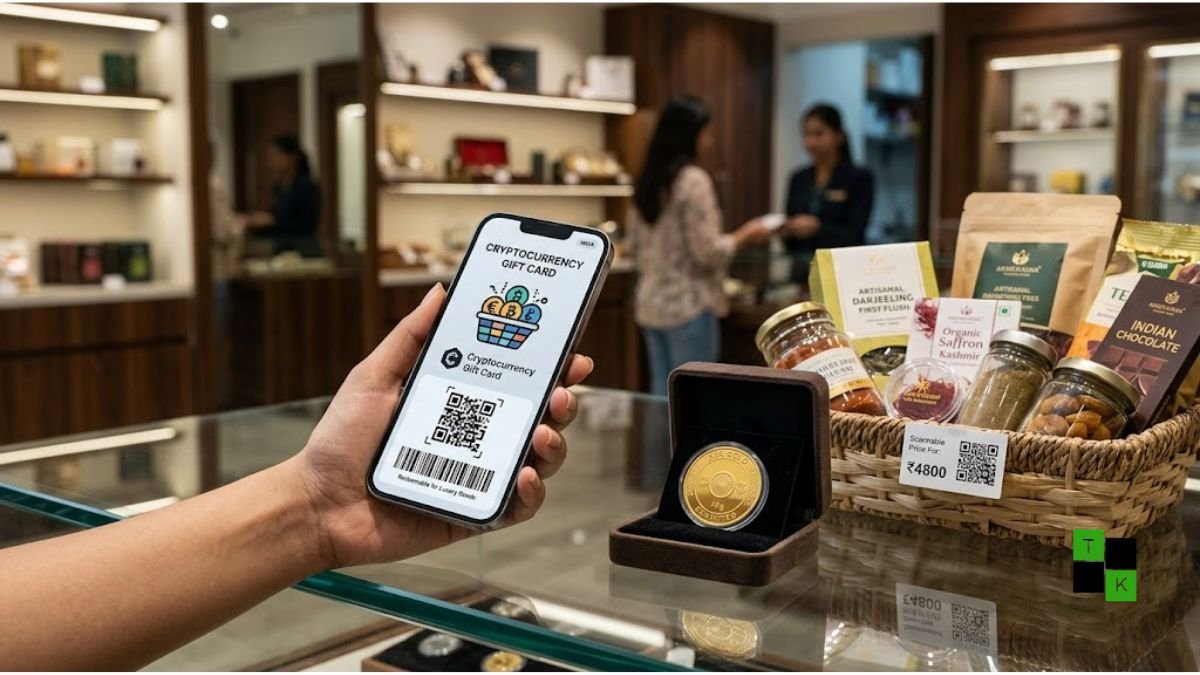
- Real-World Utility: These offshore platforms partner with domestic Indian aggregators to issue closed-loop digital gift cards redeemable at major retail chains, food delivery services, gas stations, and gold jewelers.
- Massive Volume: A single overseas platform has issued over 16 million gift cards to Indian consumers.
- The Exchange Spread: Users accept a steep discount-liquidating USDT at roughly ₹88 compared to domestic open-market rates above ₹95-to exit crypto holdings without triggering domestic bank alerts or tax reporting.
- Regulatory Scrutiny: Law enforcement advisors and the Ministry of Finance are scrutinizing the workflow under the Foreign Exchange Management Act (FEMA), Prevention of Money Laundering Act (PMLA), and Indian Income Tax regulations.
How the Cross-Border Crypto Voucher Pipeline Operates
The workflow connects decentralized non-custodial wallets with mainstream domestic retail storefronts through a cross-border loop:
- Non-Custodial Transfers: Users avoid domestic crypto exchanges subject to Financial Intelligence Unit (FIU-IND) oversight and KYC tracking. Instead, they transfer tokens like USDT directly from private un-hosted software or hardware wallets to foreign fintech services headquartered in jurisdictions like Sweden, Germany, or Singapore.
- Offshore Liquidation: The foreign platform receives the digital tokens and liquidates them on international crypto markets.
- Local Aggregator Settlement: The foreign company uses the fiat proceeds to settle accounts with corporate voucher aggregators and card issuing networks based in India.
- Instant Delivery: Digital voucher codes and redemption PINs are delivered instantly to the user via encrypted email or mobile apps, ready for immediate redemption at point-of-sale terminals or e-commerce checkouts.
The ₹88 Arbitrage: Why Traders Absorb Steep Conversion Discounts
Under normal market conditions, liquidating foreign currency or digital dollars at a discount represents an economic loss. In India’s crypto landscape, however, users actively accept below-market rates:
- The Domestic Baseline: On compliant Indian exchanges and peer-to-peer (P2P) desks, USDT typically trades at a premium between ₹91 and ₹96.
- The Offshore Card Rate: Major international gift-card portals price redemption rates at approximately ₹88 per USDT.
- The Tax Offset: Despite giving up 7% to 8% in platform margin, users avoid the mandatory 30% flat capital gains tax, the 1% TDS under Section 194S, and the risk of bank accounts being frozen during disputed P2P transactions. For individuals with undisclosed crypto earnings, the margin taken by the offshore portal functions as an acceptable convenience discount to access consumer purchasing power.
Domestic Banking Route vs. Overseas Crypto Gift-Card Pathway
| Comparison Metric | Regulated Domestic Crypto Exit | Offshore Crypto Gift-Card Channel |
| Wallet Mechanism | KYC-Compliant FIU Registered Exchange | Non-Custodial / Private Web3 Wallet |
| Tax Compliance | Flat 30% Tax + Surcharge + 1% TDS | Untracked; Escapes Form 26AS & AIS |
| USDT Realization Rate | ~₹93 to ₹96 per USDT | ~₹88 per USDT (Platform Spread) |
| Audit & Banking Trail | Domestic Bank Account IMPS/NEFT Records | Zero Domestic Banking Records |
| Settlement Output | Direct Indian Rupee (INR) Bank Deposit | Closed-Loop Brand Vouchers & Gift Cards |
| Eligible Spending | Unrestricted Liquid Fiat Currency | Groceries, Fuel, Fashion, Electronics, Gold |
| Regulatory Risk | Fully Compliant under Income Tax Framework | Under Review: FEMA, PMLA & Tax Evasion |
Closed-Loop Cards: Exploiting Gaps in RBI Regulations
The widespread adoption of this model relies on the regulatory status of closed-loop prepaid instruments (PPIs):
- Exemption from PPI Directives: Under Reserve Bank of India guidelines, closed-loop gift vouchers issued by a specific retail brand (such as a supermarket chain, jewelry outlet, or fuel retailer) can only be redeemed for goods at that merchant’s own facilities. Because they cannot be used for third-party fund transfers or automated teller cash withdrawals, they do not face the strict spending caps or full-KYC thresholds applied to open-loop instruments like debit cards.
- Secondary Transfers: Gift card codes and digital alphanumeric pins can be forwarded or gifted without identity verification, creating a secondary transfer chain that complicates transaction tracking.
Legal and Regulatory Repercussions: FEMA and AML Oversight
The emergence of crypto-funded closed-loop vouchers has raised compliance concerns across legal and policy bodies:
- Foreign Exchange Concerns (FEMA): Legal experts emphasize that India enforces strict foreign exchange controls governing cross-border trade settlements. Using digital assets to settle domestic consumption through foreign corporate entities creates an unmonitored economic loop operating outside authorized banking channels.
- Anti-Money Laundering Framework (PMLA): Digital forensic firms advising government bodies have warned that these payment rails could be used to convert proceeds from cyber fraud, ransomware, or untaxed freelancing into physical assets like gold and jewelry.
- Policy Outlook: Regulatory authorities and finance officials are evaluating potential disclosure requirements for domestic voucher aggregators, including rules mandating tracking and reporting the corporate sources of bulk purchases backed by offshore entities.
🚨 Stay Updated with TopKhoj! 🚨
Get the latest tech news, deals, and exclusive offers first!
📰 Visit News Section📲 Join our Telegram Channel for real-time updates and best deals!
🔗 Join Telegram Now💡 Stay informed and never miss a great deal with TopKhoj!
⚠️ Disclaimer: Any link provided in the article related to a product or service will redirect you to our affiliate partner(s)' website, which are affiliate links. This means that if you make a purchase through these links, we may earn a commission at no extra cost to you. This commission helps support our blog and our work.
🔔 All prices mentioned above are subject to change based on current offers and availability on e-commerce platforms. Please check the latest price and product details on the product page before making a purchase.