Add TOPKHOJ as a Preferred Source on Google
In a rare alignment between two technology giants whose platforms have frequently competed over digital privacy and app ecosystem economics, Meta and Apple have joined forces to release Muse Spark Open.
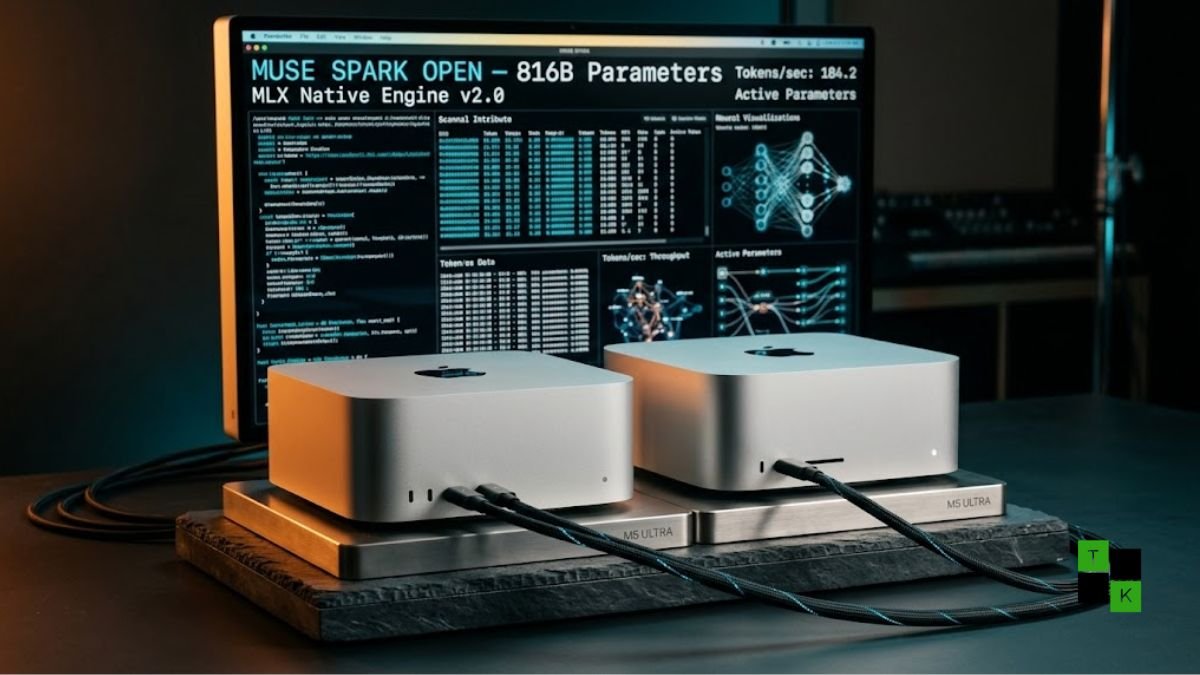
Marking the companies’ first public technical partnership since 2017, the release delivers an 816-billion-parameter open-weights foundation model equipped with a massive 1-million-token context window. Co-engineered to process and synthesize across text, high-resolution imagery, video, and audio streams, Muse Spark Open is fine-tuned specifically for local deployment on Apple Silicon. Leveraging Apple’s open-source MLX machine learning framework, the model is architected to run across interconnected M5 Ultra Mac Studio desktops-effectively clustering multiple workstations into a cohesive local supercomputer with up to 1 terabyte (1TB) of shared unified memory.
Now available for download on Hugging Face and companion model repositories under a limited commercial open-source license, Muse Spark Open establishes a new frontier for localized research, topping prominent developer benchmarks including a record 61.8 on JobBench and outperforming competitive Chinese and Western architectures such as GLM 5.3.
The Silicon Architecture: Turning Linked Mac Studios into a 1TB Supercomputer
Running an 816-billion-parameter multimodal model locally has traditionally required specialized server racks packed with enterprise Nvidia H100 or B200 GPUs-hardware that is both prohibitively expensive and power-constrained for research labs and independent studios. Apple and Meta have bypassed this infrastructure bottleneck through memory unification:
- Apple MLX Engine Optimization: Apple’s machine learning research team worked directly alongside Meta’s AI engineers to write dedicated kernel primitives for MLX, Apple’s open-source array framework tailored specifically for Apple Silicon. MLX enables zero-copy memory operations between unified CPU and GPU cores, preventing data transmission bottlenecks.
- M5 Ultra Interconnect & Node Linking: By linking multiple M5 Ultra Mac Studio systems over high-bandwidth Thunderbolt 5 and low-latency optical interconnects, the hardware functions as a single distributed node.
- 1 Terabyte Unified Memory Pool: Clustered configurations pool up to 1TB of high-speed Unified Memory (UMA). Because Apple Silicon shares memory across the entire chip architecture, the 816B model weights, activation caches, and 1-million-token KV (key-value) buffers reside entirely within local RAM, achieving high token-generation speeds without relying on enterprise cloud datacenters.
1-Million-Token Context & Native Multimodal Ingestion
Muse Spark Open is built from the ground up to handle complex, heterogeneous data types simultaneously rather than relying on external adapter layers:
- Native Multimodal Synthesis: The model processes text, still photographs, multi-minute video sequences, and raw multi-channel audio natively within a single latent space. It can transcribe dialogue, analyze screen recording video frames, cross-reference source code, and output fully refactored software projects without separate sub-models.
- 1-Million-Token Window: With support for up to 1,000,000 active tokens, Muse Spark Open can ingest entire software codebases, comprehensive technical manuals, or hours of video footage in a single prompt session, maintaining long-horizon memory consistency throughout multi-hour workflows.
- Long-Task Autonomous Problem Solving: The model is optimized for long-duration task planning, breaking down ambiguous instructions (e.g., “Audit this repository for race conditions, generate unit tests, and document the API changes in Markdown”) into discrete, self-verifying operational steps.
Benchmark Supremacy: JobBench Leader & Outperforming GLM 5.3
In comprehensive independent evaluations, Muse Spark Open demonstrates state-of-the-art proficiency across programming and agentic workflows:
- JobBench Record (61.8): On JobBench-the industry-standard benchmark designed to evaluate autonomous model execution on complex, multi-step workplace tasks-Muse Spark Open scored 61.8, eclipsing previous open-weights records and matching top-tier proprietary models.
- Outperforming GLM 5.3: The architecture outpaces Zhipu AI’s flagship GLM 5.3, particularly in code refactoring, mathematical reasoning, and temporal video comprehension.
- Latency on Local Hardware: When running on a dual M5 Ultra cluster (1TB configuration) with 4-bit and 8-bit quantization profiles, the model delivers real-time generation speeds suitable for interactive developer pair-programming.
Model Comparison: Muse Spark Open vs. Leading Open & Frontier Architectures
| Technical Metric | Meta / Apple Muse Spark Open | Zhipu AI GLM 5.3 | Meta Llama 3.3 (70B) | Frontier Cloud Equivalents |
| Total Parameter Count | 816 Billion Parameters | ~400B – 600B Mixture | 70 Billion Parameters | 1T+ Dense/MoE (Proprietary) |
| Context Window Length | 1,000,000 Tokens (1M) | 128,000 – 200,000 Tokens | 128,000 Tokens | 1M – 2M Tokens |
| Supported Modalities | Text, Image, Video, Audio | Text, Code, Image | Text & Code Primary | Multimodal (Omni Suites) |
| JobBench Score | 61.8 (Category Leader) | 56.4 | 48.2 | 60.5 – 63.0 |
| Silicon Optimization | Apple MLX Native (M-Series) | CUDA / ROCm Primary | CUDA, ROCm, MLX | Proprietary Cloud TPU / GPU |
| Hardware Footprint | Linked M5 Ultra Studios (1TB) | Multi-GPU Server (H100/A100) | Single High-End Workstation | Cloud API Exclusive |
| Open Weights Access | Yes (Hugging Face) | Selective Open Weights | Yes (Llama Community) | No (Closed Commercial API) |
| Licensing Framework | Limited Commercial License | Enterprise Commercial | Broad Llama 3.3 License | Commercial SaaS / Per-Token |
Licensing Terms: Open Weights via Hugging Face
Meta and Apple have structured the release to encourage widespread research while protecting enterprise boundaries:
- Open-Weights Distribution: Model checkpoints, quantized weights (GGUF, MLX-native formats), and inference pipelines are immediately available for download via Hugging Face, GitHub, and the Apple Machine Learning Research portal.
- Limited Commercial License: Free access is granted for academic research, personal development, and commercial deployments up to a specified monthly revenue threshold. High-volume enterprise entities exceeding commercial thresholds must obtain an enterprise commercial distribution waiver directly from Meta.
- Reproducibility Code: Apple has open-sourced the underlying multi-node orchestration scripts on GitHub, allowing developers to set up their own local Mac Studio compute clusters with minimal command-line configuration.
Strategic Significance: A Landmark Truce Between Meta and Apple
The release of Muse Spark Open carries profound implications for the global AI ecosystem:
- A Thawing of Silicon Valley Rivalries: Since Apple’s 2021 App Tracking Transparency (ATT) privacy rollout dealt a major blow to Meta’s mobile ad tracking, relations between Menlo Park and Cupertino have remained cool. Partnering on their first public technical product since 2017 highlights that open-source AI and alternative compute platforms present common strategic ground.
- Apple Silicon as an Enterprise AI Contender: For Apple, co-branding the launch validates MLX and Apple Silicon as serious contenders in high-performance machine learning. By showing that linked consumer-pro Mac Studios can run frontier-class 816B models locally, Apple directly challenges the assumption that cutting-edge AI must remain tethered to enterprise cloud servers.
- Decentralized AI Independence: For Meta, the partnership diversifies distribution beyond Nvidia-dominated cloud clusters, giving millions of software developers and enterprise creators the ability to run capable, private, and unmoderated foundational intelligence on local office hardware.
Getting Started
Developers and machine-learning researchers can begin experimenting with Muse Spark Open today:
- Download Weights: Available on Hugging Face at
meta-models/Muse-Spark-Open-816B-A42Bwith dedicated model cards for MLX, PyTorch, and quantized inference runtimes. - System Requirements: For full 816B parameter inference, a clustered setup of two or more Apple M5 Ultra Mac Studios (or systems totaling at least 512GB to 1TB of Unified Memory) is recommended; quantized 4-bit configurations can execute across smaller unified memory pools with reduced context windows.
🚨 Stay Updated with TopKhoj! 🚨
Get the latest tech news, deals, and exclusive offers first!
📰 Visit News Section📲 Join our Telegram Channel for real-time updates and best deals!
🔗 Join Telegram Now💡 Stay informed and never miss a great deal with TopKhoj!
⚠️ Disclaimer: Any link provided in the article related to a product or service will redirect you to our affiliate partner(s)' website, which are affiliate links. This means that if you make a purchase through these links, we may earn a commission at no extra cost to you. This commission helps support our blog and our work.
🔔 All prices mentioned above are subject to change based on current offers and availability on e-commerce platforms. Please check the latest price and product details on the product page before making a purchase.