
Add TOPKHOJ on Google:
 Preferred Source
Following the summer debut of its Pro and Pro Max siblings, Xiaomi is expanding its flagship performance family with the official arrival of the Redmi K100 standard edition. Formally locked in for launch in China on October 27, 2026, at 7:00 PM CST (4:30 PM IST), the vanilla model charts a distinct, battery-centric hardware strategy rather than simply acting as a stripped-down alternative.
While the earlier K100 Pro models prioritized smaller footprints or camera sensors, the standard K100 tackles battery anxiety head-on.
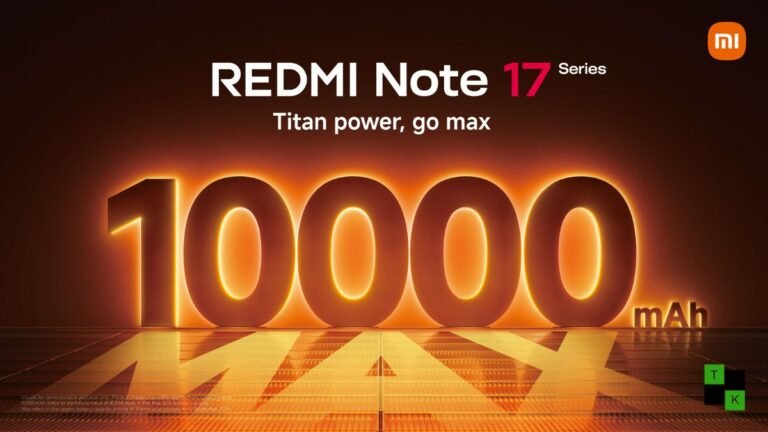
The headline feature of the Redmi K100 standard edition is an enormous 10,000mAh silicon-carbon battery-the largest cell ever fitted inside a Redmi device-paired with 100W wired fast charging.
Combined with Qualcomm’s 3nm Snapdragon 8 Elite platform, a dedicated D2 display and gaming processor, an expansive 6.83-inch 165Hz flat AMOLED display, and dual stereo speakers co-engineered with Bose, the phone is engineered for sustained gaming marathons.
Expected to debut at an aggressive starting price around 3,499 to 3,599 CNY (~$490 / ~₹41,000 – ₹43,000), it also establishes the direct hardware template for the upcoming global and Indian POCO F9.
Battery Milestone: 10,000mAh Silicon-Carbon Chemistry
While competing performance flagships have hovered between 6,000mAh and 8,000mAh, the standard Redmi K100 breaks into five-figure capacity:
- 10,000mAh Silicon-Carbon (Si/C) Cell: By utilizing high-density silicon-carbon anode chemistry, Xiaomi has integrated a true 10,000mAh battery pack without ballooning the device into an unwieldy brick. Real-world simulations indicate up to 18 to 22 hours of continuous high-refresh gaming or up to three full days of standard mixed usage on a single charge.
- 100W Wired Fast Charging: Certified under model number M786BC via China’s 3C regulatory body, the phone supports 100W wired charging, replenishing the massive cell to full capacity in approximately 45 to 50 minutes.
- 27W Reverse Wired Power Delivery: The large pack doubles as an emergency power bank, capable of outputting up to 27W wired reverse charging to top up accessories, smartwatches, or a friend’s phone over USB-C.
- Hardware Charge-Bypass: Designed with competitive players in mind, the power management controller can route wall power directly to the motherboard during extended gaming sessions, keeping the battery cell cool and preserving long-term cycle health.
Esports Visuals: 6.83-Inch 165Hz Flat AMOLED
Touch precision and visual speed are central to the K100’s front panel design:
- Flat 6.83-Inch AMOLED Canvas: The phone avoids curved display edges that induce accidental palm inputs during matches. The flat panel delivers a 1.5K resolution (2510 × 1156 pixels, ~405 PPI) with 68 billion colors and Dolby Vision playback.
- 165Hz Refresh Rate & D2 Coprocessor: The screen natively clocks up to 165Hz. It is augmented by Xiaomi’s in-house D2 dedicated graphics and display chip, which handles real-time frame interpolation and Super-Resolution rendering to maintain stable frame rates with lower GPU overhead.
- 3,500 Nits Peak & Low-Flicker Dimming: Visuals hit up to 3,500 nits peak HDR brightness, supported by 2,560Hz high-frequency PWM dimming to minimize visual strain during late-night gaming sessions.
- 3,500Hz Instant Touch Response: The digitizer tracks inputs with a 480Hz multi-finger touch reporting rate and an instantaneous touch sampling ceiling of 3,500Hz, ensuring virtually zero latency when triggering on-screen fire buttons.
Processing Silicon & Bose Audio Engineering
Rather than jumping to the higher-cost next-generation tiers used on the Pro models, the vanilla K100 balances sustained power and cost efficiency:
- Qualcomm Snapdragon 8 Elite (3nm): Powered by Qualcomm’s 3nm Snapdragon 8 Elite (SM8750-AB) processor, featuring custom Oryon V2 Phoenix CPU cores clocked up to 4.32 GHz and the Adreno 840 GPU. Because the thermal profile of this chip is thoroughly understood, Xiaomi has tuned the platform for maximum clock stability without aggressive throttling.
- Dual Stereo Speakers Tuned by Bose: Moving away from standard generic audio tuners, the Redmi K100 debuts dual symmetrical stereo speakers co-engineered with Bose. The acoustic chambers provide improved bass response, wide spatial staging for competitive footstep cues, and Hi-Res wireless audio certification over LHDC 5.0.
- Memory & Storage: Configurations will range from 12GB or 16GB of LPDDR5X RAM paired with 256GB or 512GB of high-speed UFS 4.0/4.1 storage.
Optics & Industrial Build: Dual 50MP Array in Firefly Green
To hit its price target and accommodate the 10,000mAh battery, Xiaomi streamlined the optical suite:
- 50MP “Light & Shadow Hunter 800” Main Camera: The primary shooter utilizes a 1/1.55-inch 50-megapixel sensor with an f/1.68 aperture, Phase Detection Autofocus (PDAF), and Optical Image Stabilization (OIS). It delivers clean dynamic range and fast shutter response for everyday snapshots.
- 8MP Ultra-Wide Angle Lens: Secondary duties are handled by an 8MP ultra-wide sensor (f/2.2, 120° FOV). Unlike the K100 Pro Max, the standard model omits a periscope telephoto lens; zoom relies on in-sensor digital crop. A 20MP front camera handles streaming and video calls.
- Firefly Green & IP68 Sealing: Officially showcased in a signature Firefly Green finish with an anodized aluminum frame, the phone incorporates an under-display ultrasonic fingerprint sensor and an official IP68 dust- and water-resistance rating.
- HyperOS 4 & Super XiaoAi 2.0: Out of the box, the handset runs HyperOS 4 based on Android 17, featuring on-device AI scheduling, live gaming performance overlays, and deep interconnectivity across Xiaomi ecosystem products.
Redmi K100 vs. Redmi K100 Pro vs. OnePlus Ace 7
| Feature Dimension | Redmi K100 (Standard Edition) | Redmi K100 Pro (Mid-Tier) | OnePlus Ace 7 (Competitor) |
| Launch Date | October 27, 2026 (7:00 PM CST) | August 11, 2026 (China) | October 29, 2026 (China) |
| Battery Capacity | 10,000mAh Silicon-Carbon Cell | 8,580mAh Silicon-Carbon | 9,000mAh Silicon-Carbon |
| Wired Fast Charging | 100W Wired Fast Charging | 100W Wired + 50W Wireless | 120W SuperVOOC Wired |
| Primary Processor | Snapdragon 8 Elite (3nm) | Snapdragon 8 Elite Gen 5 V-Series | Snapdragon 8 Elite Gen 5 V-Series |
| Display Panel | 6.83″ Flat 1.5K AMOLED | ~6.6″ 1.5K Flat OLED | 6.78″ Flat 1.5K LTPO OLED |
| Refresh Rate | 165Hz High Fluidity | 185Hz Refresh Rate | 185Hz Refresh Rate |
| Display Coprocessor | Xiaomi D2 Dedicated Gaming Chip | D2 Gaming Chip | Integrated Display Driver |
| Acoustic Hardware | Dual Speakers Tuned by Bose | Stereo Speakers | Dual Stereo Speakers |
| Rear Main Camera | 50MP Light Hunter 800 (OIS) | 50MP Main (1/1.3″, OIS) | 200MP Wide (f/1.8, OIS) |
| Telephoto Module | Omitted (Digital Crop) | 50MP Telephoto Lens | Omitted (Digital In-Sensor Crop) |
| Cooling Method | Expansive 3D Vapor Chamber | 3D Vapor Chamber | Active Dual-Airflow Fan |
| Operating System | HyperOS 4 (Android 17) | HyperOS 3 / 4 | ColorOS 17 (Android 17) |
| Expected Price (CN) | ~3,499 CNY (~$490 / ~₹41,000) | Starting 3,699 CNY (~$520) | ~2,799 CNY (~$415 / ~₹36,990) |
| Global Rebrand | POCO F9 | POCO F9 Pro | OnePlus 16R |
Buying Verdict & Global POCO F9 Outlook
With advance reservations already open in China ahead of the October 27 showcase:
- The Battery-First Value Proposition: By equipping the standard edition with a 10,000mAh battery-larger than either the K100 Pro (8,580mAh) or the K100 Pro Max (9,070mAh)-Xiaomi has given the entry-tier model a distinct selling point. For mobile gamers and heavy media consumers, the massive battery makes it an appealing endurance option.
- The Trade-Offs: To deliver a 10,000mAh battery and a 165Hz display under $500, Xiaomi made calculated concessions: there is no wireless charging, the camera array is a basic dual-sensor setup without a dedicated telephoto zoom lens, and it runs the established Snapdragon 8 Elite rather than the newly minted Gen 5 silicon.
- The Global POCO Transition: For international and Indian shoppers, the standard K100 is expected to serve as the hardware template for the POCO F9 in early 2027. If POCO retains the 10,000mAh cell and 165Hz display in the sub-₹40,000 segment, it could become a strong contender in the budget performance category.
The Redmi K100 standard edition demonstrates that high-end smartphones don’t need to be delicate devices requiring multiple daily recharges. By prioritizing a 10,000mAh battery and a 165Hz display, Xiaomi has engineered a phone built for pure endurance.
🚨 Stay Updated with TopKhoj! 🚨
Get the latest tech news, deals, and exclusive offers first!
📰 Visit News Section📲 Join our Telegram Channel for real-time updates and best deals!
🔗 Join Telegram Now💡 Stay informed and never miss a great deal with TopKhoj!
⚠️ Disclaimer: Any link provided in the article related to a product or service will redirect you to our affiliate partner(s)' website, which are affiliate links. This means that if you make a purchase through these links, we may earn a commission at no extra cost to you. This commission helps support our blog and our work.
🔔 All prices mentioned above are subject to change based on current offers and availability on e-commerce platforms. Please check the latest price and product details on the product page before making a purchase.