Add TOPKHOJ on Google:
 Preferred Source
India has transformed itself from a net importer of consumer gadgets into the world’s second-largest smartphone manufacturer over the past decade. However, the vast majority of that output has relied on contract assembly for foreign brands like Apple, Samsung, and Xiaomi. Now, the Indian government has established an explicit timeline to break out of the contract manufacturing tier.
Speaking at the NDTV World Summit in New Delhi on October 23, 2026, Union Minister for Electronics and Information Technology Ashwini Vaishnaw set a direct two-year deadline for the country’s consumer tech sector:
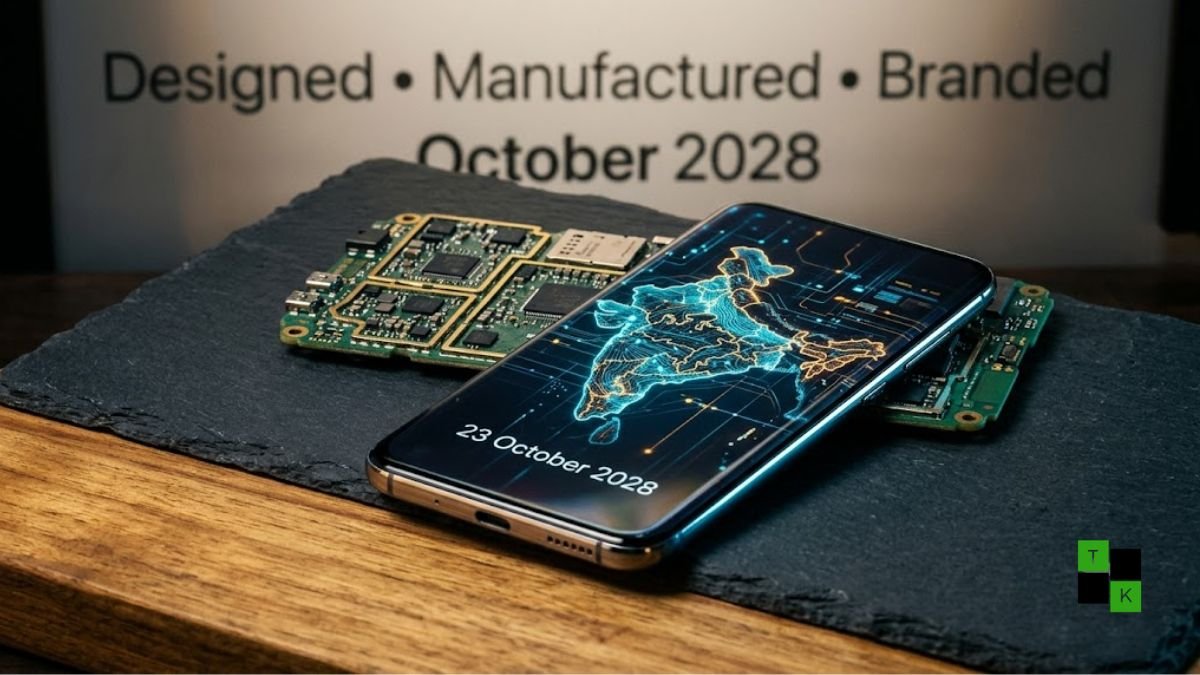
“This is 23 October 2026. Please note it: 23 October 2028. You will have Indian-designed, Indian-manufactured, Indian-branded mobile phones.”
Characterizing the mission as India’s upcoming “Apple and Samsung moment,” the minister outlined a high-stakes transition from surface-mount assembly (SMT) and screwdriver packaging to domestic intellectual property (IP), motherboard design, radio-frequency engineering, and global retail branding.
The Core Problem: Assembly Without Intellectual Property
To understand why Vaishnaw’s October 2028 declaration marks a strategic pivot, consider where value is captured in consumer hardware:
- The Low-Margin Assembly Trap: Through the Production-Linked Incentive (PLI) scheme, India has turned electronics into its third-largest national export, churning out tens of millions of iPhones and Android smartphones annually. However, traditional assembly-level value addition in India typically hovers around 15% to 22%.
- The High-Value IP Gap: The remaining 75% to 85% of profit and intellectual property-spanning industrial design, baseband processor integration, operating system software, camera tuning algorithms, and brand markup-flows back to Cupertino, Seoul, and Shenzhen.
- The 2028 Three-Part Standard: Vaishnaw’s framework demands three simultaneous criteria:
- Indian-Designed: The complex Printed Circuit Board Assembly (PCBA), thermal dissipation arrays, antenna architecture, and chassis integration must be engineered domestically.
- Indian-Manufactured: Physical component fabrication, PCB surface mounting, and structural unibody assembly must happen in domestic facilities.
- Indian-Branded: The consumer-facing logo, intellectual property rights, operating revenue, and supply-chain profits must belong to an Indian corporate entity.
Early Successes: Domestic Motherboards and U.S. Exports
The 2028 ambition is not starting from zero. Vaishnaw revealed that the Ministry of Electronics and Information Technology (MeitY) launched a targeted hardware challenge approximately three and a half years ago to test local engineering capabilities:
- The PCBA Challenge: Government agencies challenged domestic engineering firms to design complete smartphone motherboard layouts from scratch-a hurdle that historically stumped Indian electronics firms in the 2010s.
- Two Companies Break Through: Two Indian domestic enterprises have successfully designed complex, multi-layer smartphone motherboard systems that match international standards.
- Supplying American 5G Networks: One Indian hardware firm has already designed, integrated, and supplied a fully functional 5G smartphone to a major tier-one telecommunications carrier in the United States, proving that domestic hardware design can clear Western carrier certification and regulatory testing.
- Market Share Rebound: After domestic brands like Micromax, Intex, and Karbonn were nearly wiped out by predatory pricing in 2017–2018, Indian smartphone makers (spearheaded by Lava’s turnaround) have rebuilt their domestic market share to 7%-the highest level recorded since 2018.
The Structural Challenges of the 24-Month Clock
While the political commitment is clear, taking on global flagships within 24 months involves serious technical and economic hurdles:
- RF and Component Packaging: As Vaishnaw acknowledged, a smartphone is one of the most densely packed engineering objects ever built. cramming 5G radio frequency front-end modules, dynamic antennas, camera ISP modules, silicon-carbon battery packs, and high-frequency power management ICs into an 8mm chassis requires years of specialized validation.
- The Semiconductor Timeline: India’s domestic semiconductor fabs (such as Tata Electronics’ Dholera facility and CG Semi’s Sanand packaging plant) are currently under construction or in early equipment trial phases. By October 2028, bleeding-edge 2nm or 3nm application processors will still need to be sourced from global foundries like TSMC or Samsung Foundry. Policy support will likely define “Indian-designed” around system architecture, board-level IP, and firmware integration rather than requiring 100% domestic silicon at launch.
- Software Ecosystem & Trust: A smartphone is only as reliable as its operating system. Competing with iOS or Google-backed Android skins (One UI, ColorOS) requires long-term software commitments-such as 5 to 7 years of bi-monthly security patches, rapid bug resolution, and developer relations-an area where previous Indian brands struggled.
India’s Mobile Manufacturing Evolution: Assembly vs. The 2028 Blueprint
| Parameter | Era 1: Complete Import (Pre-2015) | Era 2: PLI Assembly (2020–2026) | Era 3: Full Domestic IP (October 2028 Target) |
| Manufacturing Model | CBU Import (Finished Box Units) | Semi-Knocked Down (SKD) / PCBA SMT | End-to-End Domestic ODM / OEM Design |
| Local Value Addition | 2% – 5% (Packaging & Warehousing) | ~15% – 22% (Assembly & Testing) | 45% – 60%+ (Domestic Design, Chassis, Pack) |
| Hardware IP Ownership | Foreign Multinational | Foreign Multinational (Apple/BBK/Samsung) | Indian Corporate Entity / Domestic IP |
| Board Engineering (PCBA) | Imported Assembled from China/Taiwan | Surface Mounted in India on Foreign Schematics | Indian-Engineered Motherboard Layout |
| Export Status | Minimal / Consumer Inflow | 3rd Largest Export Category ($15B+) | High-Value Product & Brand Exports |
| Primary Market Focus | Cheap Feature Phones / Rebadged White-Label | Sub-₹20K Midrangers & Contract Flagships | Competitive Mass Mid-Tier to Halo Flagships |
Strategic Roadmap: How India Reaches October 23, 2028
Industry analysts expect the Ministry to deploy a phased roadmap over the next 24 months:
- A Shift from PLI to Design-Linked Incentives (DLI): Just as the original PLI scheme subsidized factory machinery and factory throughput, an expanded DLI framework will provide financial grants for local hardware engineering, chip tape-outs, and antenna patent filings.
- Targeting the Upper Mid-Range First: Rather than attempting to challenge an iPhone Pro Max or Galaxy Ultra out of the gate, the first wave of 2028 commercial products will likely target the ₹25,000 to ₹40,000 “performance flagship” segment. This price bracket allows Indian brands to provide high-refresh OLEDs and large silicon-carbon batteries while managing silicon costs.
- Consortium Model: Industry observers predict that domestic manufacturing giants (such as Dixon Technologies, Tata Electronics, or Lava International) may form joint product ventures with domestic design startups to share financial and R&D risk ahead of 2028.
Vaishnaw’s announcement provides a clear benchmark for India’s consumer technology ambitions. By committing to October 23, 2028, the government has invited industry observers and consumers to measure whether India can evolve from building other nations’ flagships into establishing a globally recognized technology brand of its own.
🚨 Stay Updated with TopKhoj! 🚨
Get the latest tech news, deals, and exclusive offers first!
📰 Visit News Section📲 Join our Telegram Channel for real-time updates and best deals!
🔗 Join Telegram Now💡 Stay informed and never miss a great deal with TopKhoj!
⚠️ Disclaimer: Any link provided in the article related to a product or service will redirect you to our affiliate partner(s)' website, which are affiliate links. This means that if you make a purchase through these links, we may earn a commission at no extra cost to you. This commission helps support our blog and our work.
🔔 All prices mentioned above are subject to change based on current offers and availability on e-commerce platforms. Please check the latest price and product details on the product page before making a purchase.