Add TOPKHOJ as a Preferred Source on Google
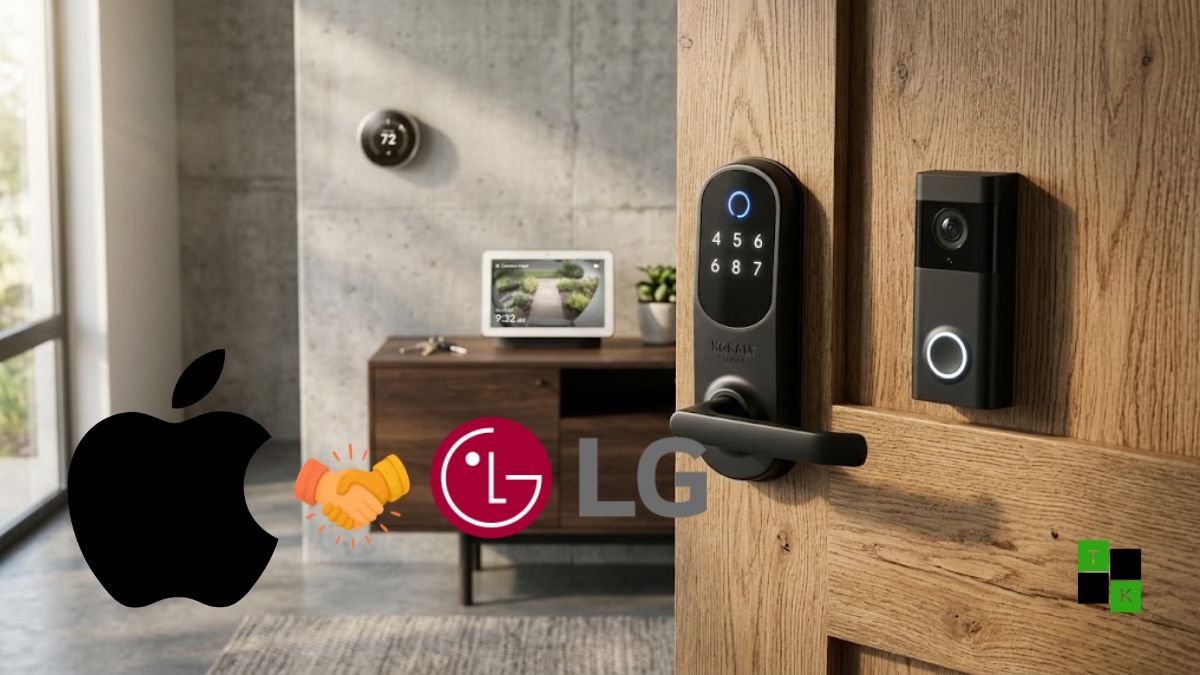
In an unexpected shift in its hardware playbook, Apple has partnered with South Korean electronics giant LG Electronics to co-develop a dedicated lineup of smart home accessories. According to industry reports from Bloomberg, the joint pipeline spans seven connected home devices, including a video doorbell, a smart deadbolt lock, a smart thermostat, a room temperature sensor, and three specialized security cameras (indoor, outdoor, and floodlight).
While the accessories are slated to carry LG branding and be manufactured and serviced by LG, they are being co-engineered by Apple to integrate deeply with Cupertino’s upcoming smart home display hub (often dubbed “HomePad”), an upgraded HomePod mini, and a refreshed Apple TV 4K set for introduction on October 13, 2026.
This alliance marks Apple’s most aggressive move to date to capture the modern living space. Below is an examination of what these co-developed devices offer, the strategic reasons driving Apple’s partnership with LG, and an analysis of the primary rivals Apple must confront to dominate the smart home.
The Co-Developed Lineup: 7 Core Smart Home Devices
Rather than releasing isolated accessories, Apple and LG have architected an interconnected hardware foundation for the connected household:
- Smart Video Doorbell: Features high-resolution video capture, package detection, and end-to-end encrypted streaming via HomeKit Secure Video.
- Smart Deadbolt Lock with Ultra-Wideband (UWB): Incorporates an Apple UWB chip alongside NFC Express Mode, enabling hands-free, proximity-based automatic unlocking as an iPhone or Apple Watch approaches the front door.
- Smart Climate Thermostat: Designed with intuitive touch dials, smart HVAC scheduling, and cross-platform temperature coordination.
- Wireless Room Temperature Sensor: A discrete puck sensor that monitors regional room temperature and humidity, dynamically feeding data into the central thermostat.
- Indoor Security Camera: Offers on-device spatial presence detection, automated privacy shutters, and local facial recognition.
- Outdoor Weatherproof Camera: Features high-durability ingress sealing, color night vision, and vehicle/pet detection.
- Outdoor Floodlight Camera: High-lumen dual floodlights integrated with an intelligent perimeter security camera.
All devices are engineered around Matter over Thread and Wi-Fi, ensuring cross-platform interoperability while prioritizing Apple HomeKit, Apple Intelligence, and Siri voice workflows.
Why Is Apple Partnering with LG? (Strategic Rationale)
For a company famous for its vertically integrated “walled garden”-controlling every screw, chip, and line of code-partnering with a third-party manufacturer like LG raises an obvious question: Why didn’t Apple build these accessories entirely in-house under the Apple logo?
1. The “Second-Party” Playbook: Scaling Without Overhead
Developing smart home peripherals involves complex physical logistics. Thermostats require compatibility with hundreds of legacy 24V HVAC furnace configurations. Smart locks demand mechanical calibration across varied door jamb thicknesses, weatherstripping, and ANSI Grade-1 deadbolt standards. Floodlights require high-voltage line-wire installations.
By using a second-party supplier model-a strategy Apple previously executed with LG UltraFine monitors for Mac, Belkin MagSafe docks, and Logitech iPad styluses-Apple offloads manufacturing, electrical certification, liability, and hardware support to LG. Apple shapes the industrial design, dictates firmware security, and tunes software protocols without burdening its own balance sheet with low-margin physical accessory warranties.
2. Immediate Ecosystem Parity for the October 13 Home Hub
Apple is preparing to launch its long-rumored smart home command center (a tabletop/wall-mounted display hub with an iMac G4-inspired arm, running a dedicated homeOS platform). A smart display is only as useful as the ecosystem it commands. By partnering with LG, Apple can launch its hub into an ecosystem populated by certified, co-engineered cameras, locks, and climate systems on day one, avoiding the slow, fragmented third-party adoption that plagued the early years of HomeKit.
3. LG’s Appliance Dominance and the “Homey” Acquisition
LG is not just a display manufacturer; it is one of the world’s largest consumer home appliance and HVAC manufacturers. Furthermore, in mid-2024, LG acquired an 80% controlling stake in Athom, the developer of the popular open smart home platform Homey. Partnering with LG gives Apple direct leverage over industrial manufacturing, global supply chains, and established relationships with electrical and home-building contractors.
4. Preserving the “Apple Privacy” Brand
Smart security cameras and audio doorbells are fraught with privacy controversies. By having the hardware manufactured and branded by LG-while requiring Apple’s HomeKit Secure Video (HHSV), on-device Apple Intelligence processing, and local iCloud encryption-Apple maintains strict privacy safeguards for users while distancing the core Apple consumer brand from potential hardware-level vulnerabilities or installation headaches.
Apple-LG Lineup: Architecture & Protocol Overview
| Hardware Device | Primary Protocols | Key Apple Integration Feature | Strategic Role in Home Ecosystem |
| Smart Deadbolt | Matter over Thread, UWB, NFC | Hands-Free Proximity Auto-Unlock (iPhone/Watch) | Front door access control & security |
| Video Doorbell | Wi-Fi, Matter, Thread | HomeKit Secure Video & Chime on HomePod | Visual front-porch monitoring & visitor alerts |
| Smart Thermostat | Matter over Thread, Wi-Fi | Siri / Apple Intelligence Adaptive Scheduling | Whole-home energy & HVAC climate control |
| Temp Sensor | Thread / Bluetooth LE | Micro-Location Zone Management | Balances climate room-by-room |
| Indoor Camera | Wi-Fi, Matter, HomeKit | Local Face & Pet Recognition via Apple TV/Hub | Interior security with automated privacy shutter |
| Outdoor Camera | Wi-Fi, PoE / Battery, Thread | End-to-End Encrypted iCloud Storage | Perimeter surveillance & motion triggers |
| Floodlight Camera | Hardwired AC, Wi-Fi, Matter | Siri Automation Lighting Triggers | Active intruder deterrence & high-lumen lighting |
Who Could Be the Biggest Rival for Apple?
Entering the core smart home hardware arena places Apple into direct competition with established tech giants and specialized incumbents.
1. The Biggest Hardware & Volume Rival: Amazon (Ring, Blink, and Echo)
- Market Position: Amazon remains the undisputed global volume leader in smart home security and ambient computing. Through Ring (video doorbells, floodlights, alarm systems) and Blink (low-cost security cameras), Amazon commands massive market share.
- The Competitive Clash: Amazon’s strategy relies on low-cost hardware subsidized by Ring Protect subscription cloud services. Apple’s counter-strategy focuses on zero-fee local storage (bundled into existing iCloud+ tiers) and superior user privacy. However, dislodging Ring’s household name recognition and aggressive promotional pricing will be Apple and LG’s steepest hurdle.
2. The Direct Ecosystem & AI Rival: Google (Nest)
- Market Position: Google Nest has long set the design and computational benchmark for smart climate control and video analysis via the Nest Learning Thermostat, Nest Doorbell, and Nest Cam.
- The Competitive Clash: Google’s hardware philosophy mirrors Apple’s aesthetic: minimalist, premium industrial design backed by computational intelligence (Google Gemini). The Apple-LG thermostat and doorbell directly challenge Google Nest’s core offerings. Apple’s primary advantage lies in tighter silicon integration with household iPhones and iPads, whereas Google relies heavily on cloud-processed video feeds and Google Home apps.
3. The Appliance & Platform Rival: Samsung (SmartThings)
- Market Position: South Korean rival Samsung commands an expansive smart home platform through Samsung SmartThings, bridging televisions, refrigerators, washing machines, and third-party sensors.
- The Competitive Clash: LG’s decision to align its smart home hardware with Apple’s ecosystem represents an escalation in the rivalry between LG and Samsung. While Samsung leverages Galaxy devices and SmartThings Hubs embedded directly into smart TVs, Apple and LG are creating a cohesive alternative tailored to the high-spending iOS demographic.
4. Specialized Incumbents: Ecobee, Schlage, and Aqara
- The Collateral Impact: For years, Apple relied on boutique HomeKit partners-recommending Ecobee for thermostats, Schlage and Yale for smart locks, and Aqara for budget sensors. An officially blessed, Apple-engineered LG ecosystem threatens to marginalize these third-party accessories, funneling consumers toward the first-party Apple/LG hardware stack.
Strategic Summary: What to Expect Next
The Apple-LG alliance represents a calculated compromise: Apple delivers the industrial design guidelines, software frameworks, Apple Intelligence models, and seamless iOS integration, while LG absorbs the complex manufacturing, supply chain management, and operational logistics of residential hardware.
With Apple’s dedicated smart home event slated for October 13, 2026-introducing the new HomePad display hub, updated HomePod mini, and Apple TV 4K-the foundation for Apple’s long-awaited assault on the living room is officially in place. If Apple and LG can deliver reliable hardware backed by Matter and hands-free UWB convenience, Amazon Ring and Google Nest will face their most serious ecosystem challenger to date.
🚨 Stay Updated with TopKhoj! 🚨
Get the latest tech news, deals, and exclusive offers first!
📰 Visit News Section📲 Join our Telegram Channel for real-time updates and best deals!
🔗 Join Telegram Now💡 Stay informed and never miss a great deal with TopKhoj!
⚠️ Disclaimer: Any link provided in the article related to a product or service will redirect you to our affiliate partner(s)' website, which are affiliate links. This means that if you make a purchase through these links, we may earn a commission at no extra cost to you. This commission helps support our blog and our work.
🔔 All prices mentioned above are subject to change based on current offers and availability on e-commerce platforms. Please check the latest price and product details on the product page before making a purchase.