Add TOPKHOJ as a Preferred Source on Google
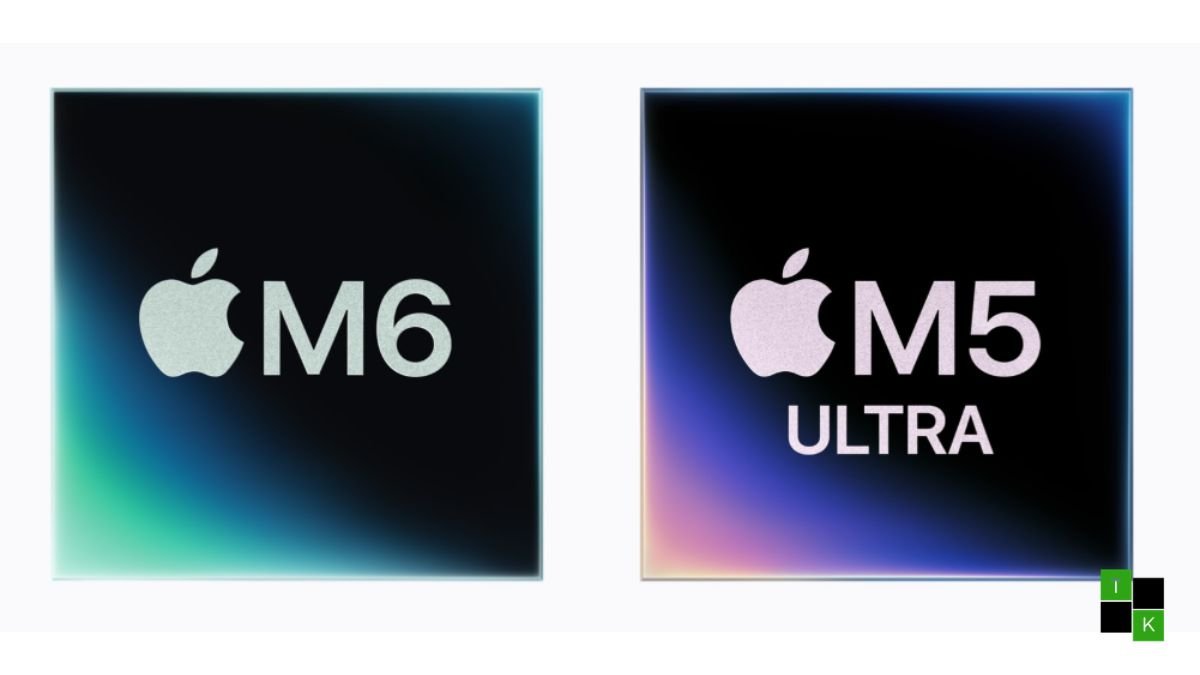
Apple rarely drops two different generations of silicon on the exact same day, but the rulebook is officially out the window. During a surprise press update on August 25, 2026, Cupertino officially lifted the curtain on Apple’s M6 and M5 Ultra chips. Consequently, we now have a fascinating split strategy playing out in real-time. The cutting-edge 2nm M6 is making its debut in a refreshed Mac mini, while the brute-force M5 Ultra is turning the new Mac Studio into an uncompromising local AI powerhouse.
If you were waiting for the TSMC 2nm era to arrive on the desktop, it is finally here. Meanwhile, for those who simply need to crunch massive local data models without relying on cloud servers, Apple built an absolute quad-die monster.
30-Second TL;DR
- The 2nm Era Begins: The M6 is Apple’s first consumer chip built on a 2nm node, bringing a 12-core CPU, up to 32GB of RAM, and a blazing 170GB/s of bandwidth to the standard Mac mini.
- Quad-Die Muscle: The M5 Ultra links two M5 Max dies together via UltraFusion, delivering up to 36 CPU cores, an 80-core GPU, and a staggering 512GB of unified memory.
- Hardware-Level AI: Both chips now feature Neural Accelerators built directly into their GPU cores, significantly speeding up agentic AI and local machine learning tasks.
Technical Specifications Overview
Here is exactly how the two newly announced processors stack up on paper:
| Hardware Feature | Apple M6 (Standard Tier) | Apple M5 Ultra (Workstation Tier) |
| Silicon Fabrication Node | 2nm TSMC Process | Advanced Apple Silicon Process |
| Die Architecture | Single Monolithic Die | Quad-Die (Two Linked M5 Max Dies) |
| Interconnect Bandwidth | N/A | Over 4.4 TB/s UltraFusion |
| CPU Core Configuration | 12 Cores (2 Super, 4 Perf, 6 Efficiency) | Up to 36 Cores (12 Super, 24 Perf) |
| GPU Core Count | 12 Cores with Neural Accelerators | Up to 80 Cores with Neural Accelerators |
| Neural Engine (NPU) | Dual 16-Core Neural Engine | 32-Core Neural Engine |
| Unified Memory Limits | 16GB Base / Up to 32GB | Up to 512GB Unified Memory |
| Memory Bandwidth | 170 GB/s | 1.2 TB/s |
| Debut Hardware | New Mac mini | New Mac Studio |
A Tale of Two Architectures
1. The M6: A 2nm Desktop Revolution
Apple is finally shipping a chip built on a 2nm manufacturing process, a massive leap forward that Mac users have been eagerly anticipating. By shrinking the transistors, Apple managed to cram significantly more logic into the standard M6 without melting the compact chassis of the Mac mini.
Specifically, the new entry-level chip receives a bump up to 12 CPU cores. This arrangement consists of two super cores, four performance cores, and six efficiency cores. Furthermore, the company claims that the M6 features the “world’s fastest CPU core,” driving a 40 percent faster overall CPU performance compared to previous baseline models.
However, the graphical side is where things get truly interesting. The 12-core GPU now includes dedicated Neural Accelerators inside each core. Therefore, the graphics engine does not just render pixels; it actively helps the Dual 16-core Neural Engine process machine learning tasks. Apple claims this results in up to a 30 percent increase in peak GPU compute for AI compared to the M5.
“M6 features a 12-core GPU – two more cores than M5 – with a Neural Accelerator in each core. This design delivers a nearly 30 percent increase in peak GPU compute for AI compared to M5.” – Apple Newsroom Disclosure
Moreover, Apple finally addressed the memory bottleneck. The base Mac mini now ships with 16GB of unified memory as the standard floor, configurable up to 32GB. In addition, memory bandwidth has been pushed to a snappy 170GB/s, ensuring that multitasking and loading everyday apps feel incredibly responsive.
2. The M5 Ultra: The 512GB Quad-Die Behemoth
While the M6 represents everyday efficiency, the M5 Ultra exists to obliterate heavy rendering timelines. Apple engineered the M5 Ultra as its very first quad-die design. By linking two M5 Max dies using the next-generation UltraFusion interconnect, the chip achieves a staggering 4.4 TB/s of inter-die bandwidth. Consequently, the operating system treats this massive slab of silicon as a single, unified processor with incredibly low latency.
The sheer scale of this processor is difficult to overstate. It scales up to a 36-core CPU, featuring 12 super cores and 24 performance cores. Meanwhile, the graphics pipeline boasts an enormous 80-core GPU, which also integrates Neural Accelerators throughout its architecture.
For professional video editors, the updated Media Engine packs twice the video encode and decode blocks of the M5 Max. As a result, the new Mac Studio can simultaneously play up to 33 streams of 8K ProRes 422 video at 30 frames per second without dropping a single frame.
Perhaps the most impressive metric is the memory pool. The M5 Ultra supports up to 512GB of unified memory, running at a mind-bending 1.2 TB/s of bandwidth. Because this bandwidth is 50 percent higher than the M3 Ultra, professional studios can run massive language models with hundreds of billions of parameters entirely on-device.
Release Timeline and Availability
- August 25, 2026: Apple officially announced both chips and opened pre-orders for the Mac Studio and Mac mini.
- September 22, 2026: Initial commercial availability and shipping commence for the Mac Studio.
- Late October 2026: The fully maxed-out Mac Studio configurations featuring 512GB of unified memory begin shipping to customers.
What is Confirmed
- The M6 Specifications: Verified as a 2nm chip featuring a 12-core CPU, a 12-core GPU with Neural Accelerators, and 16GB of base memory.
- The M5 Ultra Architecture: Confirmed as a quad-die design pushing up to 36 CPU cores, an 80-core GPU, and 512GB of memory.
- Hardware-Level AI Acceleration: Verified that both chips embed Neural Accelerators directly inside the GPU cores to speed up local AI compute.
- Launch Hardware: Confirmed that the M6 powers the new Mac mini, while the M5 Ultra is exclusive to the Mac Studio.
What is Not Confirmed
- M6 Pro and Max Variations: Apple has not yet revealed when the Pro or Max tiers of the M6 generation will hit the market.
- MacBook Pro Integration: Official timelines for bringing the 2nm M6 chip to the portable MacBook lineup remain unannounced.
Why This News Matters
The simultaneous drop of Apple’s M6 and M5 Ultra highlights exactly how fast the semiconductor landscape is moving. By rolling out a 2nm desktop chip right now, Apple maintains its comfortable lead in consumer efficiency. On the other hand, the M5 Ultra proves that Apple is taking enterprise-level AI workloads seriously. By offering 512GB of shared memory running at 1.2 TB/s, Apple is giving production houses the ability to run massive generative AI models locally, bypassing the expensive subscriptions and privacy risks associated with cloud computing.
What Happens Next
With pre-orders officially live today, the first wave of hardware will land on professional desks by September 22. As soon as reviewers get their hands on these machines, we will see real-world benchmarks detailing exactly how much of an advantage that 2nm M6 node provides over older Apple silicon. Furthermore, creative professionals will undoubtedly push the M5 Ultra to its absolute limit to see if it truly handles 33 streams of 8K video flawlessly.
Conclusion
Whether you need a compact, snappy desktop for everyday tasks or an industrial-grade workstation for rendering 3D simulations, Apple’s latest silicon update covers the entire spectrum. The M6 brings next-generation efficiency to the masses, while the M5 Ultra redefines what a local desktop can achieve. Ultimately, this dual-launch strategy guarantees that macOS remains a premier destination for both casual users and high-end creative professionals.
🚨 Stay Updated with TopKhoj! 🚨
Get the latest tech news, deals, and exclusive offers first!
📰 Visit News Section📲 Join our Telegram Channel for real-time updates and best deals!
🔗 Join Telegram Now💡 Stay informed and never miss a great deal with TopKhoj!
⚠️ Disclaimer: Any link provided in the article related to a product or service will redirect you to our affiliate partner(s)' website, which are affiliate links. This means that if you make a purchase through these links, we may earn a commission at no extra cost to you. This commission helps support our blog and our work.
🔔 All prices mentioned above are subject to change based on current offers and availability on e-commerce platforms. Please check the latest price and product details on the product page before making a purchase.