Add TOPKHOJ as a Preferred Source on Google
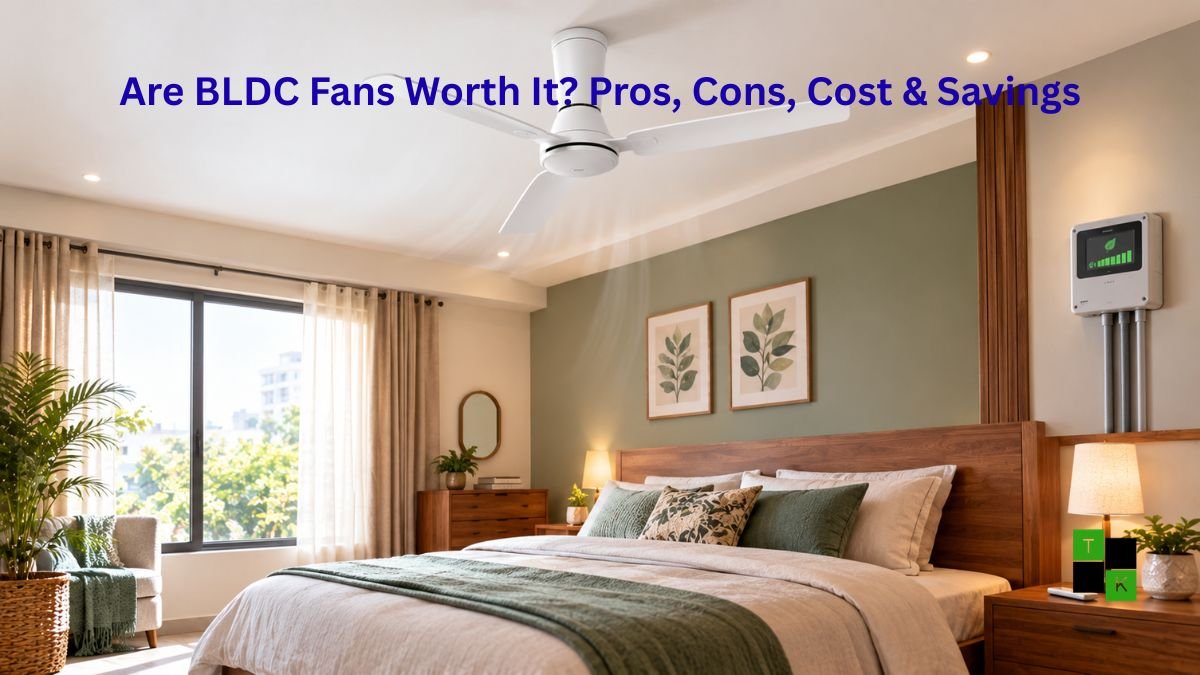
If you are thinking about replacing your regular ceiling fan, you may be asking: are BLDC fans worth it? BLDC ceiling fans have become popular because they can consume significantly less electricity than many conventional fans while also offering features such as remote control, timer functions and electronic speed control.
However, a BLDC fan usually costs more upfront than a basic conventional fan. So the real question is not simply whether BLDC technology is better. It is whether the higher initial price makes sense for your usage, electricity tariff and long-term needs.
For households that run ceiling fans for many hours every day, the lower electricity consumption can make BLDC technology particularly interesting. The Bureau of Energy Efficiency (BEE) has published comparisons showing substantially lower power consumption for BLDC fans than traditional fan examples.
Are BLDC Fans Worth It? Quick Answer
BLDC fans can be worth it if you use your ceiling fans frequently and want lower electricity consumption, remote control and other convenience features.
They may be less compelling if you use a fan only occasionally or your main priority is keeping the initial purchase price as low as possible.
Before buying, consider:
- How many hours you use the fan each day
- Your electricity rate
- The price difference between BLDC and conventional fans
- Number of fans in your home
- Whether you want remote control
- Whether you use an inverter
- How long you plan to keep the fan
What Is a BLDC Fan?
BLDC stands for Brushless Direct Current. A BLDC ceiling fan uses a brushless motor and electronic control to rotate the blades. Unlike many conventional ceiling fans that use AC induction motors, BLDC fans use electronically controlled motor technology.
One of the main advantages is efficiency. BEE’s reference material gives an example of a traditional fan consuming around 60W compared with a BLDC fan around 28W, while also showing that consumption changes depending on the selected speed.
This lower power requirement is the main reason BLDC fans have attracted attention from buyers trying to reduce electricity consumption.
Why Are BLDC Fans More Expensive?
A basic conventional ceiling fan is relatively simple. A modern BLDC fan can include:
- BLDC motor
- Electronic control circuitry
- Remote receiver
- Remote control
- Digital speed control
- Timer functions
- Sleep modes
- LED indicators
- Additional electronic components
These components can increase the manufacturing cost and therefore the retail price. So when comparing a ₹2,000 conventional fan with a ₹3,500-₹5,000 BLDC fan, don’t judge the difference only by the purchase price.
You should also consider how much electricity the fan will consume during several years of use.
How Much Electricity Can a BLDC Fan Save?
The exact saving depends on the two fans being compared. Let’s use a simple example:
- Conventional fan: 75W
- BLDC fan: 30W
- Usage: 10 hours per day
Conventional fan
75 × 10 × 30 ÷ 1,000 = 22.5 units/month
BLDC fan
30 × 10 × 30 ÷ 1,000 = 9 units/month
Difference: 13.5 units/month. At ₹8 per unit: 13.5 × ₹8 = ₹108/month. That works out to approximately: ₹1,296 per year
This is only an example. Your actual savings can be higher or lower depending on fan wattage, speed, usage and electricity tariff.
How Long Does It Take for a BLDC Fan to Pay for Itself?
This is one of the most important questions when considering a BLDC fan.
Suppose:
- Conventional fan costs ₹2,000
- BLDC fan costs ₹3,500
- Additional upfront cost = ₹1,500
- Estimated electricity saving = ₹1,296/year
The simple payback calculation would be: ₹1,500 ÷ ₹1,296 ≈ 1.16 years
So under these assumptions, the additional purchase cost could theoretically be recovered through electricity savings in around 14 months. But this is not a guaranteed payback period.
Actual payback depends on:
- Your electricity tariff
- Actual fan wattage
- Fan speed
- Hours of daily operation
- Purchase price
- Seasonal usage
- Number of days the fan operates
Therefore, use your own numbers before deciding.
BLDC Fans Make More Sense for Heavy Users
The more you use a fan, the more important its electricity consumption becomes. Consider two people.
User A
Runs the fan: 4 hours/day
User B
Runs the fan: 12 hours/day
User B uses the fan three times as much every day. Therefore, the potential electricity saving from switching to a more efficient fan can also become considerably more meaningful.
This is why BLDC fans can be particularly attractive for:
- Bedrooms
- Living rooms
- Home offices
- Shops
- Small businesses
- Offices
- Rooms occupied throughout the day
What If You Have Multiple Ceiling Fans?
This is where the difference can become even more noticeable. Suppose you have four ceiling fans and each BLDC fan saves an average of 10 units per month compared with your previous fans.
That’s: 40 units/month or approximately: 480 units/year. At ₹8 per unit: ₹3,840/year. Again, this is an illustration rather than a guaranteed saving.
The actual difference should be calculated using the wattage and operating hours of your own fans.
BLDC Fans and Inverter Backup
Another reason to consider BLDC technology is inverter usage. Because a BLDC fan generally requires less electrical power than many conventional fans, it places a smaller load on an inverter.
For example: 30W BLDC fan versus 75W conventional fan
The BLDC fan requires substantially less power. That can potentially allow your inverter battery to run the fan for longer. BEE identifies reduced power consumption and improved inverter backup as benefits associated with BLDC ceiling fans.
However, actual backup depends on:
- Battery capacity
- Battery voltage
- Battery condition
- Inverter efficiency
- Number of connected appliances
- Fan speed
So don’t assume a specific backup time without considering the complete system.
Are BLDC Fans Better for Bedrooms?
They can be. Bedrooms are one of the situations where BLDC features can become particularly useful. For example, many remote-controlled BLDC fans provide:
- Speed adjustment
- Timer
- Sleep mode
- Boost mode
- Remote power control
You can change the fan speed without getting out of bed. The lower power consumption can also be useful because bedroom fans often run for many hours during summer nights.
Are BLDC Fans Better for Living Rooms?
It depends on how you use the room. If your living room is occupied throughout the day and the ceiling fan runs frequently, lower power consumption may be valuable.
If the room is used for only a few hours each day, the financial benefit may take longer to offset the higher purchase price. Room usage should therefore be part of the buying decision.
Are BLDC Fans Good for Shops and Offices?
They can be particularly interesting in spaces where fans operate for long hours. For example, a small shop might operate a fan: 10-12 hours every day. An office might run fans throughout the working day.
When operating hours increase, electricity consumption becomes more important. For commercial users with multiple ceiling fans, even a modest reduction in power consumption per fan can add up over time.
However, commercial buyers should also consider durability, warranty, service availability and installation requirements.
Are BLDC Fans Quiet?
BLDC fans are generally designed for smooth and quiet operation, although actual noise depends on the particular model and installation.
Noise can also be affected by:
- Blade balance
- Motor quality
- Bearings
- Installation
- Ceiling condition
- Speed
- Room acoustics
Therefore, don’t assume that every BLDC fan will be silent. A properly installed quality model can, however, provide a very comfortable experience.
Do BLDC Fans Require a Regulator?
Many BLDC ceiling fans use electronic speed control and come with remote controls. This means they may not operate in exactly the same way as a conventional fan controlled through a standard regulator.
The installation requirements vary by model. If you are replacing an existing ceiling fan, check the manufacturer’s installation instructions before assuming that your existing regulator setup can be used unchanged.
Do BLDC Fans Work Without Electricity?
No. A BLDC fan still requires electrical power to operate. The difference is that it generally requires less power than many conventional fans. During a power cut, a BLDC fan can work from an inverter or other compatible backup power system.
Are BLDC Fans Reliable?
BLDC motor technology itself is well established. The absence of traditional motor brushes eliminates brush wear as a maintenance concern.
However, a BLDC fan also contains electronic components. Therefore, reliability depends on:
- Motor quality
- Electronics
- Bearings
- Construction quality
- Installation
- Manufacturer support
- Usage conditions
When buying, warranty and after-sales service are worth considering alongside energy efficiency.
Are BLDC Fans Expensive to Repair?
This can depend on the component that fails. A conventional fan has relatively simple electrical components, while a BLDC fan can contain electronic control components and a remote-control system.
Therefore, repairs may not always be directly comparable with those of a basic conventional fan. This is one reason it is worth checking the manufacturer’s warranty and service network before purchasing a BLDC fan.
BLDC Fan Pros and Cons
Advantages of BLDC Fans
- Lower electricity consumption: This is the biggest reason many buyers consider them.
- Remote control: You can change the fan speed without getting up.
- Timer and sleep functions: Available on many models.
- Lower inverter load: Lower power consumption can be useful during power cuts.
- Electronic speed control: Speed can be controlled precisely on many models.
- Modern designs: Many current BLDC models have slim, contemporary designs.
- Potential long-term savings: Frequent users may recover the higher initial purchase price through lower electricity consumption.
Disadvantages of BLDC Fans
- Higher upfront price: They usually cost more than basic conventional fans.
- More electronics:Electronic components can make repairs more specialized.
- Remote dependence: If the remote is lost or damaged, operation may be less convenient depending on the model.
- Battery requirement: Remote controls normally require batteries.
- Not every model is equally efficient: BLDC technology alone doesn’t tell you the complete efficiency of a particular fan.
- Payback depends on usage: Occasional users may take longer to recover the additional purchase price.
BLDC Fan vs Normal Fan
Here’s a simplified comparison:
| Feature | BLDC Fan | Normal Fan |
|---|---|---|
| Electricity consumption | Generally lower | Generally higher |
| Initial price | Usually higher | Usually lower |
| Motor | BLDC | Usually induction |
| Remote | Common on many models | Model dependent |
| Timer | Common on feature-rich models | Less common |
| Inverter load | Lower | Higher |
| Speed control | Electronic on many models | Usually regulator |
| Long-term operating cost | Potentially lower | Potentially higher |
| Maintenance | Low, but electronics involved | Generally simple |
| Best for | Frequent use | Budget-focused buyers |
How to Decide If a BLDC Fan Is Worth It
Instead of asking whether every BLDC fan is worth buying, calculate your own situation.
Step 1: Find your current fan’s wattage
Check the label or specifications.
Step 2: Find the BLDC fan’s wattage
Use the manufacturer’s specification.
Step 3: Estimate daily usage
For example: 10 hours/day
Step 4: Check your electricity rate
Use the approximate per-unit rate from your electricity bill.
Step 5: Calculate annual consumption
Use: Watts × Hours × Days ÷ 1,000
Step 6: Compare the purchase prices
Find the difference between the BLDC fan and the conventional fan.
Step 7: Estimate the payback
Divide: Additional purchase price ÷ annual electricity saving. This gives you a rough simple payback period.
Example: Is a BLDC Fan Worth It?
Suppose: Normal fan: ₹2,000, BLDC fan: ₹3,500, Additional cost: ₹1,500; Normal fan: 75W, BLDC fan: 30W; Usage: 10 hours/day, Electricity: ₹8/unit
Estimated annual electricity difference: Approximately 164 units, Estimated annual cost difference: Approximately ₹1,312
Simple payback: ₹1,500 ÷ ₹1,312 ≈ 1.14 years
Under these assumptions, the additional purchase price could theoretically be recovered in around 14 months.
But if you use the fan for only four hours a day, the payback would be much longer. That’s why daily usage matters so much.
What Should You Look for When Buying a BLDC Fan?
Don’t choose a BLDC fan based only on the word “BLDC.” Check the following:
1. Power Consumption
Look at the actual wattage. Read How Much Electricity Does a BLDC Fan Use?
2. Air Delivery
A low-wattage fan isn’t useful if it doesn’t provide the airflow you need.
3. Sweep Size
Common sizes include 900mm, 1200mm and 1400mm. Choose according to your room.
4. Speed Range
More speed levels can give you better control.
5. Remote Features
Check whether the remote includes:
- Timer
- Sleep
- Boost
- Speed control
- Power control
6. Warranty
Compare warranty coverage between models.
7. Service Availability
A strong service network can matter if electronic components require attention.
8. Current Price
BLDC fan prices vary considerably during sales and promotions. Compare the actual current price rather than relying on an old advertised price.
Is a BLDC Ceiling Fan With Remote Worth It?
If you want both energy efficiency and convenience, a BLDC ceiling fan with remote can make a lot of sense. You get the lower-power motor along with controls that can make everyday operation easier.
For example, the Atomberg Renesa Enzel 1200mm combines BLDC technology with remote control, LED speed indication, multiple operating modes and a modern design.
You can read our detailed product guide here: BLDC Ceiling Fan with Remote: Atomberg Renesa Enzel Review
The important thing is to compare its current price and specifications with competing BLDC models before purchasing.
Frequently Asked Questions
Are BLDC fans really worth the money?
They can be, particularly for people who run ceiling fans for many hours every day. The potential electricity savings and additional features can help justify the higher upfront price.
How much electricity can a BLDC fan save?
There is no single saving figure. It depends on the wattage of the BLDC fan, the conventional fan being replaced, daily usage and electricity tariff.
Do BLDC fans reduce electricity bills?
They can reduce the portion of your electricity bill attributable to ceiling-fan usage because they generally consume less electricity than many conventional fans.
How long does a BLDC fan take to pay for itself?
The payback period depends on the purchase-price difference and electricity savings. Heavy users generally have greater potential to recover the additional upfront cost more quickly.
Are BLDC fans good for bedrooms?
Yes. Remote control, low power consumption and features such as timer or sleep mode can make them particularly convenient for bedrooms.
Are BLDC fans good for inverter use?
Yes. Their lower power consumption can reduce the load on an inverter and potentially extend backup compared with a higher-power conventional fan.
Do BLDC fans need a regulator?
Many BLDC fans use electronic controls and remote controls instead of conventional regulator-based speed control. Always follow the installation instructions for the specific model.
Are BLDC fans noiseless?
No fan should automatically be assumed to be completely noiseless. BLDC models can offer quiet operation, but noise depends on the motor, blades, balance, installation and speed.
Are BLDC fans more expensive than normal fans?
Usually, yes. The higher price reflects the motor technology, electronics and additional features found in many BLDC models.
Is a 5-star BLDC fan worth buying?
A 5-star rating can be useful when comparing energy-efficient ceiling fans, but don’t make the decision based on the rating alone. Also compare actual power consumption, airflow, price, warranty and features.
Final Verdict: Are BLDC Fans Worth It?
For frequent users, a BLDC fan can be a worthwhile upgrade.
The biggest advantage is its potential to reduce electricity consumption. The benefit becomes more noticeable when a fan runs for many hours every day or when several fans are used throughout the home.
The remote control, timer, sleep modes and electronic speed control found on many models are additional advantages.
However, BLDC fans aren’t automatically the right choice for everyone. If you use a fan occasionally and want the lowest possible upfront cost, a conventional fan can still make sense.
If you run fans for long hours and plan to keep them for several years, comparing BLDC models is worth doing. And if your specific requirement is a BLDC ceiling fan with remote, take a closer look at the Atomberg Renesa Enzel and compare it with other models before making your final decision. Read the Atomberg Renesa Enzel 1200mm BLDC Ceiling Fan review
🚨 Stay Updated with TopKhoj! 🚨
Get the latest tech news, deals, and exclusive offers first!
📰 Visit News Section📲 Join our Telegram Channel for real-time updates and best deals!
🔗 Join Telegram Now💡 Stay informed and never miss a great deal with TopKhoj!
⚠️ Disclaimer: Any link provided in the article related to a product or service will redirect you to our affiliate partner(s)' website, which are affiliate links. This means that if you make a purchase through these links, we may earn a commission at no extra cost to you. This commission helps support our blog and our work.
🔔 All prices mentioned above are subject to change based on current offers and availability on e-commerce platforms. Please check the latest price and product details on the product page before making a purchase.