Add TOPKHOJ as a Preferred Source on Google
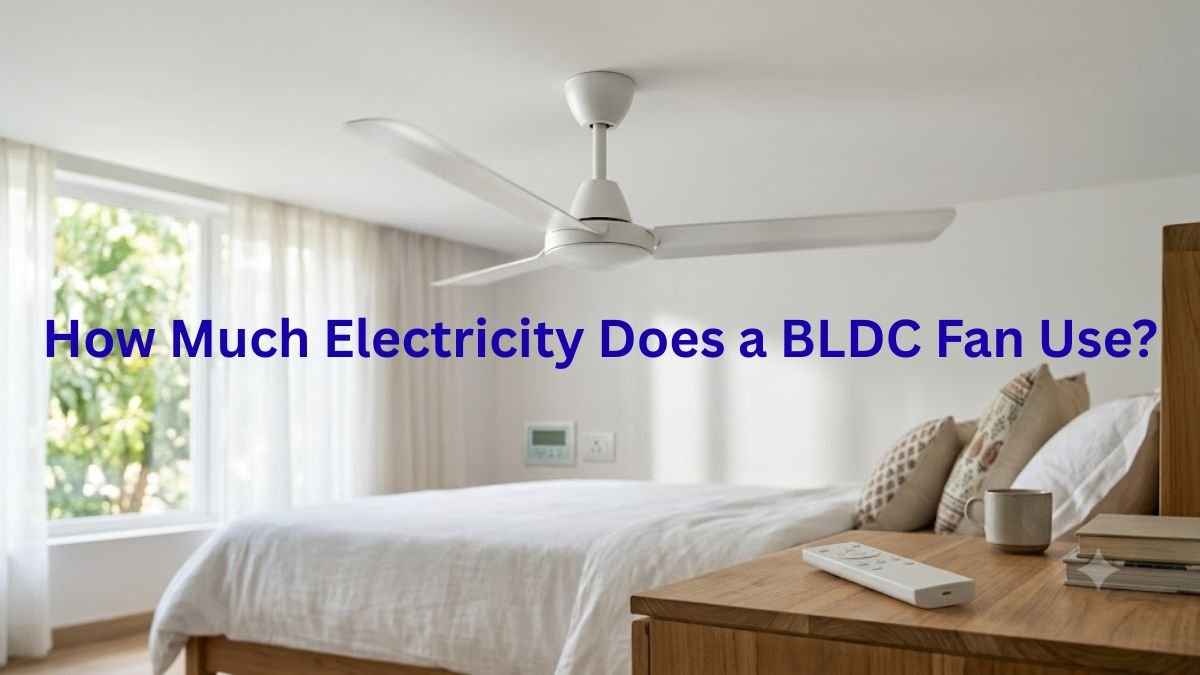
If you are trying to reduce your electricity bill, you may be wondering: how much electricity does a BLDC fan use?
A typical BLDC ceiling fan can use considerably less electricity than a conventional ceiling fan. The exact amount depends on the motor, fan size, speed setting, operating hours, and model.
As a general reference, the Bureau of Energy Efficiency (BEE) describes traditional ceiling fans as typically consuming around 60-80 watts, while a BLDC fan in its reference example consumes around 28-32 watts.
That difference can become significant when a ceiling fan runs for several hours every day. In this guide, we’ll calculate BLDC fan electricity consumption by hour, day, month, and year, explain how fan speed affects consumption, and show how you can estimate the running cost of your own fan.
How Many Watts Does a BLDC Fan Use?
There isn’t one fixed wattage for every BLDC fan. Modern BLDC ceiling fans can have different power ratings depending on their motor, blade design, sweep size, and maximum speed.
As a broad reference, current BLDC ceiling fans commonly fall in the roughly 26-35W range at higher speeds, although some models can differ. Atomberg’s current ceiling-fan guidance places many BLDC models in this range.
The BEE handbook provides another useful reference point, describing a 28W BLDC fan alongside a 60W traditional fan and showing how consumption changes across speed levels.
Therefore, if you see a BLDC fan advertised as consuming 28W, that does not mean every BLDC fan consumes exactly 28W. Always check the specification of the particular model you are considering.
How Much Electricity Does a BLDC Fan Use Per Hour?
Electricity consumption is measured in kilowatt-hours (kWh), commonly called units on electricity bills.
The basic calculation is: Electricity used = Power in watts × Hours of use ÷ 1,000
For example, suppose a BLDC fan consumes 30W.
If you run it for one hour: 30 × 1 ÷ 1,000 = 0.03 kWh
So, a 30W BLDC fan uses approximately: 0.03 units of electricity per hour
At 10 hours: 30 × 10 ÷ 1,000 = 0.30 units
At 12 hours: 30 × 12 ÷ 1,000 = 0.36 units
This is why even a fan that runs for many hours can consume relatively little electricity when its power draw is low.
BLDC Fan Electricity Consumption Calculator
Here is a simple reference using a 30W BLDC fan:
| Usage | Electricity Consumption |
|---|---|
| 1 hour | 0.03 units |
| 4 hours | 0.12 units |
| 8 hours | 0.24 units |
| 10 hours | 0.30 units |
| 12 hours | 0.36 units |
| 16 hours | 0.48 units |
| 24 hours | 0.72 units |
These calculations assume the fan continuously consumes 30W. Actual consumption can be lower at reduced speed.
How Much Electricity Does a BLDC Fan Use Per Day?
Let’s assume a 30W BLDC fan operates for 10 hours per day.
The calculation is: 30W × 10 hours ÷ 1,000 = 0.30 units per day
For 12 hours: 30W × 12 ÷ 1,000 = 0.36 units per day
For 16 hours: 30W × 16 ÷ 1,000 = 0.48 units per day
So, at full rated power, a 30W BLDC fan would consume less than half a unit of electricity even after running continuously for 16 hours.
How Much Electricity Does a BLDC Fan Use Per Month?
Now let’s extend the calculation to 30 days.
30W BLDC fan running 8 hours daily
30 × 8 × 30 ÷ 1,000 = 7.2 units per month
30W BLDC fan running 10 hours daily
30 × 10 × 30 ÷ 1,000 = 9 units per month
30W BLDC fan running 12 hours daily
30 × 12 × 30 ÷ 1,000 = 10.8 units per month
30W BLDC fan running 16 hours daily
30 × 16 × 30 ÷ 1,000 = 14.4 units per month
30W BLDC fan running 24 hours daily
30 × 24 × 30 ÷ 1,000 = 21.6 units per month
Remember that these calculations assume a constant 30W load. A BLDC fan normally operates at different speeds, so actual monthly consumption can be lower.
BLDC Fan Electricity Cost Per Month
To calculate your approximate electricity cost, multiply the units consumed by your electricity rate.
For example, let’s assume: Electricity rate = ₹7 per unit
A 30W BLDC fan running 12 hours every day consumes approximately: 10.8 units per month
Estimated cost: 10.8 × ₹7 = ₹75.60 per month
At ₹8 per unit: 10.8 × ₹8 = ₹86.40 per month
At ₹10 per unit: 10.8 × ₹10 = ₹108 per month
So the approximate monthly running cost at 12 hours per day would be:
| Electricity Rate | Approx. Monthly Cost |
|---|---|
| ₹6/unit | ₹64.80 |
| ₹7/unit | ₹75.60 |
| ₹8/unit | ₹86.40 |
| ₹9/unit | ₹97.20 |
| ₹10/unit | ₹108 |
Your actual bill can differ because residential electricity tariffs may use slabs, fixed charges, taxes, and other components.
BLDC Fan vs Normal Fan Electricity Consumption
The difference becomes easier to understand when we compare a BLDC fan with a conventional fan.
BEE’s published reference material gives a traditional fan consumption of approximately 60W and a BLDC fan consumption of approximately 28W in its example. It also shows that consumption changes substantially as fan speed changes.
For a simple comparison, let’s use:
- Normal fan: 75W
- BLDC fan: 30W
- Usage: 12 hours per day
Normal 75W fan
75 × 12 × 30 ÷ 1,000 = 27 units/month
BLDC 30W fan
30 × 12 × 30 ÷ 1,000 = 10.8 units/month
Difference: 27 – 10.8 = 16.2 units per month
At ₹8 per unit: 16.2 × ₹8 = ₹129.60
That means the theoretical difference is approximately ₹130 per month per fan under these assumptions.
Again, this is an illustration, not a guaranteed saving. The actual result depends on the exact wattage and operating conditions of both fans.
How Much Can You Save With a BLDC Fan?
A simple way to estimate potential savings is Savings = (Old fan watts – BLDC fan watts) × daily hours × days ÷ 1,000 × electricity rate
For example:
- Old fan = 75W
- BLDC fan = 30W
- Difference = 45W
- Usage = 12 hours/day
- Electricity rate = ₹8/unit
Annual energy difference: 45 × 12 × 365 ÷ 1,000 = 197.1 units
Estimated annual electricity-cost difference: 197.1 × ₹8 = ₹1,576.80
That’s roughly ₹1,577 per year per fan under those assumptions. If you have four frequently used ceiling fans, the theoretical difference would be about ₹6,307 per year.
However, don’t treat this as a guaranteed saving. Your actual result will depend on the real wattage of both fans, the speed at which you operate them, your electricity tariff, and how many hours they run.
Does Fan Speed Affect BLDC Electricity Consumption?
Yes. This is one of the most important things to understand when calculating BLDC fan electricity consumption. A fan doesn’t necessarily consume its maximum rated wattage at every speed.
BEE’s example shows the difference clearly. In its comparison, a 28W BLDC fan uses approximately:
- Speed 1: 4.6W
- Speed 2: 7.9W
- Speed 3: 13.7W
- Speed 4: 23W
- Speed 5: 27.9W
The corresponding traditional fan in the same BEE example ranges from 15.35W at its first stage to 61W at its fifth stage.
This means a BLDC fan operating at a lower speed can consume dramatically less power than its maximum rated wattage.
Does a 28W BLDC Fan Always Consume 28W?
No. This is an important misconception. If a fan has a maximum rated consumption of 28W, that generally refers to a specified operating condition, typically the highest speed. At lower speeds, the actual power draw can be considerably lower.
BEE’s example illustrates this with a 28W BLDC fan whose consumption ranges from 4.6W at the first stage to 27.9W at the fifth stage.
Therefore, saying that a 28W BLDC fan consumes exactly 28W all day would overestimate its actual electricity consumption if you normally operate it at lower speeds.
How Much Electricity Does a 1200mm BLDC Fan Use?
A 1200mm ceiling fan is one of the most common sizes for bedrooms and medium-sized rooms. The power consumption depends on the specific model.
Atomberg’s current 1200mm fan information states that its BLDC models can consume around 28-32W, compared with approximately 70-80W for conventional 1200mm fans.
For example, using 30W as a calculation: 8 hours/day: 7.2 units/month, 10 hours/day: 9 units/month, 12 hours/day: 10.8 units/month, 16 hours/day: 14.4 units/month
This makes a 1200mm BLDC fan particularly interesting for rooms where the ceiling fan operates for much of the day.
What About the Atomberg Renesa Enzel?
The Atomberg Renesa Enzel 1200mm is an example of the type of BLDC ceiling fan people consider when trying to reduce fan electricity consumption.
The model covered in our product guide features a 1200mm sweep, BLDC motor, remote control, 5-star positioning, LED speed indication and multiple operating modes.
The important point is that you shouldn’t assume its electricity consumption from the generic “BLDC” label alone. The actual power draw depends on the selected speed and the exact product specification.
If you’re specifically researching a BLDC ceiling fan with remote, you can read our detailed guide: Atomberg Renesa Enzel 1200mm BLDC Ceiling Fan with Remote Review
How Much Electricity Does a BLDC Fan Use on an Inverter?
BLDC fans can be useful during power cuts because they generally require less power than conventional fans.
For example, a 30W fan puts a substantially smaller load on an inverter than a 75W fan. However, inverter backup cannot be calculated from fan wattage alone.
It also depends on:
- Battery capacity
- Battery voltage
- Battery condition
- Inverter efficiency
- Other appliances connected
- Fan speed
- Conversion losses
BEE identifies longer inverter backup as one of the advantages associated with BLDC fans. So, a BLDC fan can help reduce inverter load, but don’t assume a specific number of backup hours without calculating the entire system.
Does a BLDC Fan Save Electricity Even at Low Speed?
Yes, and this is one of the reasons BLDC fans can be particularly efficient. At lower speed settings, the motor can consume substantially less power.
For example, BEE’s reference 28W BLDC fan consumed only 4.6W at its first speed stage compared with 27.9W at the fifth stage.
This means that if you normally use your fan at moderate or low speed, your actual electricity consumption may be much lower than the maximum wattage printed in the specifications.
What Factors Affect BLDC Fan Electricity Consumption?
Several factors influence the amount of electricity your fan uses.
1. Fan Speed
Higher speed generally requires more power.
2. Motor Efficiency
Not all BLDC motors are identical. Motor design and electronics affect efficiency.
3. Fan Size
Larger fans can have different power requirements because they move air over a larger area.
4. Blade Design
Blade shape, pitch and aerodynamic design influence the relationship between power consumption and airflow.
5. Daily Operating Hours
A fan used for 15 hours per day will naturally consume more electricity than one used for four hours.
6. Room Temperature
A hotter room may cause you to run the fan at higher speeds or for longer periods.
7. Installation
A properly installed and balanced fan can operate more effectively and quietly.
How to Calculate Your Own BLDC Fan Electricity Cost
You don’t need a complicated calculator. Use this formula: Monthly units = Wattage × Hours per day × Days per month ÷ 1,000
Then: Monthly electricity cost = Monthly units × Electricity rate
Example
Suppose your BLDC fan is rated at 32W. You use it for 10 hours every day. Your electricity rate is ₹8 per unit.
Monthly consumption: 32 × 10 × 30 ÷ 1,000 = 9.6 units
Estimated energy cost: 9.6 × ₹8 = ₹76.80 per month
This gives you a much better estimate than simply looking at the fan’s wattage.
BLDC Fan Electricity Consumption: Quick Reference
Assuming a constant 30W power draw:
| Daily Usage | Monthly Consumption | Cost at ₹8/unit |
|---|---|---|
| 4 hours | 3.6 units | ₹28.80 |
| 6 hours | 5.4 units | ₹43.20 |
| 8 hours | 7.2 units | ₹57.60 |
| 10 hours | 9 units | ₹72 |
| 12 hours | 10.8 units | ₹86.40 |
| 16 hours | 14.4 units | ₹115.20 |
| 24 hours | 21.6 units | ₹172.80 |
These figures assume a constant 30W load and a flat ₹8/unit rate. Real household bills may differ because of speed changes, tariff slabs and other charges.
Is a BLDC Fan Worth It for Electricity Savings?
It can be, especially if you use your ceiling fan for many hours every day. A person who runs a fan for only a few hours each week may see limited financial benefit from upgrading solely for energy savings.
On the other hand, a household that operates several fans for 8–16 hours every day can potentially see a more meaningful difference in electricity consumption.
The higher purchase price of a BLDC fan should therefore be considered alongside:
- Expected daily usage
- Electricity tariff
- Fan lifespan
- Difference in purchase price
- Desired features
- Number of fans in the home
BLDC Fan vs Normal Fan: Electricity Consumption at a Glance
| Factor | BLDC Fan | Conventional Fan |
|---|---|---|
| Typical power range | Around 26-35W for many models | Often around 60–80W |
| Low-speed consumption | Can be very low | Generally higher |
| Energy efficiency | High | Lower than efficient BLDC models |
| Inverter load | Lower | Higher |
| Remote control | Common on many models | Model dependent |
| Initial price | Usually higher | Usually lower |
The wattage ranges above are broad references rather than specifications for every fan. BEE’s published example uses 28W for a BLDC fan and 60W for a traditional fan.
Frequently Asked Questions
How many units does a 30W BLDC fan consume in a month?
At 10 hours of daily use, a 30W fan consumes approximately 9 units per month if it continuously operates at 30W.
How much electricity does a 30W BLDC fan use in 12 hours?
A 30W fan running for 12 hours uses approximately 0.36 units per day, or about 10.8 units over 30 days.
How much does a BLDC fan cost to run?
It depends on wattage, usage and your electricity tariff. For example, a 30W fan running 12 hours per day uses about 10.8 units per month. At ₹8 per unit, that works out to approximately ₹86.40.
Does a BLDC fan consume 30 watts all the time?
No. A 30W rating generally represents a specified operating condition, often maximum speed. Actual power consumption can be much lower at reduced speeds.
How much electricity does a 1200mm BLDC fan use?
Many 1200mm BLDC models fall around the 28-35W range, but the exact consumption depends on the model. Atomberg’s current 1200mm range information lists 28-32W for its BLDC models.
Is a 28W BLDC fan really 28W?
Not necessarily at every speed. BEE’s example of a 28W BLDC fan shows consumption ranging from 4.6W at the lowest stage to 27.9W at the highest stage.
Does a BLDC fan reduce electricity bills?
It can reduce the electricity used by the fan compared with a higher-power conventional model. The actual bill reduction depends on the two fans being compared, operating hours, speed and electricity tariff.
Does a BLDC fan work well with an inverter?
Yes. Because BLDC fans generally use less power, they place less load on an inverter than many conventional fans. This can help extend available backup, although actual runtime depends on the complete inverter and battery setup.
Are all BLDC fans equally energy efficient?
No. BLDC is a motor technology, not a guarantee that every fan has identical efficiency. Compare the actual wattage, airflow, speed range and efficiency specifications of individual models.
Final Takeaway
So, how much electricity does a BLDC fan use?
For many modern models, maximum power consumption is roughly in the 26-35W range, although individual fans can differ. BEE’s reference material gives a 28W BLDC example and shows substantially lower consumption than a traditional fan across its speed levels.
A 30W BLDC fan running for:
- 8 hours/day uses about 7.2 units/month
- 10 hours/day uses about 9 units/month
- 12 hours/day uses about 10.8 units/month
- 16 hours/day uses about 14.4 units/month
The actual number can be lower because BLDC fans generally consume less power at lower speed settings.
If you’re choosing a new fan, don’t look at wattage alone. Compare air delivery, sweep size, motor efficiency, speed levels, remote features, warranty and price as well.
And if you’re specifically looking for a BLDC ceiling fan with remote, check our detailed Atomberg Renesa Enzel guide before buying.
Read: BLDC Ceiling Fan with Remote – Atomberg Renesa Enzel Review
🚨 Stay Updated with TopKhoj! 🚨
Get the latest tech news, deals, and exclusive offers first!
📰 Visit News Section📲 Join our Telegram Channel for real-time updates and best deals!
🔗 Join Telegram Now💡 Stay informed and never miss a great deal with TopKhoj!
⚠️ Disclaimer: Any link provided in the article related to a product or service will redirect you to our affiliate partner(s)' website, which are affiliate links. This means that if you make a purchase through these links, we may earn a commission at no extra cost to you. This commission helps support our blog and our work.
🔔 All prices mentioned above are subject to change based on current offers and availability on e-commerce platforms. Please check the latest price and product details on the product page before making a purchase.