Add TOPKHOJ on Google:
 Preferred Source
After years of playing catch-up to Qualcomm and Apple silicon in multi-threaded throughput and sustained thermal efficiency, Samsung’s in-house semiconductor division appears poised for a major performance turnaround. According to investigative industry disclosures published by South Korean business outlet ChosunBiz on October 25, 2026, internal benchmark testing of Samsung’s upcoming Exynos 2700 processor has demonstrated substantial multi-core compute leads over Qualcomm’s premiere platform.
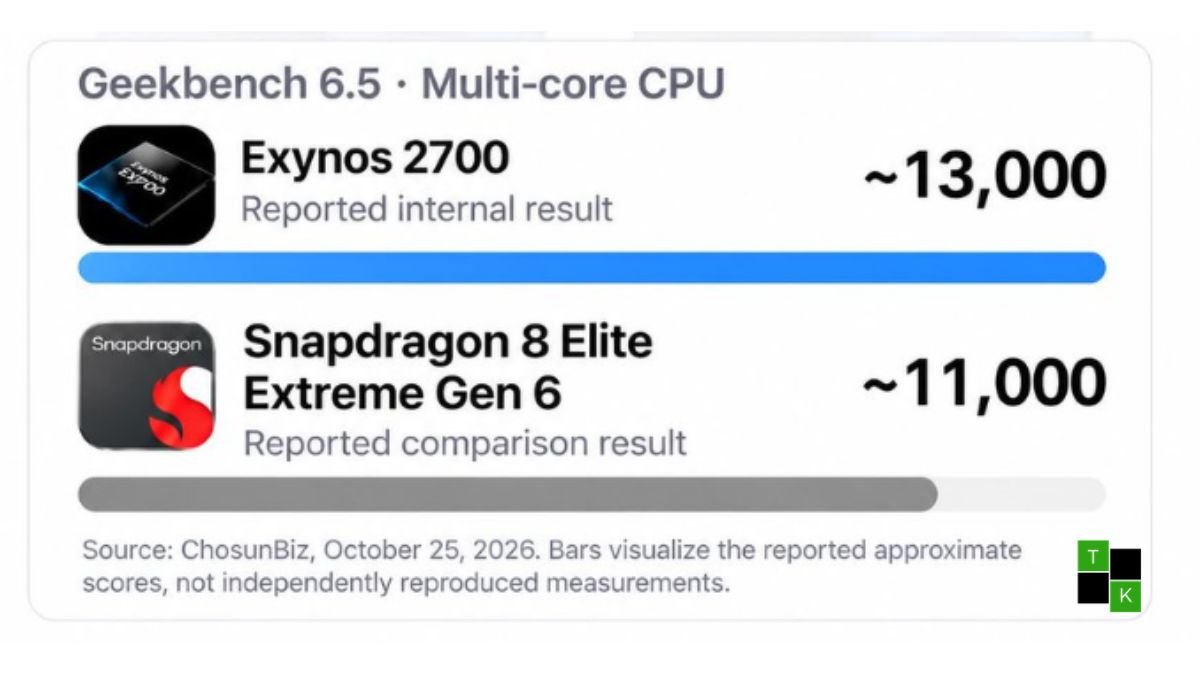
In early Geekbench 6.5 testing, the Samsung Exynos 2700 recorded a multi-core score of approximately 13,000 points.
When tested directly against the commercially released Snapdragon 8 Elite Extreme Gen 6-benchmarked within retail hardware like the Xiaomi 18 Pro Max, which achieved roughly 11,000 points-the Exynos 2700 pulled ahead by approximately 18% to 20% in pure multi-threaded CPU throughput.
The leak adds technical substance to reports that Samsung plans to deploy the 2nm Exynos 2700 broadly across the Galaxy S27, S27 Plus, and S27 Pro in late January 2027.
The Benchmark Breakdown: Geekbench 6.5 and Beyond
The internal test metrics compiled by Samsung’s mobile division provide a multi-layered view of compute and graphics scaling:
- Geekbench 6.5 Multi-Core Metric: In standard Geekbench 6.5 multi-threaded evaluations, the Exynos 2700 averaged around 13,000 points, comfortably clear of the ~11,000 baseline set by Qualcomm’s 2nm Snapdragon 8 Elite Extreme Gen 6. This translates to a direct 18.18% performance advantage in high-concurrency CPU tasks.
- Geekbench 7.0 Multi-Core Resilience: In early builds of the newer Geekbench 7.0 standard, the Exynos 2700 reportedly retained a 15% performance delta over competing 2nm Qualcomm silicon.
- GPU Compute Gains: Graphics benchmarks indicate that the Exynos 2700’s redesigned RDNA-based GPU posted scores up to 20% higher than competing Adreno solutions on select compute passes.
- Real-World Comparison Environment: Notably, the testing was reportedly conducted in China using standard production runs of the Xiaomi 18 Pro Max as the hardware vessel for Qualcomm’s Snapdragon 8 Elite Extreme silicon, ensuring a real-world reference point rather than open bare-board test rigs.
Silicon Architecture: Inside Samsung Foundry’s 2nm SF2P Node
The performance gains of the Exynos 2700 are closely tied to Samsung Foundry’s maturing manufacturing lithography:
- Second-Generation 2nm GAA (SF2P): The Exynos 2700 is fabricated on Samsung Foundry’s second-generation 2nm Gate-All-Around (GAA) process, known as SF2P. By utilizing multi-bridge channel FETs (MBCFET), the architecture improves drive current while significantly reducing parasitic sub-channel leakage compared to classic FinFET structures.
- Next-Gen Core Layout: The SoC incorporates ARM’s latest compute core IP, deploying high-frequency prime cores optimized for short-burst responsiveness, backed by dense clusters of energy-efficient execution units that spread multi-threaded application loads.
- Xclipse Graphics Upgrade: Continuing Samsung’s strategic collaboration with AMD, the onboard Xclipse GPU integrates upgraded RDNA architectures featuring hardware-accelerated ray tracing, variable rate shading (VRS), and dedicated AI upscaling pipelines.
The Real-World Nuance: Peak Bursts vs. Thermal Realities
While a 13,000-point Geekbench result is an impressive technical milestone, seasoned hardware analysts emphasize that peak synthetic scores only tell half the story:
- The Thermal Throttling Variable: Geekbench tests execute in short, rapid bursts lasting only a few minutes. Whether the Exynos 2700 can sustain this 20% lead during 45 minutes of continuous 3D gaming or 8K 60fps video capture will depend entirely on its power curve and sustained thermal dissipation.
- Cooling Implementation in Final Handsets: Because prototype test chips often run without the thermal constraints of a sealed commercial chassis, real-world retail performance inside the 8mm bodies of the Galaxy S27 and S27 Plus will rely heavily on the size and efficiency of Samsung’s internal vapor chamber cooling systems.
- Battery Consumption Considerations: A 13,000 multi-core score requires significant peak current draw. Samsung’s power management ICs must effectively control battery drain to prevent excessive draw from the standard 4,200mAh to 5,000mAh cells planned for the compact S27 tiers.
Benchmark Showdown: Exynos 2700 vs. Top-Tier Mobile Processors
| Processor Platform | Foundry Node | Geekbench 6.5 Multi-Core | Multi-Core Delta vs Exynos | GPU Compute Lead | Primary Deployment |
| Samsung Exynos 2700 | Samsung 2nm (SF2P) | ~13,000 Points (Reported) | Baseline (Top Performer) | +20% in Peak RDNA Passes | Galaxy S27 / S27+ / S27 Pro |
| Snapdragon 8 Elite Extreme Gen 6 | TSMC 2nm (N2) | ~11,000 Points | -15% to -20% Slower | Adreno Next Architecture | Xiaomi 18 / S27 Ultra |
| MediaTek Dimensity 9600 Pro | TSMC 2nm (N2) | ~10,800 – 11,200 Points | -14% to -17% Slower | Mali-G1 Architecture | OPPO Find X10 Pro Max |
| Apple A20 Pro Silicon | TSMC 2nm (N2P) | ~11,500 – 12,200 Points | -6% to -12% Slower | Apple 6-Core Metal GPU | iPhone 18 Pro / Foldable |
Strategic Implications for the Galaxy S27 Series
If these performance leads hold up in retail silicon, it dramatically shifts the market dynamic for Samsung’s upcoming smartphone cycle:
- Vindication for Exynos Deployment: Samsung has faced years of consumer blowback in regions like Europe and India whenever Exynos-powered Galaxy models were perceived as inferior to their Qualcomm counterparts. A verified 18% to 20% multi-core performance lead would turn the Exynos 2700 into a major selling point for the Galaxy S27, Galaxy S27 Plus, and the new Galaxy S27 Pro rather than a perceived regional penalty.
- Margin Independence: Licensing Qualcomm’s top-tier Snapdragon silicon across 100% of global shipments severely squeezes device profitability. Powering the high-volume base and Plus variants with proprietary 2nm SF2P silicon gives Samsung Mobile greater financial cushion to manage high memory component costs.
- The S27 Ultra Separation: With Qualcomm’s Snapdragon 8 Elite Extreme Gen 6 slated to remain exclusive to the apex Galaxy S27 Ultra, Samsung establishes a distinct internal division: custom Qualcomm compute power for the halo S Pen device, and high-efficiency domestic 2nm silicon driving the mainstream flagship portfolio.
As engineering validation tests wrap up ahead of mass assembly, the Samsung Exynos 2700 is shaping up to make early 2027 a pivotal moment in mobile semiconductor competition.
🚨 Stay Updated with TopKhoj! 🚨
Get the latest tech news, deals, and exclusive offers first!
📰 Visit News Section📲 Join our Telegram Channel for real-time updates and best deals!
🔗 Join Telegram Now💡 Stay informed and never miss a great deal with TopKhoj!
⚠️ Disclaimer: Any link provided in the article related to a product or service will redirect you to our affiliate partner(s)' website, which are affiliate links. This means that if you make a purchase through these links, we may earn a commission at no extra cost to you. This commission helps support our blog and our work.
🔔 All prices mentioned above are subject to change based on current offers and availability on e-commerce platforms. Please check the latest price and product details on the product page before making a purchase.