Add TOPKHOJ as a Preferred Source on Google
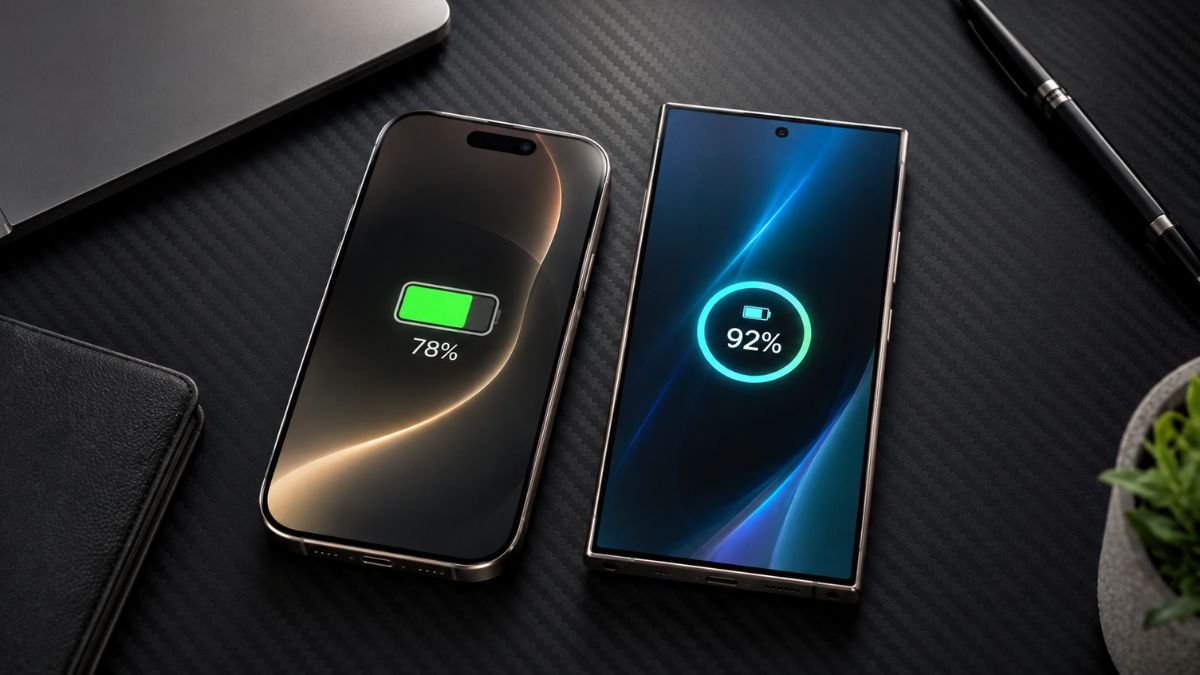
The ongoing debate surrounding iPhone vs Samsung battery life and durability comes down to two contrasting engineering philosophies that define the modern flagship smartphone market. While Apple relies on tight vertical hardware-software integration to extract maximum endurance from compact battery cells, Samsung packs larger physical capacities paired with faster charging speeds and advanced glass coatings.
Whether you are deciding between top-tier powerhouses like the iPhone Pro Max and the Galaxy Ultra series, or looking at standard base models, understanding how these devices hold up against daily wear, accidental drops, and heavy screen-on time is essential before spending flagship money.
Flagship Head-to-Head: Battery & Durability Specs
| Category / Metric | Apple iPhone Flagships (Pro Max Series) | Samsung Galaxy Flagships (Ultra Series) |
| Typical Battery Capacity | 4,685 mAh – 4,900 mAh | 5,000 mAh – 5,500 mAh |
| Active Screen-On Endurance | 17 to 18+ Hours (Mixed GSMArena / PhoneBuff loops) | 16 to 17.5+ Hours (Mixed real-world loops) |
| Wired Fast Charging | Up to 27W – 30W (~50% in 30 mins) | 45W Super Fast Charging 2.0 (~65% in 30 mins) |
| Wireless Charging Standard | 25W MagSafe / Qi2.2 Magnetic | 15W Fast Wireless / Qi standard |
| Reverse Wireless Power | No (Limited reverse-wired via USB-C) | Yes (Wireless PowerShare 4.5W) |
| Rated Battery Cycle Lifespan | 1,000 Charge Cycles to 80% capacity | Up to 2,000 Charge Cycles on newer flagships |
| Front Screen Protection | Ceramic Shield (Dual-ion exchange glass-ceramic) | Corning Gorilla Armor (Anti-reflective glass-ceramic) |
| Chassis Mid-Frame | Grade 5 Titanium bonded to Aluminum substructure | Grade 2 Titanium or Reinforced Armor Aluminum |
| Water & Dust Resistance | IP68 (Rated up to 6 meters for 30 minutes) | IP68 (Rated up to 1.5 meters for 30 minutes) |
| Screen Anti-Reflectivity | Standard Oleophobic Anti-Fingerprint Coating | Low-Reflection Optical Treatment (~75% glare cut) |
Battery Performance: Optimization vs. Raw Capacity
Daily Screen-On Time
Apple has consistently demonstrated that physical battery size does not tell the whole story. Thanks to energy-dense custom silicon (A-series chips) and strict background process management in iOS, iPhones achieve high operational efficiency.
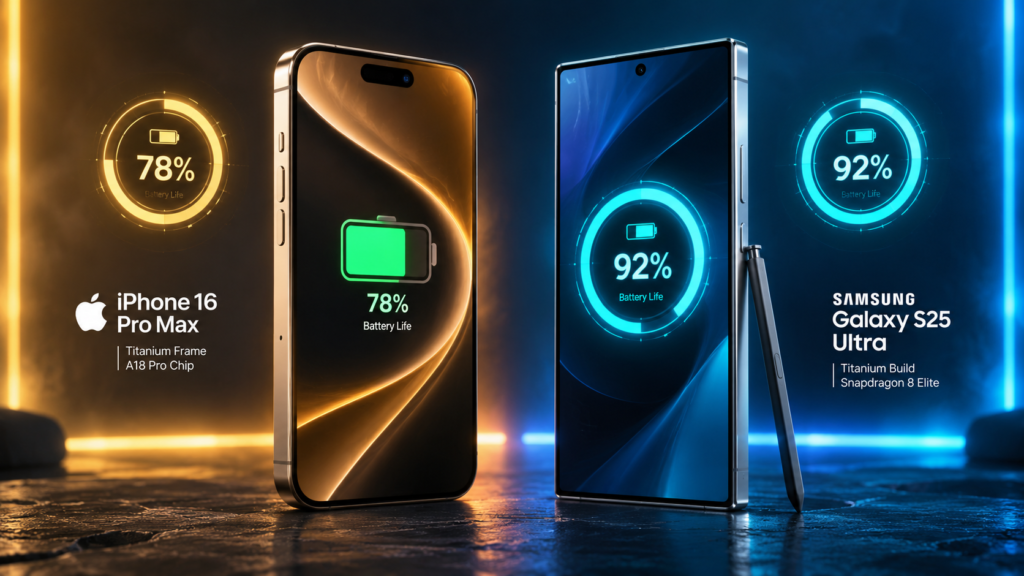
In standardized robotic battery drain tests-such as those conducted by PhoneBuff and GSMArena-the iPhone Pro Max regularly goes toe-to-toe with the Galaxy Ultra, often finishing within minutes of each other despite the iPhone carrying a smaller battery cell.
- Where iPhone Leads: iPhones excel in video playback, social media scrolling, and standby battery drain. Leaving an iPhone idle overnight typically consumes just 1% to 2% of battery life.
- Where Samsung Leads: Galaxy flagships equipped with Qualcomm’s Snapdragon Elite silicon handle intense graphics multitasking and sustained 5G cellular web browsing with minimal thermal penalty.
Charging Speed and Flexibility
Samsung holds an advantage in charging speed and ecosystem utility:
- Wired Speeds: Samsung’s 45W wired charging takes a 5,000mAh cell from 0 to 65% in roughly half an hour, whereas Apple caps wired intake around 27W to 30W.
- Reverse PowerShare: Samsung lets you place a smartwatch, wireless earbuds, or a friend’s phone on the back of your Galaxy to top it up wirelessly on the go. iPhones remain limited to reverse-wired cable output.
Long-Term Battery Longevity & Health Retention
How a battery performs on day 300 matters just as much as day one.
Recent battery degradation analyses show Samsung making major strides in chemical longevity, with newer Galaxy S-series flagships engineered to retain 80% original capacity across up to 2,000 full charging cycles. Apple rates its latest iPhone generations for 1,000 charge cycles before hitting the 80% health threshold.
Both manufacturers provide robust software-level battery preservation tools, including charging limits (capping daily top-offs at 80%) and adaptive nighttime charging schedules to reduce chemical wear.
Physical Durability: Ceramic Shield vs. Gorilla Armor
When a smartphone takes a hard fall onto asphalt or concrete, the structural chemistry of the display glass and mid-frame determines whether you walk away with a cosmetic scuff or a shattered screen.
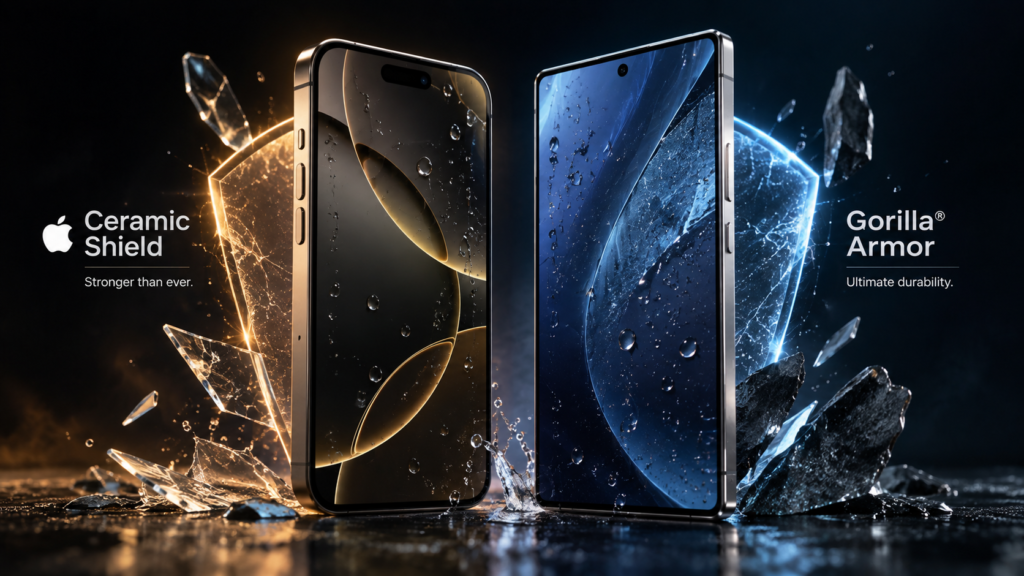
Display Glass Engineering Comparison
 ├── Apple Ceramic Shield ──> Nano-Ceramic Crystals Embedded in Matrix (Max Drop Fracture Toughness)
 └── Corning Gorilla Armor ──> Scratch-Resistant Glass-Ceramic + 75% Ambient Glare Reduction
1. Drop Resistance (Shatter Protection)
- Apple’s Ceramic Shield: Co-developed with Corning, Ceramic Shield infuses nano-scale ceramic crystals into the glass matrix. In face-first flat drops from head height (6 feet), the iPhone’s Ceramic Shield consistently demonstrates remarkable shatter resistance.
- Samsung’s Gorilla Armor / Victus 2: Samsung’s latest flat-panel designs paired with Gorilla Armor have eliminated the fragile curved display edges of older models. While it survives standard waist-high drops reliably, extreme concrete drop tests show slightly higher edge-fracture rates compared to Apple’s dense glass-ceramic formulation.
2. Scratch Resistance and Glare
Samsung’s Gorilla Armor stands out on everyday scratch protection:
- Gorilla Armor’s Anti-Glare Advantage: Beyond surviving micro-abrasions from pocket sand and keys significantly better than traditional glass, Gorilla Armor cuts surface reflections by up to 75%. This makes Galaxy displays clearer outdoors without cranking brightness to maximum levels.
- Ceramic Shield Scratch Reality: Because Apple tuned Ceramic Shield to be softer and more ductile to absorb drop impacts, it remains susceptible to fine hairline scratches over time if used without a screen protector.
3. Water and Ingress Protection
While both brands carry official IP68 ratings, Apple’s water resistance testing standard goes beyond the industry baseline. Apple certifies iPhones for submersion up to 6 meters for 30 minutes, whereas Samsung certifies Galaxy devices up to 1.5 meters for 30 minutes.

- Galaxy AI and Now Brief – Enter the new era of 5G smartphone AI with a companion that stays one-step ahead of your needs…
- Gemini Live – Get real-time answers and ideas with Gemini Live. Chat freely, attach images, and prepare for presentation…
- Ultra Wide Camera – Capture razor-sharp details from Wide to Telephoto and even Ultra Wide. Whether shooting landscapes …
The Verdict: Which Device Wins on Battery & Toughness?
- Choose Apple iPhone If: You prioritize long screen-on time during mixed everyday app use, want better face-first drop shock absorption, require superior water submersion ratings, and value magnetic Qi2/MagSafe accessories.
- Choose Samsung Galaxy If: You want faster 45W charging, anti-reflective display glass that reduces outdoor glare, reverse wireless charging for accessories, and higher rated long-term battery cycle longevity.
🚨 Stay Updated with TopKhoj! 🚨
Get the latest tech news, deals, and exclusive offers first!
📰 Visit News Section📲 Join our Telegram Channel for real-time updates and best deals!
🔗 Join Telegram Now💡 Stay informed and never miss a great deal with TopKhoj!
⚠️ Disclaimer: Any link provided in the article related to a product or service will redirect you to our affiliate partner(s)' website, which are affiliate links. This means that if you make a purchase through these links, we may earn a commission at no extra cost to you. This commission helps support our blog and our work.
🔔 All prices mentioned above are subject to change based on current offers and availability on e-commerce platforms. Please check the latest price and product details on the product page before making a purchase.