Add TOPKHOJ as a Preferred Source on Google
In what marks its most decisive strategic maneuver to date toward infrastructure self-reliance, Microsoft has officially unveiled its next-generation custom artificial intelligence chip: the Microsoft Azure Maia 300.
Announced directly by Microsoft Chairman and CEO Satya Nadella, the introduction of the Maia 300 represents the company’s “biggest bet yet on our own silicon”. Engineered specifically to handle the soaring computational and thermal demands of real-time AI workloads, the Maia 300 delivers 40% more tokens per watt compared to leading commercial GPU-based systems. Crucially, Microsoft confirmed that starting next calendar year, it will scale the Maia silicon family to multi-gigawatt deployments, transitioning the architecture to become the primary inference engine powering internal consumer and enterprise services-including Microsoft 365 Copilot, GitHub Copilot, and Azure AI workflows.
The Efficiency Imperative: 40% More Tokens Per Watt
While early phases of the generative AI boom prioritized brute-force training on massive clusters of general-purpose GPUs, hyperscalers are now grappling with the operational economics of inference-the continuous process of serving user queries, coding suggestions, and document summaries round the clock.
- The “Tokens Per Watt” Benchmark: In datacenter operations where electrical grid access, substation capacity, and thermal heat rejection form the primary growth bottlenecks, compute density per unit of energy is the paramount metric. By delivering 40% more tokens per watt than current flagship GPU architectures, the Maia 300 allows Microsoft to significantly increase active user throughput within existing datacenter power envelopes.
- Dedicated Inference Specialization: Unlike general-purpose graphics processors that dedicate silicon area to high-precision FP64 scientific calculations and raster graphics pipelines, the Maia 300 is tailored for low-precision matrix math (FP8, FP4, and INT8), high-bandwidth memory pooling, and ultra-low latency token generation.
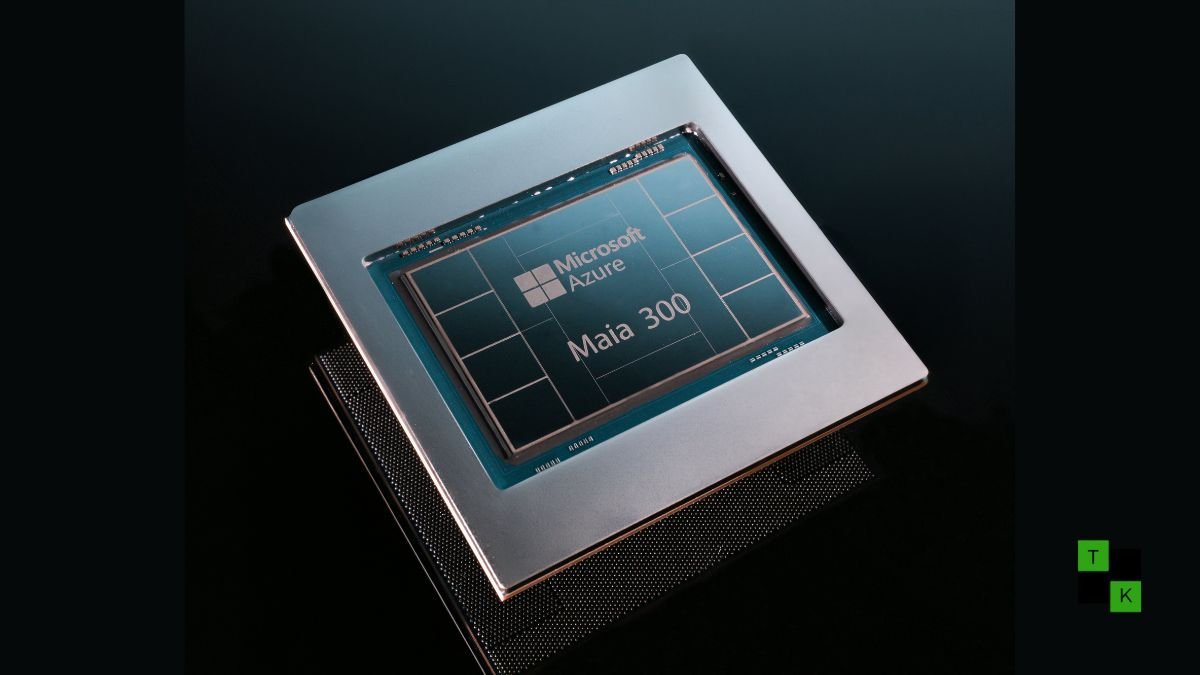
- Packaging and Modular Interconnect: Physical dies of the Azure Maia 300 reveal a multi-tile system-on-package seated on a high-density interposer, surrounded by High Bandwidth Memory (HBM) stacks to alleviate memory bandwidth bottlenecks during large language model (LLM) execution.
Global Footprint: Maia 200 Foundations Lead to Multi-Gigawatt Scale
The announcement of the Maia 300 builds upon field validation from its predecessor, the Maia 200, which Microsoft confirmed is already operating at scale across three continents:
- Maia 200 Deployment Status: Microsoft is actively running Maia 200 clusters across datacenters in the United States, Europe, and Australia.
- Real-World Fleet Gains: In production environments, the Maia 200 has demonstrated up to 1.7x more tokens per watt across live consumer and enterprise workloads in Microsoft Teams (real-time meeting recap, live translation) and Microsoft Copilot.
- Multi-Gigawatt Commitments for 2027: Starting in the upcoming calendar year, Microsoft will ramp the Maia family into multi-gigawatt power scale. Reaching multi-gigawatt volume indicates a deployment scale of hundreds of thousands of custom accelerators, marking one of the largest captive semiconductor investments in cloud computing history.
Microsoft Maia Silicon Progression: Architectural Evolution
| Hardware Architecture Attribute | First-Gen Maia 100 (2023) | Production Maia 200 (Active Fleet) | Next-Gen Maia 300 (2027 Ramp) |
| Primary Workload Target | Pilot LLM Training & Inference | Production Enterprise Workloads | Primary First-Party Inference Engine |
| Key Efficiency Gains | Baseline Custom Silicon | Up to 1.7x Tokens/Watt vs. GPUs | +40% More Tokens/Watt vs. Flagship GPUs |
| Geographic Footprint | Select US Azure Pilot Regions | US, Europe, and Australia | Global Multi-Gigawatt Datacenter Fleet |
| Key Workload Integration | Internal Bing / OpenAI Tests | Microsoft Teams & Copilot | Entire First-Party Product & Services Fleet |
| Cooling & Datacenter Form | Custom “Sidekick” Liquid Cooling | Closed-Loop Direct-to-Chip Liquid | High-Density Datacenter Rack Integration |
| Software Stack | Triton / ONNX Runtime | Azure AI Compiler & Triton Engine | Fully Unified End-to-End Silicon Co-Design |
Full-Stack Co-Design: From Silicon to Azure Power Racks
The deployment of custom silicon at multi-gigawatt scale requires deep co-engineering across software, thermal physics, and electrical delivery:
- Hardware-Software Synthesis: The Maia 300 leverages Microsoft’s deep investments in the open-source Triton compiler and ONNX Runtime, allowing internal engineering teams and partner models (including OpenAI’s GPT-series and Microsoft’s localized MAI foundation models) to target the silicon directly without extensive code rewrites.
- Datacenter Infrastructure Alignment: Designed from the start to fit into Microsoft’s modular datacenter pods, the Maia 300 utilizes direct-to-chip liquid cooling systems and custom rack architectures engineered to handle elevated thermal densities while reducing cooling water usage.
- Ecosystem Complementarity: In his announcement, Satya Nadella underscored that while Microsoft is aggressively scaling internal silicon for first-party workloads, the company remains dedicated to “continuing to bring the latest innovations from across the ecosystem into our fleet”-affirming ongoing parallel procurements of flagship accelerators from Nvidia and AMD for third-party Azure commercial cloud tenants.
Industry Analysis: Shifting the Balance of Power in Cloud AI
The introduction of the Maia 300 and the commitment to multi-gigawatt scaling signal fundamental shifts across the tech industry:
- Margin Defense Against Third-Party Hardware Costs: Off-the-shelf accelerators from merchant silicon providers carry steep hardware margins. By transitioning its massive first-party inference volume (billions of daily Copilot prompts and Office transcriptions) to proprietary Maia silicon, Microsoft can substantially improve gross margins across its AI software services.
- Parity with Hyperscale Rivals: The move brings Microsoft on par with cloud competitors like Google (which relies heavily on its in-house TPU v5p and TPU v6/Trillium chips for Google Workspace and Gemini) and Amazon Web Services (deploying Trainium and Inferentia across Bedrock services).
- Navigating the Power Grid Bottleneck: Because datacenter capacity is fundamentally constrained by regional power grids, achieving 40% higher token output per megawatt allows Microsoft to expand its commercial AI user base without waiting for new utility power plant construction.
Roadmap and Commercial Horizon
With the Maia 200 continuing its operational rollout across North America, Europe, and Australia, Microsoft is preparing its supply chains for the Maia 300 transition:
- Production Ramp: Datacenter build-outs and rack assembly for the Maia 300 will begin accelerating through early next calendar year.
- Service Transition: First-party services will systematically transition their default inference backends to Maia 300 clusters, freeing external GPU capacity on Azure for enterprise enterprise customers renting dedicated raw compute instances.
By establishing custom silicon as the foundation of its multi-gigawatt AI infrastructure, Microsoft is executing a long-term strategy to ensure its artificial intelligence platforms remain economically sustainable, power-efficient, and structurally independent.
🚨 Stay Updated with TopKhoj! 🚨
Get the latest tech news, deals, and exclusive offers first!
📰 Visit News Section📲 Join our Telegram Channel for real-time updates and best deals!
🔗 Join Telegram Now💡 Stay informed and never miss a great deal with TopKhoj!
⚠️ Disclaimer: Any link provided in the article related to a product or service will redirect you to our affiliate partner(s)' website, which are affiliate links. This means that if you make a purchase through these links, we may earn a commission at no extra cost to you. This commission helps support our blog and our work.
🔔 All prices mentioned above are subject to change based on current offers and availability on e-commerce platforms. Please check the latest price and product details on the product page before making a purchase.