Add TOPKHOJ as a Preferred Source on Google
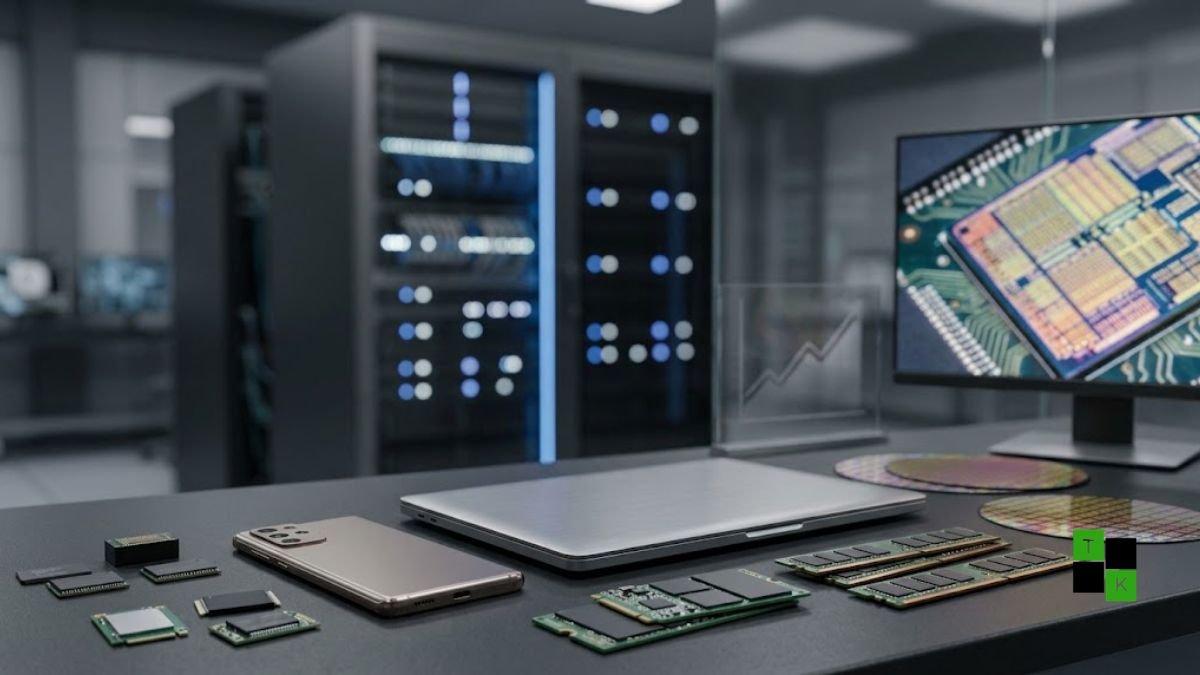
If your next smartphone or laptop suddenly costs more than you expected, you are not imagining it.
Technology prices have been moving higher across 2026, with smartphones, laptops and other consumer electronics facing a combination of rising component costs and supply constraints. In India, the effect has been particularly visible: IDC says India’s smartphone average selling price reached a record $302 in Q1 2026, up 10.4% year over year, while Counterpoint reported that Indian smartphone retail prices had risen about 21% in 2026 so far by early September. Globally, Counterpoint put the increase in smartphone retail prices at about 15%.
The biggest reason is surprisingly specific:
The AI boom is consuming enormous amounts of memory, and that is making the memory inside ordinary phones and laptops more expensive.
But memory is only the beginning.
CPU prices, SSD costs, tighter semiconductor capacity, currency movements, manufacturing expenses, logistics and the way brands protect their margins can all add to the final retail price.
Here is what is really happening.
30-Second TL;DR
Main Reason: AI data centres are competing with consumer electronics for semiconductor manufacturing capacity, especially memory.
Biggest Pressure: DRAM and NAND prices have surged, raising the bill of materials for phones and laptops.
India Effect: A weaker rupee can make imported components more expensive, adding another layer of pressure on Indian prices.
1. The Biggest Reason Is Memory
Modern phones and laptops need two memory families that are particularly important to this story:
DRAM is used as working memory, such as the RAM in a smartphone or laptop.
NAND flash is used for storage, including the internal storage in phones and SSDs in laptops.
For years, memory was one of the components that frequently became cheaper as manufacturing improved and capacity expanded.
That relationship has changed.
AI data centres are now absorbing huge amounts of memory, particularly high-bandwidth memory (HBM) used alongside AI accelerators. Memory manufacturers have strong economic incentives to dedicate more production capacity to those higher-value products.
That leaves less manufacturing capacity available for conventional memory used by consumer devices.
TrendForce says AI server demand continues to support memory prices and that suppliers are continuing to shift capacity toward server and HBM applications, keeping PC and smartphone memory supply tight.
That is the basic supply-chain problem:
AI demand rises → high-value memory demand rises → suppliers allocate more capacity there → consumer-memory supply becomes tighter → consumer-memory prices rise.
And once memory prices rise, phone and laptop manufacturers eventually have to decide who absorbs the additional cost.
2. Why AI Can Make Your Non-AI Phone More Expensive
This is the part that confuses many consumers.
You might think:
“My phone isn’t an AI server, so why should AI make it more expensive?”
Because the two products can depend on parts of the same semiconductor manufacturing ecosystem.
The memory inside your phone does not necessarily compete directly with every HBM chip going into an AI server. However, manufacturers have finite production capacity, equipment, wafer starts and advanced manufacturing resources. When more capacity is directed toward higher-value AI memory, the balance of supply available to conventional applications changes.
TechCrunch reported that Samsung, SK Hynix and Micron have been shifting production capacity toward high-bandwidth memory because of demand from AI infrastructure, leaving less capacity for the memory used in phones and laptops.
This is why the AI boom has created an unexpected consumer-electronics problem.
The technology driving the next generation of AI is also increasing the cost of some of the hardware used by ordinary consumers.
3. Memory Has Become a Much Bigger Part of a Phone’s Cost
Once memory becomes expensive, its impact on the entire smartphone changes.
Counterpoint’s recent research shows how dramatic that shift has become in lower-priced phones. In India, memory’s share of the bill of materials for phones below ₹15,000 has risen from under 20% to more than 45%, according to reporting based on Counterpoint research.
That is a huge change.
Imagine a manufacturer building a budget phone where memory was historically a relatively small portion of its component cost. If memory suddenly becomes substantially more expensive, the manufacturer has much less flexibility.
It can:
Raise the price.
Reduce specifications.
Accept lower margins.
Delay or cancel some configurations.
Or use some combination of all four.
This is why cheaper smartphones are often suffering more than expensive ones.
4. Budget Phones Have a Special Problem
A ₹10,000 phone and a ₹1,00,000 phone do not respond to component inflation in the same way.
A premium phone generally has more room for a manufacturer to absorb a higher component cost without destroying the economics of the product.
A budget phone may operate on much thinner margins.
That means a relatively small increase in memory or other components can have a much larger percentage impact on the manufacturer’s economics.
Counterpoint says this is one reason India’s lower-priced smartphone segments are under particular pressure, with brands adjusting configurations and pushing some products into higher price bands.
This helps explain something consumers may notice:
A phone that used to be considered a ₹10,000-₹12,000 product may increasingly appear closer to ₹13,000-₹15,000, while brands simultaneously reduce how many models they offer at the very bottom of the market.
The price increase is not always simply a bigger number on the box.
Sometimes it appears as the disappearance of the old specification at the old price.
5. Laptops Are Being Hit by Both DRAM and SSD Costs
Smartphones aren’t the only devices affected.
Laptops have an especially complicated cost structure because they use:
- DRAM
- SSD storage
- CPUs
- batteries
- PCBs
- power-management components
- displays
- wireless chips
- other supporting components
TrendForce says rising DRAM and SSD prices, together with higher CPU costs, have substantially increased notebook manufacturers’ cost pressure. In its 3Q26 analysis, core components including CPU, DRAM and SSD had risen to about 68% of a mainstream notebook’s bill of materials, compared with roughly 45% in its 1Q25 benchmark.
That is why laptop pricing is particularly sensitive to the current memory cycle.
An SSD may not sound expensive compared with the entire laptop, but when DRAM, NAND, CPU and other parts are all moving in the same direction, the combined effect becomes difficult to absorb.
6. SSD Prices Matter More Than People Realize
When people hear “memory shortage,” they often think only about RAM.
Storage matters too.
NAND flash is used in SSDs and smartphone storage, meaning the same broader supply pressure can affect:
128GB phone storage
256GB and 512GB phone storage
Laptop SSDs
External SSDs
enterprise storage
AI infrastructure is an enormous consumer of storage as well. TrendForce says NAND Flash demand continues to be supported by AI inference and large-scale data-centre deployments, while consumer buyers are increasingly reaching affordability limits because prices are already elevated.
So a laptop with a large SSD upgrade can become noticeably more expensive even when the CPU and screen have not changed.
7. CPUs Are Adding Another Layer of Pressure
Memory is the biggest current story, but it isn’t the only semiconductor problem.
Notebook manufacturers have also been dealing with higher CPU costs and earlier in 2026 with supply volatility.
TrendForce reported that some notebook CPUs had already experienced price increases and that CPU costs, together with memory costs, were putting additional pressure on notebook brands. In its later 3Q26 assessment, it said both CPU and memory prices remained major cost pressures even as CPU supply conditions improved.
That matters because a laptop cannot simply ship without its CPU.
When a major component becomes more expensive, the manufacturer has three choices:
Pay more.
Use a cheaper alternative.
Pass the cost to the customer.
And when multiple major components become more expensive simultaneously, the third option becomes increasingly difficult to avoid.
8. Newer Chips Are Also More Expensive to Make
There is another structural issue that predates the current memory crisis.
Modern smartphone processors increasingly use advanced semiconductor manufacturing nodes such as 3nm and 2nm.
Those manufacturing technologies can deliver better performance and efficiency, but producing advanced chips requires expensive fabrication capacity and increasingly sophisticated processes.
Counterpoint has previously identified rising SoC costs as one contributor to smartphone bill-of-material increases, particularly as manufacturers adopt more advanced process nodes and add increasingly powerful AI capabilities.
So consumers are dealing with two simultaneous forces:
Existing components are getting more expensive.
New products are also using increasingly sophisticated components.
That combination can push prices upward even when the raw specification count doesn’t look dramatically different.
9. AI Is Increasing the Cost of More Than Just Memory
AI’s impact extends beyond HBM.
AI-capable consumer devices increasingly require:
- stronger NPUs
- more powerful CPUs
- more capable GPUs
- larger memory configurations
- faster storage
- more advanced power-management hardware
- improved cooling
- faster connectivity
The result is a kind of hardware inflation through feature escalation.
A manufacturer may not simply be paying more for the same phone.
It may also be building a more expensive phone.
For example, adding local AI capabilities can mean a more powerful SoC, more RAM, stronger cooling and additional software-hardware integration.
So some price increases are caused by higher costs, while others reflect higher specifications.
Those two things should not be confused.
Read also: How Festive Sales Can Save Money on Phones and Laptops in 2026
10. Laptop Motherboards and Power Components Are Also Getting Costlier
Laptops contain far more than a CPU, RAM and screen.
TrendForce says notebook manufacturers have also faced increasing costs for PCBs, batteries and PMICs, while motherboard complexity and copper costs are contributing to higher PCB expenses. Newer standards such as Wi-Fi 7 and USB4 can also increase the cost of associated chips and connectors.
Each of these costs may look relatively small compared with DRAM.
But retail prices are influenced by the total bill of materials, not one component in isolation.
A five-dollar increase here, another ten dollars there, and a much larger increase in memory can collectively make a significant difference.
11. The Indian Rupee Adds Another Problem
Indian buyers have an additional factor that many US or Chinese buyers may not experience in the same way.
A large portion of the electronics supply chain is priced in US dollars or linked to global dollar-denominated component markets.
When the rupee weakens against the dollar, importing components or finished products becomes more expensive in rupee terms.
The rupee was around ₹95.9-₹96 per US dollar in mid-September 2026, according to Reuters reporting, after losing ground amid oil-price and global financial pressures.
That doesn’t mean a 1% currency move automatically produces a 1% phone-price increase.
Manufacturers can hedge currencies, absorb some costs, change procurement, negotiate with suppliers or adjust margins.
But over time, sustained currency weakness can add another layer of pressure.
IDC specifically identifies further rupee depreciation as one of the factors that could intensify smartphone pricing pressure in India.
12. Taxes and Import Duties Are Part of the Price-but They Are Not the Whole Story
This is where online discussions often become confusing.
A phone’s Indian retail price includes taxes and, depending on how it is sourced and manufactured, the economics of duties and local production.
Reuters notes that Indian iPhone prices are affected by import duties and an 18% GST, in addition to the global increase in memory and storage costs.
But the current 2026 price increase should not simply be described as “a tax hike.”
India actually removed certain import duties on components used in mobile phones and electronic devices in July 2026, eliminating previously imposed 7.5% and 5% duties on specified components.
That is an important distinction.
Taxes and duties influence the final price level.
But the recent broad increase in phone and laptop costs is being driven much more directly by component inflation, especially memory, plus currency and broader supply-chain pressures.
13. Shipping and Energy Costs Can Add Another Layer
Electronics do not move directly from a semiconductor factory into your pocket.
There are:
- wafer facilities
- chip packaging
- component suppliers
- assembly plants
- logistics providers
- distributors
- warehouses
- retailers
Higher transportation, fuel and energy costs can therefore raise the cost of moving and manufacturing electronics.
This is generally a secondary factor compared with the current memory shock, but it can still affect final pricing.
The issue becomes more important when oil prices rise sharply. Reuters reported Brent crude above $100 per barrel in September 2026 amid Middle East disruptions, increasing pressure on India’s import costs and inflation environment.
It would therefore be inaccurate to say logistics is the main reason phones are expensive right now.
It is better described as another cost layer sitting on top of an already stressed supply chain.
14. Brands Don’t Always Pass the Full Cost to Consumers Immediately
This is one of the most important parts of the story.
When component costs increase, a manufacturer does not necessarily raise the retail price the next morning.
Companies may already have:
Older inventory purchased at cheaper prices.
Long-term supplier contracts.
Currency hedges.
Promotional budgets.
Existing retail agreements.
Margin buffers.
These can temporarily delay the visible impact.
TrendForce says notebook brands have been protected to some degree by inventories purchased at lower prices, but as that lower-cost inventory is depleted, newer products will increasingly reflect the current cost of CPU, DRAM and SSD components.
That’s why a product can remain at the same price for several months and then suddenly become more expensive.
The manufacturer’s old-cost inventory may simply have run out.
15. Sometimes the Price Doesn’t Rise-The Specification Gets Cut
This is a particularly important consumer trend.
Imagine a laptop that used to sell for:
₹50,000 with 16GB RAM + 512GB SSD
Instead of raising the price to ₹60,000, a brand might launch a new version at:
₹50,000 with 8GB RAM + 512GB SSD
The box still says ₹50,000.
But consumers are effectively paying the same amount for less hardware.
This is called specification downgrading or product reshaping, and TrendForce has specifically warned that smartphone and notebook brands may raise prices or reduce specifications as memory costs rise.
So consumers should not measure inflation only by asking:
“Did the price go up?”
They should also ask:
“Did the product get cheaper while the specifications quietly got worse?”
16. Why Old Phones and Laptops Can Also Become More Expensive
Normally, an older model becomes cheaper when a successor arrives.
Memory inflation can disrupt that pattern.
If the manufacturer or retailer needs to replenish stock at today’s higher component costs, the economic basis for deep discounts becomes weaker.
Business Standard has reported cases where smartphones that had already launched were receiving price increases rather than following the traditional pattern of falling prices.
That is why buyers may encounter something unusual in 2026:
A six-month-old phone can become more expensive rather than cheaper.
This is not because the old phone suddenly became technically better.
It is because the economics around replacing and replenishing inventory changed.
17. Why Smartphones Are Often Hit Harder at the Budget End
The Indian smartphone market provides a good example of how inflation affects different price segments differently.
IDC says smartphone shipments in India fell 4.1% year over year in Q1 2026, even while the market’s value increased 5.8%. The entry-level segment was particularly weak, while average selling prices reached a record high.
By September, Counterpoint research cited by Business Standard showed India’s smartphone retail prices had risen approximately 21% in 2026, with the lower-priced market taking the hardest hit.
That creates a difficult cycle:
Higher memory cost → higher phone cost → higher retail price → weaker affordability → lower demand → fewer low-cost models → further movement toward higher price bands.
The market can therefore become more expensive even without every manufacturer dramatically increasing profit margins.
18. Why Laptop Prices Can Jump Even More Suddenly
Laptops have another characteristic: their bill of materials is relatively concentrated around expensive core components.
TrendForce’s 3Q26 analysis found CPU, DRAM and SSD together represented around 68% of the BOM cost for its mainstream notebook benchmark. It estimated that, under a hypothetical scenario of preserving the same gross margin as its 1Q25 benchmark, the comparable system would need roughly an 80% price increase by 3Q26.
That 80% figure is a modeled margin-preservation scenario, not an assertion that every laptop is 80% more expensive.
But the example illustrates the underlying problem very well.
When several of the most expensive components become more costly simultaneously, the traditional assumption that laptop prices will automatically fall every generation becomes much harder to maintain.
19. Why Premium Phones May Handle the Pressure Better
Interestingly, premium devices can sometimes absorb cost increases more easily.
A ₹1,00,000 smartphone has more room between component cost and retail price than a ₹10,000 phone.
Manufacturers can sometimes:
- accept a smaller margin
- reduce discounts
- adjust memory tiers
- increase the price modestly
- shift consumers toward more expensive configurations
Counterpoint’s research shows that the affordability squeeze is particularly severe in lower price bands, while premium segments have proved more resilient.
This doesn’t mean expensive phones are protected.
The iPhone is a useful example. TrendForce estimated that Apple’s iPhone 18 Pro 256GB model would see its BOM cost increase by around 38% year over year, largely because memory’s share of the cost had risen sharply.
So even premium manufacturers are being squeezed.
The difference is that they have more financial room to respond.
20. Why Manufacturers Can’t Just Make More Memory Immediately
This is another misconception.
Consumers often ask:
“If memory is expensive, why don’t manufacturers simply build more factories?”
Because semiconductor capacity takes years and enormous capital investment to expand.
A new fabrication facility does not appear overnight.
Even when companies announce new capacity, meaningful production can take significant time to arrive.
Business Standard reported industry expectations that the memory shortage could continue into 2027, while current TrendForce research says supply remains structurally tight as manufacturers continue reallocating capacity toward AI and server applications.
Reuters also reported on September 16 that smaller phone and laptop makers are preparing for a memory shortage that could last through at least 2027, with some industry projections extending the imbalance even further.
That is why this is not simply a temporary retail markup.
It is a capacity-allocation problem.
21. AI Is Changing What Memory Manufacturers Want to Produce
There is a business reason behind the supply shift.
HBM and other memory products designed for AI infrastructure can command attractive economics compared with some conventional consumer-memory products.
So memory suppliers naturally have an incentive to prioritize the applications producing stronger returns.
Reuters reported that China’s CXMT is now looking to expand into NAND flash partly because growing AI-server demand is creating an opportunity in a supply-constrained memory market.
That is a sign of how seriously the industry is treating AI-driven memory demand.
The competition is no longer just:
Samsung vs SK Hynix vs Micron
It is increasingly:
Consumer electronics vs data-centre infrastructure for scarce semiconductor capacity.
22. Why Phones and Laptops Are Becoming More Expensive at the Same Time
Now we can connect the pieces.
Smartphones
Phones are being affected by:
- LPDDR/mobile DRAM costs
- NAND storage costs
- more expensive SoCs
- AI-capable processors
- camera components
- displays
- batteries
- currency movements
- manufacturing and logistics costs
Laptops
Laptops face:
- DRAM
- SSD/NAND
- CPU
- GPU in some models
- PCB
- battery
- PMIC
- display
- wireless components
- currency
- logistics
The two product categories therefore share the same fundamental problem:
Their component supply chains are being squeezed at exactly the same time that manufacturers are trying to add more computing capability.
23. So Who Actually Pays for the Higher Costs?
Ultimately, there are only a few possible places the money can come from.
The Manufacturer Pays
The brand accepts lower margins.
The Retailer Pays
The distributor or retailer accepts lower margins.
The Consumer Pays
The product price rises.
The Specification Pays
The product gets downgraded to protect the advertised price.
The Product Line Pays
The cheapest models disappear, while manufacturers concentrate on more profitable price segments.
In reality, companies usually use a mixture of all five.
That is why the consumer experience can look different from one brand to another.
One company may raise price.
Another may remove a configuration.
Another may reduce discounts.
Another may quietly change the RAM/storage mix.
24. Why India’s Situation Is Particularly Important
India is unusually sensitive to this cycle because a large portion of smartphone demand is concentrated in affordable and mid-range categories.
Counterpoint says more than half of India’s smartphone market is concentrated below ₹20,000, making the market particularly vulnerable to memory-driven inflation.
That means even moderate increases in component costs can create a large affordability problem.
At the same time, currency pressure can add to the cost of globally priced components.
This is why the same global memory shortage can produce a more noticeable consumer impact in India than in markets where high-end smartphones represent a much larger share of sales.
25. Will Phone and Laptop Prices Come Down Again?
Eventually, prices can stabilize.
But stabilization does not necessarily mean an immediate return to 2025 pricing.
For prices to fall meaningfully, some combination of these conditions would need to improve:
- DRAM supply expands
- NAND supply expands
- AI-memory demand growth moderates
- semiconductor capacity catches up
- CPU supply stabilizes
- inventories normalize
- currency pressure eases
- competition forces brands to sacrifice margins
TrendForce currently expects memory prices to remain supported by AI and server demand even as consumer demand weakens. Its recent research continues to point to tight supply conditions into 2027.
Reuters similarly reports that smaller device manufacturers are preparing for prolonged memory scarcity.
So consumers should not assume that waiting a few months automatically guarantees that a particular phone or laptop will become cheaper.
The Real Reason in One Sentence
If the entire story has to be reduced to one sentence, it is this:
AI data-centre expansion is absorbing more valuable semiconductor capacity, especially memory, while consumer devices are simultaneously becoming more sophisticated-raising component costs that manufacturers increasingly have to pass through to prices, specifications or margins.
That is the core mechanism.
The rupee, taxes, shipping, CPUs, displays, batteries and other components matter too. But they are mostly additional layers on top of the central memory problem in the current 2026 cycle.
What This Means for Buyers
The most important lesson is that consumers should stop looking only at the sticker price.
Compare the complete specification.
A ₹45,000 laptop today may not offer the same RAM, SSD or processor configuration that ₹45,000 bought a year ago.
Likewise, a ₹15,000 smartphone today may provide less storage or memory than a similarly priced model from the previous generation.
That means the real question is not:
“Did the price increase?”
It is:
“What hardware am I getting for this price compared with the previous generation?”
That is a much better way to measure technology inflation.
Final Takeaway
The current increase in laptop and phone prices is not caused by one simple event.
Memory is the center of the storm.
AI data centres have dramatically increased demand for high-value memory, while manufacturers are reallocating semiconductor capacity toward AI-related products. That has tightened the supply of conventional DRAM and NAND used in smartphones, laptops and PCs.
Then the secondary pressures pile on.
CPU costs are higher. SSDs are more expensive. PCBs, batteries, PMICs and connectivity components add their own increases. Advanced processors and AI features also make newer devices more expensive to build. In India, rupee depreciation can further raise the local cost of globally sourced components.
Manufacturers therefore have to choose between higher retail prices, lower margins, reduced specifications, fewer budget models, or some combination of all of them.
And that is why the current price increase feels different from ordinary yearly inflation.
The technology industry is not simply charging more for the same products.
The underlying economics of making those products have changed.
🚨 Stay Updated with TopKhoj! 🚨
Get the latest tech news, deals, and exclusive offers first!
📰 Visit News Section📲 Join our Telegram Channel for real-time updates and best deals!
🔗 Join Telegram Now💡 Stay informed and never miss a great deal with TopKhoj!
⚠️ Disclaimer: Any link provided in the article related to a product or service will redirect you to our affiliate partner(s)' website, which are affiliate links. This means that if you make a purchase through these links, we may earn a commission at no extra cost to you. This commission helps support our blog and our work.
🔔 All prices mentioned above are subject to change based on current offers and availability on e-commerce platforms. Please check the latest price and product details on the product page before making a purchase.